









































Passive Balancing: Maintaining Voltage Harmony for Longevity
When a high-performance cordless tool begins to lose its runtime, the culprit is rarely the entire battery pack. More often, it is a single cell—or a small group of cells—that has drifted out of sync with its neighbors. This phenomenon, known as cell imbalance, is the silent killer of lithium-ion systems. To combat this, engineers employ a Battery Management System (BMS) feature called passive balancing.
Imbalanced cells can lead to premature battery failure. In this guide, we explore how passive balancing within the BMS maintains voltage harmony across the pack to maximize the total lifecycle of your cordless gear. We will move beyond the marketing gloss to examine the electrical mechanisms, the inherent trade-offs of heat versus efficiency, and the practical steps we take on the repair bench to diagnose these issues.
The Mechanics of Voltage Harmony
At its core, a multi-cell battery pack is only as strong as its weakest link. In a series-connected pack, the same current flows through every cell. However, no two cells are identical. Due to manufacturing variances or uneven thermal exposure, one cell may reach its maximum voltage (V_max) faster than the others during a charge cycle.
Without balancing, the BMS must stop the entire charging process to prevent that single "high" cell from overcharging. This leaves the remaining cells undercharged, effectively reducing the usable capacity of the entire pack. Passive balancing addresses this by "bleeding off" excess energy from the highest-voltage cells.
How the "Bleeding" Process Works
Passive balancing is a dissipative method. It utilizes shunt resistors and MOSFET switches integrated into the BMS circuitry. When the BMS detects that a cell's voltage has exceeded a specific threshold relative to its peers, it closes a switch to bypass that cell.
- Detection: The BMS monitors individual cell voltages using high-precision analog-to-digital converters.
- Activation: Once a voltage delta (difference) is identified—typically between 30mV and 50mV—the balancing circuit for the high cell is engaged.
- Dissipation: The excess energy is routed through a resistor, where it is converted into heat (Ohmic heating).
- Equalization: This allows the charger to continue providing current to the lower-voltage cells without overcharging the high cell, eventually bringing the entire pack into harmony.
According to the IEC Standards Webstore, specifically standards regarding secondary lithium cells and batteries, the accuracy of these monitoring systems is critical for safety and performance. However, as we have observed on our repair bench, the effectiveness of this process is fundamentally gated by the BMS's sensing accuracy.
The Precision Problem: Sensing vs. Noise
One common misconception is that any BMS with passive balancing will keep a pack "perfectly" balanced. In reality, budget-grade BMS units often suffer from a sensing accuracy of ±20-30mV. While this sounds small, it is significant in the context of lithium-ion chemistry.
If a BMS has a 30mV error margin, it may waste energy "balancing" what is actually just sensor noise. Conversely, it might fail to trigger balancing for a cell that is genuinely drifting. This is why high-quality gear emphasizes precision in the BMS architecture. According to research on BMS protection accuracy, even a small deviation in voltage thresholds can impact the long-term health of the pack.

The Thermal Conflict: Heat as a Trade-Off
Passive balancing is favored in consumer electronics for its simplicity and low cost. However, it introduces a fundamental design conflict: it intentionally generates heat inside the battery pack.
Lithium-ion cells are highly sensitive to temperature. High ambient heat is a primary accelerant for chemical degradation. When the BMS dissipates energy through resistors to balance the pack, it creates localized "hot spots." If the thermal management system is not robust, the heat generated by the balancing process can negate the longevity benefits the balancing was intended to provide.
In our engineering assessments, we often find that the choice between passive and active balancing comes down to this cost-reliability trade-off. For the portable tools used by DIY enthusiasts, passive systems are the industry standard, but their success depends heavily on the charge algorithm. A poorly tuned BMS may trigger balancing too late in the charge cycle, failing to prevent significant capacity divergence over time.
Modeling Energy Efficiency in Passive Systems
To help our users understand the real-world impact of these systems, we modeled the energy consumption of a typical passive balancing event. This "scenario modeling" helps contextualize how much energy is actually "wasted" to maintain pack harmony.
Modeling Note (Scenario Analysis): The following data is derived from a deterministic parameterized model based on common industry heuristics for consumer-grade 18650-based packs. This is a scenario model, not a controlled lab study.
| Parameter | Value | Unit | Rationale / Source Category |
|---|---|---|---|
| Pack Capacity | 5.0 | Ah | Standard 18650 cell capacity |
| Nominal Voltage | 3.7 | V | Standard Li-ion nominal voltage |
| Balancing Current | 100 | mA | Typical consumer BMS current [3] |
| Event Duration | 3,600 | s | Full charge cycle balancing window |
| Efficiency Factor | 0.7 | Ratio | Estimated thermal loss in resistors |
Estimated Impacts:
- Total Pack Energy: 18.5 Wh
- Energy per Balancing Event: ~0.37 Wh
- Lifecycle Energy Overhead: Based on our model, the energy consumed by passive balancing represents less than 0.5% of total energy throughput over the battery's lifetime.
While the energy loss is negligible for a single event, the cumulative heat must be managed. For users who care about longevity, this underscores why charging your gear in a cool, ventilated area is more than just a suggestion—it is a requirement for maintaining the integrity of the balancing process.
Maintenance and Repair: The Technician’s Perspective
When we receive battery packs for repair, the most frequent failure mode is the "dead cell" syndrome. This occurs when a single cell has been chronically under-charged because it was consistently the lowest-voltage cell in the pack. If the BMS cannot bridge the gap through passive balancing, that cell eventually drops below the "low-voltage cutoff," and the BMS locks the pack for safety.
To prevent this, we recommend periodic "maintenance charges." Leaving your cordless gear on the charger for an extra hour after the "full" light appears can allow the BMS to complete its low-current balancing phase.
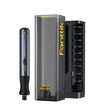
For those who perform their own maintenance or light electronics repairs, having the right tools is essential. Precision is key when working with the small fasteners found in battery housings and BMS boards. We have found that using a tool like the Fanttik E1 MAX Precision Electric Screwdriver significantly reduces the risk of stripping screws or damaging delicate components.
Modeling Maintenance Efficiency
For professional technicians or dedicated hobbyists, the efficiency of disassembly matters. We modeled the time savings of using an electric driver versus a manual one for a standard battery pack overhaul.
- Manual Disassembly: ~36 minutes (assuming 120 screws at 18 seconds each).
- Powered Disassembly: ~8 minutes (using an electric driver).
- Ergonomic Gain: A reduction of approximately 1,380 wrist rotations per session.
This speed multiplier (roughly 4.5x) allows for more focused time on the actual diagnostics of the cells and the BMS circuitry.
Engineering Trust in a Cordless World
As highlighted in The 2026 Modern Essential Gear Industry Report: Engineering Trust in a Cordless World, the future of portable power relies on "credibility math." This means moving away from vague promises and toward transparent engineering.
Passive balancing is a perfect example of this. It is not a "perfect" technology, but when implemented with high-precision sensing and robust thermal design, it is a highly effective way to ensure a battery pack reaches its intended 300–500 cycle lifespan.
For more complex DIY projects involving battery-powered devices, tools like the Fanttik F2 PRO Cordless Rotary Tool Kit or the Fanttik F2 Master Cordless Rotary Tool Kit provide the versatility needed for cleaning terminals, removing corrosion, or modifying housings for better airflow. Even small-scale precision drilling with the Fanttik K2 Nano 3.7V Precision Power Drill can be useful for mounting external cooling sinks or diagnostic ports on custom battery enclosures.
Compliance and Safety Standards
Maintaining battery health is not just about performance; it is a safety imperative. The EU General Product Safety Regulation (EU) 2023/988 mandates that products sold in the EU must meet rigorous safety standards, which includes the stability of battery systems. Furthermore, transporting these batteries requires adherence to IATA Lithium Battery Guidance, which limits the State of Charge (SoC) for shipping to prevent thermal runaway. A well-balanced pack is inherently more stable and safer to transport.
Summary of Best Practices for Users
To maximize the effectiveness of your gear’s passive balancing system, follow these expert-vetted heuristics:
- The 100% Rule: Occasionally charge your battery to 100% and leave it on the charger for an additional 30–60 minutes. This provides the BMS the "top-off" time it needs to engage the balancing resistors.
- Avoid Extreme Heat: Never charge a battery that is hot to the touch. Let it cool to room temperature first. This prevents the balancing heat from stacking with ambient heat.
- Regular Use: Long-term storage can lead to "self-discharge" divergence. If you store your gear for months, check the charge level every 90 days. Troubleshooting Battery Imbalance After Autumn Storage provides a deeper dive into this specific scenario.
- Identify the End-of-Life: If a pack takes significantly longer to charge than it used to, or if it cuts out prematurely under load, the cells may be too far out of balance for the BMS to save. Refer to our guide on Identifying When a Portable Battery Cannot Be Saved.
Final Thoughts on Battery Harmony
Passive balancing is the unsung hero of the cordless world. It is a simple, elegant solution to the complex problem of electrochemical variance. While it wastes a small amount of energy as heat, the trade-off is a significantly longer lifecycle for your tools and a lower total cost of ownership.
By understanding how these systems work and adopting healthy charging habits, you can ensure that your gear is always ready when you need it. Whether you are using a precision drill for a hobby project or a high-torque driver for automotive work, the harmony of the cells within is what powers your success.
Disclaimer: This article is for informational purposes only. Lithium-ion batteries can be hazardous if mishandled. Do not attempt to disassemble or repair battery packs unless you are a qualified technician. Always follow the manufacturer's safety instructions and local regulations regarding battery disposal and recycling.
References
Continue reading
 State of Health (SoH) vs. SoC: Understanding True Capacity
Covers the electrochemical 'knee point' of degradation, voltage sag scenarios, and practical diagnostic signs to predict gear failure.
State of Health (SoH) vs. SoC: Understanding True Capacity
Covers the electrochemical 'knee point' of degradation, voltage sag scenarios, and practical diagnostic signs to predict gear failure.
 Quality Control Audits: Validating Cell Consistency for Pros
A guide to quality control audits for professional-grade lithium-ion batteries. Learn how advanced protocols detect latent defects to...
Quality Control Audits: Validating Cell Consistency for Pros
A guide to quality control audits for professional-grade lithium-ion batteries. Learn how advanced protocols detect latent defects to...



Leave a comment
This site is protected by hCaptcha and the hCaptcha Privacy Policy and Terms of Service apply.