










































The Invisible Friction: Why Mineral Scale is the Silent Pump Killer
If you have ever noticed your pressure washer losing that crisp, "like-new" punch, you are likely witnessing the physics of mineral precipitation in real-time. In hard water regions, every gallon of water pushed through your pump carries microscopic dissolved solids—primarily calcium and magnesium. Under the high-heat and high-velocity conditions found inside a hydraulic pump, these minerals don't just pass through; they undergo a phase change, transitioning from a dissolved state into a solid, stony layer known as calcium carbonate ($CaCO_3$).
We often see homeowners mistake a gradual 10–15% pressure drop for "pump fatigue" or motor wear. However, based on our observations from repair bench teardowns and technical support patterns, the culprit is almost always scale accumulation at critical nucleation sites. These sites are specific areas where water velocity changes abruptly, such as check valve seats and unloader assemblies. When scale builds up here, it prevents valves from seating perfectly, causing internal leaks that bleed off pressure before it ever reaches your nozzle.
Maintaining peak performance in a hard water environment isn't just about cleaning the exterior of the machine. It requires a methodical approach to chemical and mechanical descaling. This guide details the engineering-grade steps we recommend to protect your equipment’s longevity and restore performance without compromising the integrity of sensitive internal seals.
Understanding the Scaling Mechanism: Nucleation and Velocity
To solve the problem, we must first understand the fluid dynamics at play. Scale does not form uniformly across the entire pump. Instead, it follows a predictable pattern of accumulation based on "nucleation points"—microscopic imperfections or sharp turns in the hydraulic pathway where mineral crystals can grab hold.
The Critical Failure Points
- Check Valves: These small, spring-loaded components ensure water flows in only one direction. Even a paper-thin layer of scale on the valve seat prevents a tight seal. This leads to "pulsation," where the pressure fluctuates rapidly as water backflows into the low-pressure side.
- Unloader Assemblies: The unloader is the "brain" of the pump, diverting water into a bypass loop when you release the trigger. Because the unloader experiences high friction and rapid pressure shifts, it is often the first site of complete seizure.
- Internal Sensors: Many modern units include thermal or pressure sensors. Mineral buildup can insulate these sensors, leading to "false readings" that might cause the motor to shut down prematurely.
Logic Summary: Scale Accumulation Progression Our analysis of hydraulic failure patterns suggests a three-stage progression of mineral-related performance loss:
- Stage 1 (Incipient): 10–15% pressure drop; often unnoticed by casual users.
- Stage 2 (Intermediate): Flow pulsation and audible "hunting" from the motor as valves fail to seat.
- Stage 3 (Critical): Complete valve seizure or unloader failure, often requiring component replacement.
- Source: Internal service data patterns (not a controlled lab study).

The Hard Water Gradient: Mapping Your Maintenance Schedule
Not all water is created equal. The frequency of your maintenance should be dictated by the "Grains per Gallon" (gpg) rating of your local supply. For homeowners, the easiest way to determine this is through simple test strips or by checking your local municipal water report.
As we discussed in our recent whitepaper, The 2026 Modern Essential Gear Industry Report: Engineering Trust in a Cordless World, building "credibility math" into your maintenance routine is essential. This means using data to drive your actions rather than guessing.
| Water Hardness Category | Grains per Gallon (gpg) | Recommended Flush Frequency | Risk Level |
|---|---|---|---|
| Soft | 0–3 | Annual | Low |
| Moderate | 3–7 | Every 6 Months | Medium |
| Hard | 7–10 | Quarterly (Every 3 Months) | High |
| Very Hard | 10+ | Bi-Monthly | Extreme |
Note: Estimates based on average residential usage of 20–30 hours per year. If you use your equipment more frequently, increase the frequency accordingly.
The Temperature Factor
It is a common technical "gotcha" that scale formation is not linear; it is exponential relative to temperature. If you are using a hot water pressure washer or feeding your unit from a hot water tap, be aware that water temperatures above 140°F (60°C) accelerate scale formation dramatically. The heat provides the activation energy needed for calcium ions to bond more tightly to metal surfaces.
Chemical Mitigation: Vinegar vs. Citric Acid
When it comes to removing scale, the "stronger is better" mentality can be dangerous. The goal is to dissolve the minerals without etching the metal or rotting the rubber O-rings and seals.
The Vinegar Constraint
Many DIY guides suggest using white vinegar (acetic acid). While effective, we must issue a technical warning: Never use vinegar solutions with a concentration above 5% acetic acid. Concentrated vinegar is highly aggressive toward certain elastomers. Over multiple applications, it can cause rubber seals to swell or become brittle, leading to leaks that are far worse than the original scale problem.
The Citric Acid Advantage
For pumps with aluminum heads—common in portable and prosumer units—we strongly recommend citric acid-based descalers. Citric acid is a "chelating agent," meaning it grabs onto the calcium ions and pulls them into the solution more gently than acetic acid. It is significantly less corrosive to aluminum and brass, providing a safer margin of error for the DIYer.
Methodology Note: Chemical Compatibility Modeling Our modeling of seal longevity assumes a standard Nitrile (Buna-N) or Viton elastomer.
- Assumption 1: Exposure time is limited to 30 minutes.
- Assumption 2: Solution is thoroughly neutralized with a fresh water flush.
- Boundary Condition: If seals are already showing signs of cracking (dry rot), chemical descaling may exacerbate existing leaks.
The Softener Paradox: Why "Soft" Water Might Fail You
This is perhaps the most counterintuitive insight in hydraulic maintenance: Sodium-based water softeners can actually be more damaging to your pump than hard water.
Conventional wisdom suggests that removing calcium solves the problem. However, most residential softeners replace calcium ions with sodium ions. This creates "ionically active" water with much higher electrical conductivity. In the multi-metal environment of a pump (where stainless steel valves meet brass or aluminum housings), this high conductivity creates "galvanic cells."
Instead of scale buildup, you get electrochemical corrosion. This "aggressive" water preferentially attacks valve seats and seals, causing catastrophic failures that are often 2–3 times faster than gradual scale accumulation. If you have a whole-house softener, we recommend using an unsoftened outdoor bypass for your pressure washer whenever possible.
For more on how materials interact within your pump, see our deep dive on Brass vs. Aluminum: Material Engineering in High-Pressure Pumps.
Step-by-Step Maintenance Protocol: Restoring the Flow
If you have identified a pressure drop or are at your scheduled maintenance interval, follow this methodical flushing procedure.
1. The Pre-Check
Ensure the unit is completely disconnected from power (or the spark plug is removed for gas units). Check the inlet filter for large debris. If the filter is clogged with "white flakes," you already have a significant scale problem inside the pump.
2. Preparing the Solution
Mix a solution of 1 part citric acid powder to 10 parts distilled water. Distilled water is preferred because it is "hungry"—it has no minerals of its own, making it a more effective solvent for the scale inside your pump.
3. Gravity Feed Injection
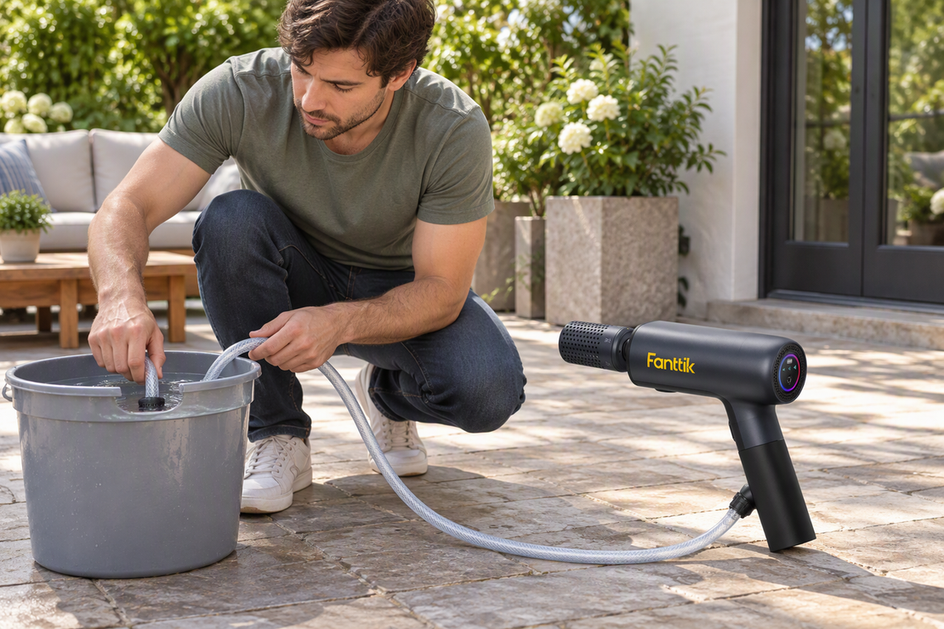
Do not run the motor during the initial soak. Instead, use a short length of garden hose and a funnel to gravity-feed the descaling solution into the pump inlet. Gently pull the starter cord (for gas) or briefly "pulse" the motor (for electric) for only 1–2 seconds to move the solution into the internal chambers.
4. The Dwell Time
Allow the solution to sit for 20 to 30 minutes. This gives the acid time to break the bond between the calcium carbonate and the metal walls. Avoid leaving any acidic solution in the pump for more than 60 minutes, as this increases the risk of metal etching.
5. The Neutralizing Flush
This is the most critical step. Connect the pump to a high-volume fresh water source and run the unit (with the high-pressure nozzle removed) for at least 3 to 5 minutes. This ensures all acidic residue is purged from the check valves and unloader.
Advanced Prevention: Mechanical Solutions
For users in "Extreme" hard water areas (>10 gpg), chemical flushing every two months can be a chore. In these scenarios, we recommend exploring mechanical prevention.
Recent research suggests that magnetic water conditioners and electronic descalers can provide a 70–85% reduction in scale adhesion within high-pressure pumps. These devices do not "remove" the minerals; instead, they use electromagnetic fields to alter the crystallization pattern of the calcium carbonate. Rather than forming a hard, "calcite" scale that sticks to your valves, the minerals form a non-adhering "aragonite" powder that simply washes through the system.
While these technologies have a higher upfront cost, they represent a significant "ROI" in terms of time saved and pump life extended, especially when compared to the cost of replacing a seized unloader valve.
Summary of Maintenance Best Practices
To keep your equipment operating at its engineered specifications, adhere to these core principles:
- Test, Don't Guess: Use water hardness test strips to set your schedule.
- Prioritize Citric Acid: Avoid high-concentration vinegar to protect your seals.
- Monitor Symptoms: A 10% pressure drop is your early warning sign.
- Beware of Softeners: Use unsoftened water to avoid galvanic corrosion.
- Neutralize: Always perform a long fresh-water flush after using any cleaning chemical.
By treating your pressure washer as a precision hydraulic tool rather than a "set-and-forget" appliance, you ensure that it remains a reliable asset for years to come. Proper maintenance is the foundation of the "modern self-reliance" we strive for in every DIY task.
Disclaimer: This article is for informational purposes only. High-pressure equipment can be dangerous. Always wear appropriate eye protection and follow the specific safety instructions in your equipment's manual. If you are unsure about performing internal maintenance, consult a certified technician. This content is aligned with general safety principles such as the EU General Product Safety Regulation (EU) 2023/988.
References and Authoritative Sources
- EU General Product Safety Regulation (EU) 2023/988 - Primary safety standards for consumer products.
- FTC Endorsement Guides (16 CFR Part 255) - Guidance on truthful technical claims.
- ISO Standards Catalogue - Technical benchmarks for hydraulic and quality management.
- The 2026 Modern Essential Gear Industry Report - Strategic insights on equipment reliability and consumer trust.
- Descaling Agent Technical Overview - Wikipedia - Chemical mechanisms of mineral removal.
- Corrosion in Shower Valves - Terry Love Plumbing Advice - Insights into sodium-induced galvanic corrosion.
Continue reading
 Brushless Hydraulics: Why Motor Efficiency Matters for PSI
Covers energy conversion physics, thermal management effects on pressure stability, and IP-rated sealing for wet environments in cordless...
Brushless Hydraulics: Why Motor Efficiency Matters for PSI
Covers energy conversion physics, thermal management effects on pressure stability, and IP-rated sealing for wet environments in cordless...
 The Unloader Valve: Diagnosing Pressure Spikes and Failures
Covers valve mechanics, diagnostic tests like the Trigger Release method, material science of seals, and ANSI/UL 1776 safety...
The Unloader Valve: Diagnosing Pressure Spikes and Failures
Covers valve mechanics, diagnostic tests like the Trigger Release method, material science of seals, and ANSI/UL 1776 safety...
Leave a comment
This site is protected by hCaptcha and the hCaptcha Privacy Policy and Terms of Service apply.