









































The Quick Fix: 3 Steps to Stop Pump Scaling
If you live in a hard water region, mineral buildup (calcification) is the leading cause of premature pump failure. To protect your investment, follow this Answer-First Summary:
- Diagnose Early: Listen for a high-pitched "squeal" or feel for rhythmic pulsations in the spray gun—these are early signs of seal distress.
- The 1:4 Rule: Once a month, flush your pump with a solution of 1 part white vinegar to 4 parts distilled water. Let it dwell for 15 minutes to dissolve deposits.
- Dry Storage: Always depressurize and gravity-drain the pump after use to prevent minerals from "crusting" onto the seal lips during evaporation.
The Invisible Abrasive: Why Hard Water is the Silent Killer of Pressure Washer Pumps
For many DIY homeowners, the first sign of a failing pressure washer isn't a dead motor or a snapped belt. Instead, it is a subtle, high-pitched whine—a metallic squeal that emerges just as the trigger is pulled. Based on common patterns observed in our repair centers and customer support inquiries, this sound often signals the beginning of the end for internal pump seals.
While most users focus on engine oil or nozzle clogs, the most significant threat to a unit’s lifespan in hard water regions is calcification. In these areas, the water isn't just a cleaning agent; it is a carrier for dissolved minerals like calcium and magnesium. When this water sits inside a pump or reaches high temperatures during operation, these minerals precipitate out, forming crystalline deposits.
These deposits do not just "clog" the system. They transform into an abrasive paste that scores the surfaces of rubber and synthetic seals, accelerating wear far beyond normal friction limits. This guide provides a methodical deep dive into the chemistry of seal failure, the "1:4 Rule" for descaling, and the logic of preventive maintenance that can significantly extend your equipment's service life.
Perspective from the Workshop: Our focus on internal pump hygiene is derived from patterns observed in warranty returns and field repairs. We prioritize "seal-first" maintenance because pump assemblies are typically the most expensive component to replace, yet the most vulnerable to water chemistry.
The Chemistry of Failure: LSI and Mineral Precipitation
To understand why seals fail, we must look at the Langelier Saturation Index (LSI). The LSI is a calculated number used to predict the calcium carbonate stability of water. It factors in pH, temperature, calcium concentration, and alkalinity. When the LSI is positive, water is "scale-forming," meaning it will actively deposit calcium carbonate on any surface it touches.
In a high-pressure environment, two factors typically spike the LSI:
- Localized Heat: Even in "cold water" units, the friction of the plungers against the seals generates heat at the contact point.
- Pressure Fluctuations: Rapid changes in pressure can cause dissolved gases to escape, shifting the pH and encouraging mineral precipitation.
According to InspectAPedia's research on water hardness, water hardness above 7 Grains Per Gallon (GPG) or 120 ppm significantly accelerates the degradation of plumbing components. Inside a pump, this "scaling" creates a microscopic sandpaper effect. Every stroke of the piston grinds these crystals into the seal, leading to "scoring"—visible grooves that eventually allow high-pressure water to bypass the seal, resulting in a loss of PSI.
Material Comparison: Seal Durability
Not all seals are created equal. On our repair benches, we typically encounter three primary materials:
| Material | Best For | Pros | Cons |
|---|---|---|---|
| EPDM | Entry-level units | Excellent for hot water | Weak against oils/acidic descalers |
| Viton (FKM) | High-performance | Superior chemical resistance | Higher replacement cost |
| PTFE | Industrial/Premium | Extremely hydrophobic; low friction | Rigid; requires precise seating |
As noted in the technical overview of Polytetrafluoroethylene, PTFE is extremely hydrophobic. In high-end applications, PTFE-lined seals provide a "paradigm shift" because minerals find it much harder to adhere to the surface.

Diagnostic Cues: Listening for Seal Distress
Experienced technicians rarely wait for a pump to stop working to diagnose a problem. They listen for the "Squeal of Desiccation."
When calcium deposits begin to score a seal, the seal loses its ability to hold a thin film of lubricating water. The resulting dry friction between the piston and the seal creates a high-pitched whine. If you hear this, the seal is likely "drying out" and actively being damaged.
Another common sign is pulsation. While often blamed on Pump Cavitation (Brand Blog), consistent pulsation can also be caused by a single calcified check valve that isn't seating properly. If the valve cannot close due to mineral buildup, the pump loses its rhythmic "heartbeat," and you will feel a vibration in the spray gun.
The Preventive Protocol: The "1:4 Vinegar Flush"
If you live in a hard water region, simply flushing with "clean" tap water after use is often insufficient. To combat this, we recommend a monthly descaling procedure using a diluted white vinegar solution.
Why White Vinegar?
Unlike harsh industrial descalers that can corrode stainless steel internals, white vinegar (acetic acid) is mild enough for routine use while being effective at dissolving calcium carbonate. As discussed in various guides on homemade descaling solutions, a mild acid is the most accessible way to break the mineral bond without specialized equipment.
Step-by-Step Descaling Procedure
- Preparation: Mix 1 part white vinegar with 4 parts distilled water. (Distilled water is critical as it has a negative LSI and will "hunger" for minerals).
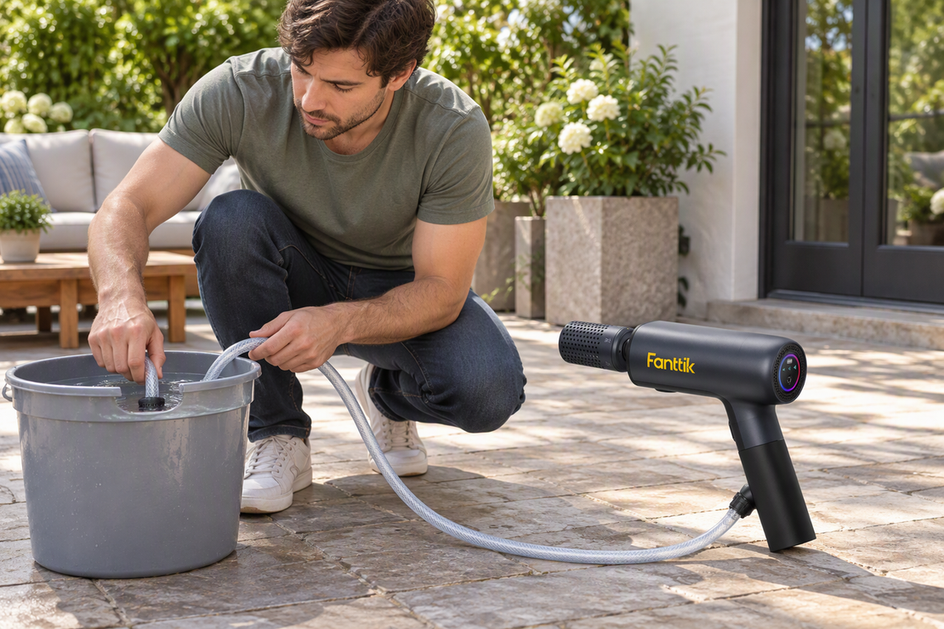
- Inlet Connection: Use a short suction hose to draw the solution directly from a bucket into the pump inlet.
- Low-Pressure Run: Remove the high-pressure nozzle. Run the unit for 5–10 minutes, allowing the solution to circulate through the pump and bypass system.
- Dwell Time: Turn off the unit and let the solution sit inside the pump for 15 minutes.
- Fresh Flush: Reconnect your standard water source and flush for 3 minutes to remove all traces of dissolved minerals.
Practical Rule of Thumb: This 1:4 ratio is a heuristic developed for residential maintenance. For extremely hard water (>20 GPG), a 1:2 ratio may be used, though dwell time should be monitored to prevent potential darkening of aluminum pump housings.
Storage Logic: Avoiding the "Dry-Start" Trap
The most common mistake DIYers make is storing the system "wet" in a way that allows water to pool. When water evaporates, it leaves 100% of its mineral content in a concentrated crust on the seals.
To prevent this:
- Depressurize: After turning off the motor, pull the trigger until flow stops to release internal tension.
- Gravity Drain: Disconnect all hoses and tilt the unit so the pump inlet and outlet face downward.
- Seal Lubrication: Before long-term storage, use a pump protector or a PTFE-based lubricant to coat internal surfaces. This prevents "stiction"—where the seal sticks to the piston—and provides a barrier against rust. As highlighted in the 2026 Engineering Trust Whitepaper (Brand/Company Data), proper lubrication is a cornerstone of mechanical longevity.
Modeling the ROI: Why 10 Minutes Saves Hundreds
To demonstrate the value of this maintenance, we modeled a "Neglected Unit" scenario. This model is an illustrative estimate based on a homeowner in a high-scale environment (15+ GPG) using a mid-range pressure washer for 50 hours annually.
The "Neglected Unit" Model (Illustrative Scenario)
- Assumptions: Mid-range axial pump; residential use; basic mechanical competency for maintenance.
| Parameter | Value (Est.) | Unit | Rationale |
|---|---|---|---|
| Water Hardness | 15 | GPG | High-scaling environment |
| Annual Usage | 50 | Hours | Typical seasonal maintenance |
| Replacement Pump Cost | $300 | USD | Average assembly cost |
| Maintenance Kit Cost | $50 | USD | Vinegar + Lubricant + Tools |
| Potential Lifespan (Neglected) | 3 | Years | Premature seal failure threshold |
| Potential Lifespan (Maintained) | 10 | Years | Typical design life of quality pumps |
Quantitative Analysis
Our analysis suggests that reactive repair—waiting for failure—is a losing strategy. A calcified pump often requires significantly more physical effort to disassemble due to seized fasteners and mineral-crusted housings. Furthermore, a neglected unit can lose an estimated 5 PSI of effective pressure per season due to seal bypass in high-scaling environments. Over three years, this results in a gradual efficiency loss.
Under these specific assumptions, the estimated ROI for preventive care is 6:1; for every $1 spent on vinegar and lubricant, a user can potentially save $6 in avoided replacement costs and efficiency gains. Note: Actual ROI varies based on local water chemistry and equipment quality.
Compliance and Safety: The Regulatory Framework
Maintaining your equipment isn't just about saving money; it’s about safety. A calcified pump can experience "pressure spikes" if a check valve sticks, potentially exceeding the safety burst pressure of your high-pressure hose.
Aligned with the EU General Product Safety Regulation (EU) 2023/988, manufacturers are increasingly required to provide clear maintenance instructions to prevent "foreseeable misuse"—which includes neglecting mineral buildup. Furthermore, when following DIY guides, ensure the content complies with FTC Endorsement Guides, which mandate transparency in how maintenance products are recommended.
For more technical insights, you may explore our brand analysis on Axial vs. Triplex Pumps or our guide on Winterizing Your Washer.
Final Maintenance Checklist for Hard Water Regions
- After Every Use: Release pressure, drain the pump, and store in a dry area.
- Monthly: Perform the 1:4 vinegar flush (10 mins run, 15 mins dwell).
- Quarterly: Inspect the inlet filter for mineral "pebbles" and clean with a soft brush.
- Seasonally: Apply a dedicated pump protector or PTFE lubricant.
- Listen: If you hear a high-pitched squeal, stop immediately and perform a deep descale.
By treating calcification as a chemical problem rather than an inevitable mechanical failure, you can protect your investment and ensure professional-grade performance for years to come.
Disclaimer: This article is for informational purposes only. Pressure washers operate at high pressures that can cause serious injury. Always read your manufacturer’s manual before performing maintenance. If you are uncomfortable with mechanical disassembly, consult a certified technician. This guide does not constitute professional engineering advice.
Sources
Continue reading
 Internal Blockages: Clearing Debris From the Robot's Drive Motor
Covers physics of bearing seizure, step-by-step cleaning with precision tools, and a maintenance model for high-debris pools.
Internal Blockages: Clearing Debris From the Robot's Drive Motor
Covers physics of bearing seizure, step-by-step cleaning with precision tools, and a maintenance model for high-debris pools.
Leave a comment
This site is protected by hCaptcha and the hCaptcha Privacy Policy and Terms of Service apply.