









































Fast-Track Winterization Summary
If you are short on time, follow this 3-step protocol to significantly reduce the risk of winter pump damage. While no method can account for every environmental variable, these steps address the most common points of failure.
- Purge (The "Burp"): Disconnect all hoses and run the motor for 10–15 seconds to clear the internal manifold.
- Protect: Circulate a propylene glycol-based antifreeze (RV/Marine grade) until the discharge fluid changes color.
- Insulate/Store: Remove the inlet filter and store the unit in the warmest available area (above 32°F is ideal).
Winterization Checklist (Printable)
| Task | Action | Done |
|---|---|---|
| Drainage | Disconnect garden hose & high-pressure hose. | [ ] |
| Purge | Run motor for 10-15s to "burp" check valves. | [ ] |
| Chemical | Add Propylene Glycol pump protector. | [ ] |
| Filter | Remove, dry, and store inlet filter screen. | [ ] |
| Safety | Wear eye protection during the "burp" process. | [ ] |
The Hydraulics of Winter Failure: Why Pumps Crack
Key Takeaway: Trapped water acts as a powerful hydraulic wedge when it freezes, often exceeding the structural limits of metal pump housings.
Based on common patterns we see on our repair benches, pump damage is rarely caused by a manufacturing defect; it is usually a result of the physics of trapped water. When water transitions from a liquid to a solid state, it expands by approximately 9% in volume.
In a confined, high-pressure environment like a pump manifold, this expansion creates immense stress. In a theoretical, fully constrained volume, these pressures can reach an estimated peak of up to 30,000 PSI (based on thermodynamic phase transition properties of ice).
Even a high-performance residential pump—which typically features a 5:1 safety margin (e.g., operating at 800 PSI with a theoretical 4000 PSI burst pressure)—is not designed to withstand these internal forces. The result is often a "brittle fracture," a sudden crack in the aluminum or brass manifold that typically renders the unit unrepairable.
Residual water frequently pools in the inlet and outlet check valve housings. These small chambers are isolated by spring-loaded valves that create a hydraulic lock. Without manual intervention, this water remains trapped, expanding against the casing the moment temperatures drop below freezing.
The Engineering of Winterization: A Three-Phase Protocol
To protect your equipment, we recommend a methodical approach that aligns with general reliability principles. Systematic maintenance is the most effective way to extend the lifespan of high-pressure systems.
Phase 1: The "Burping" Procedure and Complete Drainage
Summary: Gravity alone cannot clear a pump manifold; mechanical actuation is required to move water past internal check valves.
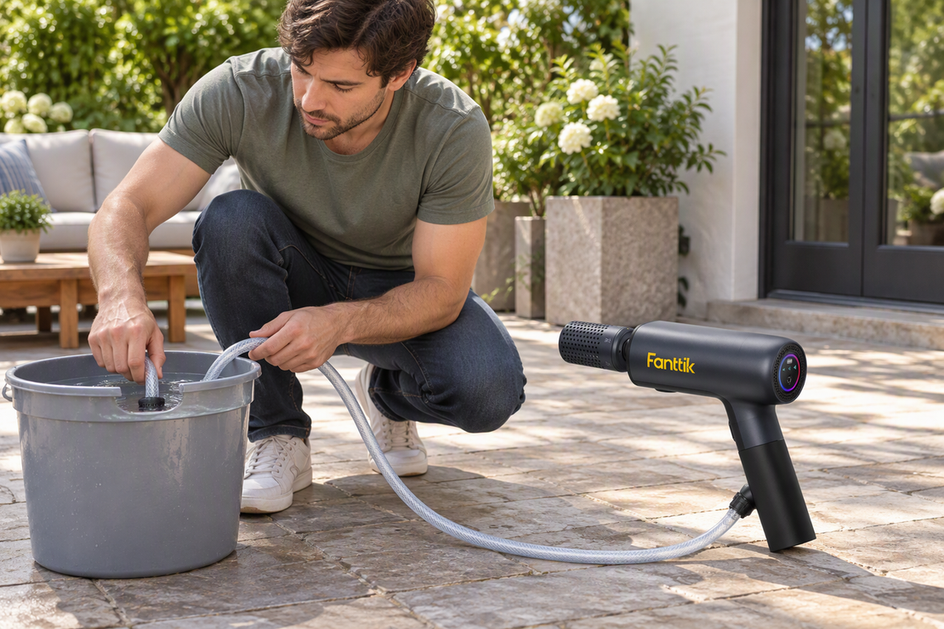
- Disconnect all Attachments: Remove the high-pressure hose, the spray gun, and the garden hose inlet.
- The Manual Actuation (The "Burp"): While the unit is off, pull the trigger on the spray gun (if still connected) to release any residual line pressure.
- Short-Burst Clearing: Wearing safety goggles, turn the motor on for no more than 10–15 seconds. This uses the pump's mechanical action to "burp" water out. You will hear a distinct change in the pump's pitch as the water clears—this is the sound of the check valves cycling air instead of fluid.
Workshop Observation: In our teardowns, we have observed that failing to "burp" the pump is a common contributor to inlet filter housing cracks. These housings can hold between 50ml and 100ml of water, which is often enough to split light-alloy casings upon freezing.
When to Seek Professional Help: If the pump motor feels "stuck" or makes a humming sound without turning during this step, stop immediately. The pump may already contain internal ice; forcing it can burn out the motor.
Phase 2: Chemical Protection and Seal Preservation
Summary: Remaining moisture must be treated with antifreeze to prevent freezing and keep internal seals from drying out.
- Chemical Selection: Use only propylene glycol-based RV or marine antifreeze.
- The "Never" Rule: Avoid using automotive engine coolant (ethylene glycol). While effective for engines, the corrosion inhibitors in ethylene glycol can degrade the nitrile or Viton O-rings used in pressure washer pumps.
- Standards Alignment: According to general material compatibility guidelines (such as those outlined in the ISO Standards Catalogue for Hydraulic Systems regarding fluid-seal interaction), using the wrong chemical can lead to premature seal failure.
- The 25% Heuristic: As a practical rule of thumb, we recommend circulating a mixture of at least 25% antifreeze until the fluid exiting the discharge port matches the color of the antifreeze.
Phase 3: Protecting the Inlet Filter
The inlet filter is often the most fragile component. If water sits in the mesh, it can expand and distort the filter, potentially allowing debris to enter the pump during the first spring start-up. Remove the filter, dry it thoroughly, and store it in a climate-controlled environment.

Modeling Cold Storage Risks: The "Cold-Soak" Effect
Key Takeaway: Extreme cold affects more than just water; it changes the viscosity of lubricants and the flexibility of metal components.
Storing a pressure washer in an unheated garage subjects components to "cold-soak" physics. We modeled a scenario for a standard residential pump stored at -20°F (-29°C) to illustrate these risks.
Estimated Winter Risk Model (Example Scenario)
| Parameter | Estimated Value | Unit | Rationale/Assumption |
|---|---|---|---|
| Ambient Temperature | -20 | °F | Typical extreme winter storage |
| Pump Safety Margin | 5:1 | Ratio | 4000 PSI Burst / 800 PSI Work |
| Ice Expansion Pressure | ~30,000 | PSI | Theoretical thermodynamic limit (constrained) |
| Battery/Power Availability | ~25 | % | Estimated reduction in capacity (Ref: BCI Standards) |
| Mechanical Load Increase | 200–350 | % | Estimated range due to fluid viscosity & friction |
Note: These values are based on a 250cc equivalent displacement model and are intended for illustrative purposes. Actual results vary by equipment grade.
Thermal Shock and Brittle Fracture
A critical risk in extreme cold is thermal shock. Bringing a "cold-soaked" pump (at 0°F) into a warm environment and immediately running hot water through it creates a sharp temperature gradient. This can induce brittle fracture in aluminum components. We recommend a gradual warm-up period of at least 4–6 hours before operation.
Material Science: O-Rings and Seal Integrity
Seals are the "soft tissue" of your hydraulic system. In extreme cold, standard nitrile O-rings can undergo a glass transition, becoming brittle and losing their elastic memory.
The Squeeze Rule: For a seal to function, it must maintain a "squeeze" against the housing. In temperatures below -20°F, seal material often contracts faster than the metal housing. If the seal loses its designed squeeze, "weeping" leaks may occur upon thawing.
Spring Inspection Checklist:
- Visual Check: Look for "flattening" of the O-ring profile (permanent set).
- Tactile Check: The seal should feel pliable, not like hard plastic.
- Replacement: If you live in a climate with frequent sub-zero nights, consider upgrading to polyurethane or silicone-based seals. These materials are often tested under IEC 60068 Standards for environmental resilience and maintain better flexibility at lower temperatures.
Strategic Maintenance: The ROI of Prevention
Treating pump failure as an "inevitable cost" is an expensive oversight. Our service records indicate that a single pump manifold failure can cost between $150 and $400 for parts and labor—frequently exceeding 50% of the unit's original value.
In contrast, a bottle of propylene glycol and 10 minutes of maintenance typically costs less than $15. Performing the three-phase winterization described above offers the highest probability of a trouble-free spring start-up.
Modeling Note: Method & Assumptions
The data in this article is derived from scenario modeling intended to illustrate risks in northern climate storage. It is not a controlled laboratory study.
- Modeling Type: Deterministic parameterized model for hydraulic expansion and temperature derating.
- Key Assumptions: Pump manifold volume of 250cc; Aluminum alloy construction; Temperature range of 80°F to -20°F.
- Boundary Conditions: These models may not apply to professional-grade Triplex pumps with forged brass manifolds, which possess different expansion coefficients and thermal mass.
Disclaimer: This article is for informational purposes only. High-pressure hydraulic systems can be dangerous. Always wear appropriate eye protection and follow the specific safety instructions in your equipment manual. We do not guarantee that these steps will prevent all damage, as environmental variables and pre-existing fatigue can influence outcomes. Consult a certified technician for professional servicing.
Sources
Continue reading
 Eliminating Pump Cavitation: Why Air Bubbles Kill Performance
Covers the physics of vapor implosion, scenario modeling for flow loss, and a pro framework for supply line...
Eliminating Pump Cavitation: Why Air Bubbles Kill Performance
Covers the physics of vapor implosion, scenario modeling for flow loss, and a pro framework for supply line...
 Detergent Science: Evaluating Chemical Aids for Exterior Stains
A guide to understanding chemical aids for high-pressure cleaning. Learn about surfactants, pH risks, and safe stain removal...
Detergent Science: Evaluating Chemical Aids for Exterior Stains
A guide to understanding chemical aids for high-pressure cleaning. Learn about surfactants, pH risks, and safe stain removal...
Leave a comment
This site is protected by hCaptcha and the hCaptcha Privacy Policy and Terms of Service apply.