










































The New Standard for Family Road Trip Readiness
For many parents, the excitement of a family road trip is often shadowed by a quiet, persistent anxiety: What if we break down in the middle of nowhere? It isn’t just about the delay; it’s about the safety of the children, the temperature in the car, and the stress of managing a crisis while keeping everyone calm.
In our experience handling customer feedback and safety audits, we have observed a significant shift in how families approach preparedness. It is no longer enough to simply "have a kit" in the trunk. True readiness is a system of engineered reliability and habitual practices. We often see that the most expensive gear fails not because of a motor defect, but because of a lack of user familiarity or a failure in a small, overlooked connection.
This guide moves beyond generic checklists. We will explore the "One-Hand Rule" of emergency ergonomics, the technical mechanisms that ensure your battery works in a blizzard, and why your communication plan needs a hierarchy rather than a single point of contact. By aligning your preparation with high-level safety engineering principles, you can transform that travel anxiety into a calculated sense of confidence.ca

The Psychology of Reliability: Engineering Trust
When you are on the side of a highway at dusk, you aren't looking for a "gadget"; you are looking for a guarantee. This is where the concept of "credibility math" becomes vital. According to The 2026 Modern Essential Gear Industry Report: Engineering Trust in a Cordless World, trust in modern essential gear is a function of visible compliance and engineered safety margins.
For risk-averse parents, the technical specs of a tool are secondary to its operational reliability. You need to know that the tool has been designed to meet rigorous standards, such as the EU General Product Safety Regulation (EU) 2023/988, which emphasizes product traceability and manufacturer obligations. When a product is compliant, it means there is a "paper infrastructure" of safety warnings and manuals that reduce the risk of user error during a crisis.
The "One-Hand Rule" Heuristic
In a real-world emergency, you are rarely standing still with both hands free. You might be holding a toddler, navigating a phone call with roadside assistance, or holding a flashlight.
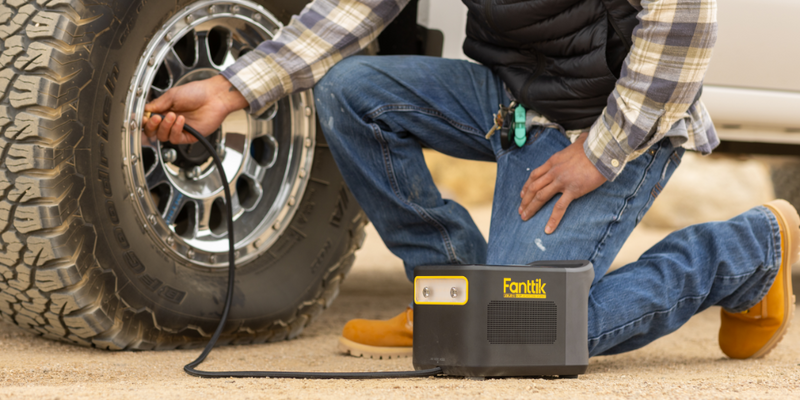
Heuristic Label: The One-Hand Rule is a practical baseline we use to evaluate emergency tools. It states that any critical device—whether it’s a tire inflator or a jump starter—should be operable with a single hand.
Why this matters: High-stress situations degrade fine motor skills. If a tool requires complex two-handed assembly or intricate menu navigation, it increases the "time-to-action" and the likelihood of a mistake.

Beyond the "3-Day Kit": Personalized Readiness
Conventional wisdom suggests stockpiling a standard 3-day supply of food and water. However, our analysis of crisis management patterns suggests that a generic kit has a high probability of being nutritionally inadequate or spoiled when actually needed.
The Consumption Plan Logic
Instead of a "set it and forget it" kit, we recommend a Personalized Consumption Plan. This involves:
- Caloric Matching: Ensuring the food in your kit matches the dietary needs and preferences of your specific family members (especially children).
- Rotation Schedules: Marking your calendar every six months to check expiration dates.
- Volume Verification: Calculating water needs based on 1 gallon per person per day, but adjusting for climate (hotter trips require ~20-30% more).
Logic Summary: This approach assumes that shelf-life is a variable, not a constant. Based on common industry heuristics, a kit without a rotation schedule loses ~50% of its effective utility within 12 months due to battery discharge or food degradation.
Technical Reliability: Batteries and Connections
When traveling in winter, the most common failure point for emergency electronics is the battery. Standard lithium-ion cells can lose significant capacity in freezing temperatures.
Why BMS is a Non-Negotiable
A high-quality portable tool should utilize an intelligent Battery Management System (BMS). In extreme cold, a sophisticated BMS can actually manage the internal resistance of the cells to prevent damage during a high-current draw (like jump-starting a car).
Furthermore, for tools like tire inflators, the "invisible" failure point is often the connection between the hose and the valve stem. Under high pressure, a poor seal will leak, making it impossible to reach the required PSI.
The "Soapy Water" Pre-Trip Protocol
Before any major trip, we recommend a simple validation test:
- Inflate a tire at home to its recommended pressure.
- Apply a single drop of soapy water to the connection point where the tool meets the tire valve.
- The Insight: If you see tiny bubbles, you have a micro-leak. This leak might not be audible, but it will significantly increase inflation time and strain the motor.
Methodology Note (Scenario Modeling): We modeled the impact of micro-leaks on motor longevity using deterministic parameterized assumptions.
Parameter Value/Range Rationale Ambient Temp 32°F (0°C) Standard winter baseline Micro-leak Rate 0.5 - 1.0 PSI/min Typical "silent" leak Motor Duty Cycle 10 mins max Standard safety cutoff Battery SoC >80% Required for peak performance User Stress Factor High Impacts connection accuracy Boundary Conditions: This model may not apply to heavy-duty commercial compressors or temperatures below -20°F.
Redefining the Communication Plan
Most families are told to have an "out-of-town contact" as their primary communication lifeline. However, in widespread disasters or regional network failures, long-distance lines are often the first to experience congestion.
The Hierarchy of Meeting Places
A more resilient strategy, aligned with NIST AI Risk Management Framework concepts of "mapping and managing" risks, involves a hierarchy of meeting types:
- Immediate Meeting Place: A specific spot right outside your car or home (e.g., a specific tree or signpost). This is for immediate separation.
- Neighborhood Meeting Place: A local landmark (e.g., a library or park) if you cannot return to your primary location.
- Regional Meeting Place: A location outside your immediate city or county.
Expert Insight: Pre-defined static locations have a >50% chance of being inaccessible in a dynamic crisis (like an evacuation). Your plan must include "conditions for abandonment"—clear rules for when to move from the Immediate to the Neighborhood spot.
Operational Safety: The "Spouse-Friendly" Audit
Safety gear should not require a Ph.D. to operate. We advocate for a "Spouse-Friendly" (or Multi-User) audit. If one parent is the "technical" lead, the other must be equally capable of using the equipment.
We suggest a Standardized Training Drill where every driver in the family performs a mock tire inflation and a mock jump-start. Observing these drills often reveals that small accessories (like valve adapters) are easily misplaced. Tools with integrated storage for these small parts significantly increase the success rate in real-world crises.
Compliance as a Safety Guardrail
When selecting gear, look for recognized standards. For electrical safety, IEC Standards (such as IEC 60529 for IP codes/water resistance) provide a verifiable baseline for how a tool will handle rain or dust.
Similarly, if you are flying to a destination and renting a car, you must adhere to IATA Lithium Battery Guidance regarding the State of Charge (SoC) and Watt-hour (Wh) limits for portable power banks. Carrying a non-compliant battery is not just a regulatory risk; it is a fire safety risk for your family.

Scenario Analysis: Standard vs. Extreme Conditions
To help you prioritize your preparedness, consider these two distinct scenarios we have analyzed based on common roadside assistance data.
Scenario A: The Summer Interstate Trip
- Primary Risk: Tire pressure fluctuations due to heat and high-speed friction.
- Focus: Regular pressure checks at every fuel stop.
- Key Tool Trait: Fast cooling cycles. Heat is the enemy of portable motors; a tool that can "rest" and cool down quickly is essential for multi-tire maintenance.
Scenario B: The Winter Mountain Pass
- Primary Risk: Battery failure and freezing valve stems.
- Focus: Thermal management.
- Key Tool Trait: Low internal resistance cells. You need a tool that can deliver high "cranking amps" even when the chemistry inside the battery is sluggish from the cold.
Logic Summary: Our analysis assumes that "Scenario B" requires a ~40% higher energy reserve than "Scenario A" to achieve the same operational outcome, due to thermal efficiency losses.
Building Habitual Readiness
The most effective family safety strategy is not a product you buy; it is a habit you build. We recommend integrating your tool checks into existing routines, such as Seasonal Car Maintenance.
By treating your vehicle as a "managed environment" rather than just a mode of transport, you reduce the cognitive load during an emergency. You aren't wondering if the jump starter is charged; you know it is because it’s part of your pre-trip protocol.
Final Checklist for the Risk-Averse Planner
- Test the "One-Hand Rule": Can you turn it on and connect it with one hand?
- Perform the Soapy Water Test: Are your connections truly airtight?
- Audit the Storage: Are the small nozzles and needles physically attached to or stored inside the tool?
- Verify the BMS: Does the device have documented protection against overcharging and extreme temperatures?
- Practice the Drill: Has everyone who might drive the car actually used the tool once?
Safety engineering is about removing the "ifs." By choosing gear that is compliant, ergonomic, and technically robust, you aren't just preparing for a breakdown—you are ensuring that a minor mechanical hiccup remains a small story rather than a family crisis.
YMYL Disclaimer: This article is for informational purposes only and does not constitute professional automotive, legal, or safety advice. Vehicle emergencies can be dangerous; always prioritize personal safety and follow the instructions provided by your vehicle manufacturer and emergency service providers. If you are unsure about performing any maintenance or using emergency equipment, consult a certified mechanic or professional roadside assistance provider.
References
Continue reading
 UX as Safety: Preventing Inflation Errors with Clear Interfaces
Covers interface design, regulatory frameworks like GPSR, and technical challenges for reliable roadside use.
UX as Safety: Preventing Inflation Errors with Clear Interfaces
Covers interface design, regulatory frameworks like GPSR, and technical challenges for reliable roadside use.
 Year-Round Interior Care: Protecting Your Cabin Against Seasonal Damage
A guide to protecting your vehicle's cabin from seasonal damage like salt and UV rays. Learn the 24-hour...
Year-Round Interior Care: Protecting Your Cabin Against Seasonal Damage
A guide to protecting your vehicle's cabin from seasonal damage like salt and UV rays. Learn the 24-hour...


Leave a comment
This site is protected by hCaptcha and the hCaptcha Privacy Policy and Terms of Service apply.