









































Executive Summary: The "Answer-First" Guide to Tire Pressure
The Core Conclusion: Maintaining correct tire pressure is one of the most effective ways to reduce commuting costs. A 5 PSI drop in tire pressure typically results in a 2% to 4% reduction in fuel economy (based on US Department of Energy and NHTSA estimates). In regions with high fuel prices, this "invisible leak" can cost a driver nearly $100 annually in wasted fuel alone.
Quick Action Checklist
- Target PSI: Find the specific "Cold Tire Pressure" on the sticker inside your driver-side door jamb (not the max PSI on the tire sidewall).
- The 10°F Rule: Expect to lose approximately 1 PSI for every 10°F drop in ambient temperature.
- Check Frequency: Check monthly and during the first week of any major seasonal temperature shift.
- Recommended Tool: Use a calibrated digital inflator (like the Fanttik X9 Pro) rather than gas station pumps, which are often poorly maintained.
Safety Disclaimer: This guide is for informational purposes. Tire pressure is critical for vehicle handling and braking. Always follow your vehicle manufacturer’s specifications. If your TPMS light remains on or a tire frequently loses air, consult a certified mechanic immediately to check for punctures or rim damage.
The Hidden Cost of 5 PSI: Quantifying Seasonal Underinflation
For the average commuter, vehicle maintenance often feels like a series of reactive fixes—replacing a dead battery or swapping squeaky brake pads. However, one of the most significant drains on a household’s automotive budget is silent: seasonal tire pressure fluctuation.
Based on our observations of vehicle performance patterns and customer support data, a consistent 5 to 8 PSI underinflation is a common state for many drivers during autumn and winter. This isn't just a technical oversight; it’s a financial leak. While 5 PSI may seem negligible, the cumulative impact over a year of commuting is substantial.

The Thermodynamics of Tire Pressure: The 10°F Rule
To understand why your commute costs more in November than in August, we look at the science of compressed air. Tire pressure is a direct function of ambient temperature.
The Physics of Air Density
According to Gay-Lussac’s Law, the pressure of a gas is proportional to its temperature (at a constant volume). In practical terms, this creates a reliable heuristic: tire pressure typically drops by about 1 PSI for every 10°F (5.5°C) decrease in temperature.
If you set your tires to 35 PSI on a 75°F afternoon, a 35°F cold snap will drop those tires to approximately 31 PSI—even without a single leak.
The "Visible Deficit" Trap
A common misconception is waiting for a tire to "look low." Modern radial tires feature stiff sidewalls designed to maintain their shape. A tire can lose up to 25% of its air—dropping from 32 PSI to 24 PSI—and still appear identical to a fully inflated one to the naked eye. By the time you notice a visual change, you have likely been overpaying for fuel for weeks.
Quantifying the Financial Impact: Fuel and Rolling Resistance
The financial penalty of underinflation stems primarily from rolling resistance. When a tire is underinflated, the "footprint" (the area of rubber contacting the road) deforms more significantly. This deformation generates internal heat and requires more energy from the engine to overcome.
The Rolling Resistance Heuristic
While exact figures vary by tire brand and vehicle weight, industry data from the NHTSA suggests that for every 1 PSI drop, fuel economy can decrease by roughly 0.2% to 0.3%. In more extreme cases or with heavier vehicles, this sensitivity can be higher.
- 5 PSI Under: Potential 1% to 3% MPG loss.
- 10 PSI Under (Common Neglect): Potential 3% to 6% MPG loss.
Regional Cost Variations: A Comparative Model
The dollar amount saved by correcting 5 PSI varies by local fuel prices. We have modeled two scenarios for a typical commuter driving 12,000 miles per year at 25 MPG.
| Parameter | Texas Scenario (Low Fuel) | California Scenario (High Fuel) |
|---|---|---|
| Fuel Price (per gallon) | $2.50 | $5.00 |
| Annual Fuel Spend (Baseline) | $1,200 | $2,400 |
| 5 PSI Penalty (Estimated 4% Loss) | $48 | $96 |
| 13 PSI Penalty (Typical Neglect) | $125 | $250 |
How We Calculate This:
- Baseline Gallons: 12,000 miles / 25 MPG = 480 gallons.
- MPG with 5 PSI Loss: 25 MPG * 0.96 (4% loss) = 24 MPG.
- New Fuel Consumption: 12,000 miles / 24 MPG = 500 gallons.
- Annual Waste: 20 extra gallons * Fuel Price ($2.50 or $5.00).
Note: The 4% MPG loss used here is a conservative midpoint for vehicles under heavy load or those using older tire compounds.
The Reality of the "Neglect Cycle"
While "5 PSI" is our benchmark, real-world data suggests many drivers face a steeper penalty. According to a report by Firestone/Bridgestone, underinflated tires cost U.S. drivers an estimated $18.6 billion annually.
Because tires naturally lose about 1 PSI per month through permeation, a driver who only checks pressure quarterly is often starting at a deficit. In field observations, average underinflation is often closer to 13 PSI. At that level, you aren't just losing fuel; you are compromising the structural integrity of the tire and increasing stopping distances.
The EV Range Penalty
For Electric Vehicle (EV) owners, the stakes are higher. EVs are highly sensitive to rolling resistance. A 5 PSI drop can reduce range by an estimated 1.5% to 2%. On a vehicle with a 300-mile range, that's a loss of 6 miles per charge. While electricity is cheaper than gas, this reduction increases "range anxiety" and time spent at charging stations.
Strategic Maintenance: The "First Week" Heuristic
To avoid the neglect cycle, we recommend a maintenance strategy centered on temperature shifts rather than the calendar.
- The 10-Degree Trigger: Most TPMS (Tire Pressure Monitoring System) sensors only trigger when pressure drops 25% below the recommendation. By then, your fuel economy has already suffered. Instead, check pressure during the first week of any sustained 10°F average temperature shift.
- Locate the "Cold Pressure" Spec: Never use the PSI on the tire sidewall (that is the maximum). Use the placard on the driver-side door jamb. Measure "cold," meaning the car has been parked for at least three hours.
- Precision Matters: Gas station pumps are often uncalibrated. Using a dedicated device like the Fanttik X9 Classic provides a digital readout that is typically more reliable than analog "pop-out" gauges.
The ROI of Portable Inflation Technology
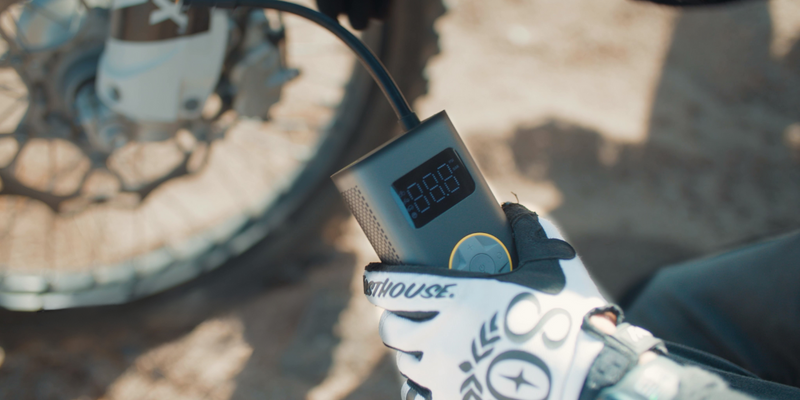
The primary barrier to maintenance is inconvenience. Portable, cordless inflators transform this task into a 60-second routine.
- For Daily Commuters: The Fanttik X9 Pro allows you to set a target PSI and stops automatically, ensuring precision without the guesswork.
- For Specialized Needs: The Fanttik X10 Ace Mini Bike Pump offers high-pressure capability for e-bikes and road bikes in a pocket-sized form.
Transparency Note: As the manufacturer of Fanttik products, we design our tools to meet the rigorous standards outlined in The 2026 Modern Essential Gear Industry Report, focusing on accuracy and consumer self-reliance.
Modeling the Savings: Assumptions and Parameters
To ensure our recommendations are grounded in verifiable logic, we use the following parameters for our fuel economy model.
| Parameter | Value | Rationale / Source |
|---|---|---|
| Baseline MPG | 25 | Average for U.S. light-duty vehicles |
| Crr Sensitivity | ~1.5% per PSI | Estimated change in Rolling Resistance |
| MPG Impact | 0.2% - 0.4% per PSI | US DOE / FuelEconomy.gov |
| TPMS Trigger | -25% PSI | Standard NHTSA safety threshold |
Boundary Conditions:
- Savings may be lower for vehicles with specialized "Eco" (Low Rolling Resistance) tires.
- Impact is significantly higher for heavy-duty trucks or vehicles carrying cargo.
Ensuring Device Safety and Accuracy
Technical compliance is as important as performance. Our products align with international safety and quality standards:
- Measurement Accuracy: Digital sensors are developed referencing NIST Handbook 44 principles for weights and measures.
- Electrical Safety: Cordless inflators meet IEC Standards for battery safety.
- General Safety: We adhere to the EU General Product Safety Regulation (EU) 2023/988 for consumer protection.
The Long-Term Financial Outlook
Maintaining correct tire pressure offers a clear, immediate Return on Investment (ROI). By reclaiming that 3% in fuel efficiency, you can save $50 to $100 annually while extending tire life by preventing uneven wear. In the context of modern automotive preparedness, self-reliance means having the data and the tools to prevent problems before they cost you money.
Sources & References
- US Dept. of Energy: Keeping Tires Inflated for Fuel Economy
- Firestone/Bridgestone: Air is Money Report
- The 2026 Modern Essential Gear Industry Report
- NIST Handbook 44: Weights and Measures
- NHTSA: Tire Safety Ratings and Maintenance
- EU General Product Safety Regulation (EU) 2023/988
- ISO Standards for Automotive Tyres
- Rolling Resistance Mechanics - Wikipedia
- FTC Endorsement Guides (16 CFR Part 255)
Continue reading
 Off-Season Storage: Keeping Your Inflator Calibrated in the Garage
Explains NIST/IATA standards for battery SOC, thermal buffering techniques, and a post-storage verification protocol to ensure inflator readiness.
Off-Season Storage: Keeping Your Inflator Calibrated in the Garage
Explains NIST/IATA standards for battery SOC, thermal buffering techniques, and a post-storage verification protocol to ensure inflator readiness.
 Understanding the Lifecycle of Lithium-Ion Inflator Cells
Covers lab vs real-world cycle life, thermal damage from hot car storage, diagnostic signs of failure, and the...
Understanding the Lifecycle of Lithium-Ion Inflator Cells
Covers lab vs real-world cycle life, thermal damage from hot car storage, diagnostic signs of failure, and the...
Leave a comment
This site is protected by hCaptcha and the hCaptcha Privacy Policy and Terms of Service apply.