










































Beyond the Plug: Evaluating Safety Certifications for Shop Power
Quick Take: Workshop Power Essentials
- The 80% Rule: Never exceed 12A of continuous load on a 15A power strip to prevent thermal runaway.
- Certification Matters: Look for molded UL or ETL marks; treat CE-only marks on high-draw tools with caution unless backed by third-party testing.
- MOV Lifespan: Surge protection degrades with every spike. If your strip is over 3–5 years old or has weathered a major storm, the protection is likely spent.
- Audit Frequency: Perform a physical "touch test" and connection check every six months.
We have all seen it in home workshops across the country: a $10 power strip from a general retailer daisy-chained to a 15-amp circuit, powering a high-draw table saw and a shop vacuum simultaneously. To the untrained eye, if the plug fits and the light stays on, the system is "working." However, based on common patterns observed in repair centers and field failure analysis, this is exactly where the risk of electrical fires begins.
Not all power strips are built for heavy-duty shop use. In a modern workshop, managing the electrical load is as critical as the precision of your measurements. This article evaluates the specific safety marks, internal component requirements, and technical heuristics required to handle high-draw power tools and battery chargers safely.
The 15A Bottleneck and the 80% Heuristic
A common and costly mistake we frequently observe among DIYers is using a power strip rated for 15A on a circuit already supplying 15A to other outlets. The physics of a workshop environment are unforgiving. Consider a standard 12A startup surge from a table saw combined with an 8A draw from a shop vac. When run simultaneously through a standard strip, the internal wiring can overheat well before the main breaker trips.
To mitigate this, we follow the 80% Continuous Load Rule. This is a professional heuristic (derived from NEC guidelines for continuous loads) stating that you should never load a circuit or a power strip beyond 80% of its rated capacity for use lasting more than three hours. For a standard 15A circuit, that limit is 12A.
Logic Summary: Our 80% rule is a shop-standard heuristic designed to provide a thermal safety margin. It accounts for "inrush current"—the momentary spike in power when a motor starts—which can be 3 to 5 times higher than the running current.
The "Touch Test" for Thermal Integrity
Experienced electricians often use a simple sensory check: feel the power strip housing after 30 minutes of heavy use. If the casing is noticeably warm to the touch (exceeding roughly 105°F or feeling uncomfortable to hold), it is a strong indicator of underspecification, poor internal contact, or impending failure. In our analysis of the 2026 Modern Essential Gear Industry Report (Manufacturer Whitepaper), we emphasize that "credibility math" in tools starts with these visible safety margins. If warmth is detected, the immediate step is to power down and check for loose plugs or overloaded circuits.

Decoding Safety Marks: UL, ETL, and the CE Gap
When evaluating power accessories, the marks on the back of the device are your first line of defense. However, there is a significant amount of "certification labeling" in the market that prosumers must navigate.
1. UL (Underwriters Laboratories) and ETL (Intertek)
In North America, UL Standards and ETL marks are the gold standard. These indicate that a representative sample of the product has been tested by a Nationally Recognized Testing Laboratory (NRTL) to meet specific safety requirements.
However, a UL mark on a battery cell does not guarantee the safety of the entire power bank. As noted in research from Battery Tech Online, standards like UL 2054 (for cells) are often voluntary. A product may have "UL-listed cells" but an uncertified charging circuit, which is a critical distinction for workshop fire prevention.
2. The CE Self-Declaration Pitfall
For those in the European market, the CE marking is mandatory. However, a "critical gap" often exists here. A CE-marked tool can legally reach the market via a self-declaration pathway, meaning the manufacturer claims compliance without mandatory third-party oversight. For high-risk shop equipment, a CE mark without a corresponding GS (Geprüfte Sicherheit) mark or third-party test report is generally considered a lower tier of assurance.
3. IEC 60529 and IP Ratings
In wet or dusty shop environments, the IEC 61347 and IEC 60529 standards (which define IP codes) are vital. If you are charging batteries in a garage prone to moisture, look for an IP rating (e.g., IP54 or higher) that specifically addresses liquid and dust ingress.
Internal Engineering: MOVs and Outlet Spacing
Beyond the stickers, the physical construction of the power strip reveals its true quality.
The Finite Life of Surge Protection
Most certified power strips use a Metal Oxide Varistor (MOV) to divert excess voltage. An MOV has a finite life defined by its Joule rating. Every time it absorbs a small surge, it degrades.
How to detect MOV failure:
- Status LEDs: Most quality strips include a "Protected" LED. If this light is off, the MOV is likely spent, and the strip no longer provides surge protection.
- The "Event" Rule: If your shop has experienced a significant power surge (e.g., a nearby lightning strike or utility transformer failure), replace the strip immediately, even if the "Protected" light remains on.
- The Age Rule: In a workshop environment with frequent motor-driven spikes, we recommend replacing surge protectors every 3–5 years.
According to technical data on High Energy MOVs, once an MOV is spent, the strip may continue to provide power without any surge protection, leaving your expensive chargers vulnerable.
The Spacing Heuristic
A quick visual cue for quality is the spacing between outlets. Cheap strips often cram outlets together. In a workshop, where tools often have large, molded plugs, cramped spacing prevents plugs from seating fully, leading to exposed prongs and potential arcing. We recommend strips where the outlets are spaced at least 1.5 inches apart or oriented at 45-degree angles.
Managing Low-Draw Precision Tools
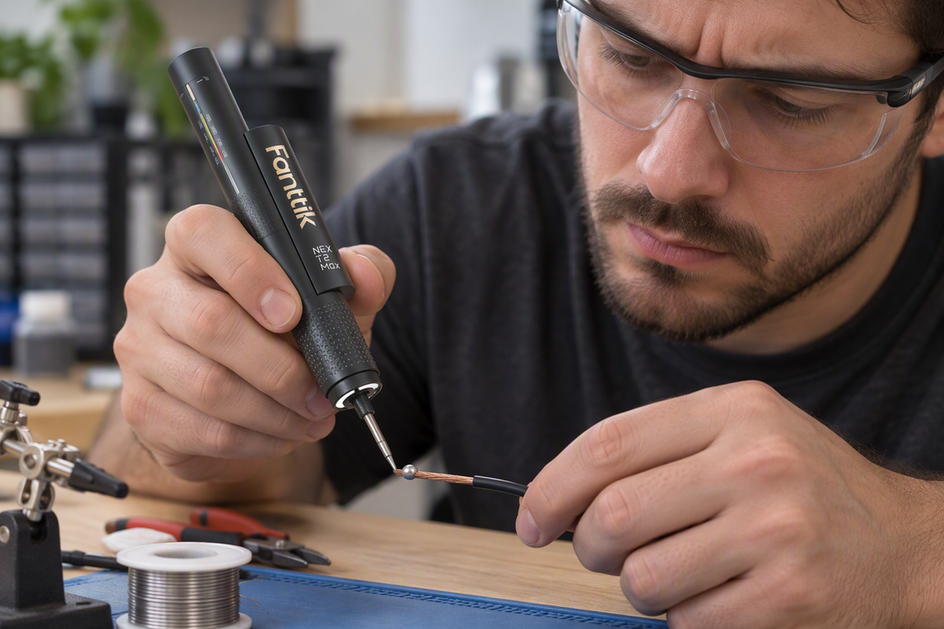
While high-draw saws require heavy-duty distribution, the modern workshop also relies on precision electronics. Tools like the Fanttik E1 MAX or the S2 Pro (Manufacturer Data) use sensitive Lithium-ion batteries that require stable charging. Using a high-quality, certified power hub ensures that the "noise" from larger motors on the same circuit doesn't damage the Battery Management Systems (BMS) of these precision instruments.
Scenario Modeling: Precision Tool Productivity
We modeled the assembly of a standard workshop cabinet to demonstrate the ergonomic and time benefits of precision power tools.
Method & Assumptions (Model 1.1):
- Scenario: 120 screws (M4 size) into pre-drilled pilot holes in 3/4" birch plywood.
- Manual Rate: 18s/screw (based on average human torque fatigue over 120 repetitions).
- Powered Rate: 4s/screw (constant speed of 200 RPM, e.g., Fanttik S2 Pro).
- Measurement: Time-motion analysis from start of thread to flush seating.
| Metric | Manual Assembly | Powered Assembly (e.g., S2 Pro) | Unit |
|---|---|---|---|
| Total Time | 36 | 8 | Minutes |
| Time Saved | 0 | 28 | Minutes |
| Wrist Rotations | ~1,440 | ~60 | Count |
| Speed Multiplier | 1.0x | 4.5x | - |
Note: This is a scenario model based on standard shop observations; actual results vary by material density and user fatigue.
Modeling Workshop Power & Emergency Preparedness
In unheated workshops, electrical management extends to equipment starting. We analyzed the "Winter Starting Confidence" for a diesel engine in a 20°F unheated shop.
Method & Assumptions (Model 2.1):
- Model Type: BCI Temperature Derating & SAE J537 Standards.
- Inputs: 2.5L Diesel Engine (high compression), 20°F Ambient Temp.
- Battery: Aging 450CCA Lead-Acid (estimated 60% health).
- Cranking Factor: 1.7x increase in required amperage due to cold oil viscosity (15W-40).
| Parameter | Value | Unit | Rationale |
|---|---|---|---|
| Required Amps (at 80°F) | 305 | A | Baseline compression load |
| Required Amps (at 20°F) | 526 | A | Cold oil viscosity adjustment |
| Available Battery Amps | ~270 | A | 450CCA derated for age/temp |
| Power Gap | 256 | A | Deficiency to overcome |
| Safety Margin | 2.54x | Ratio | Confidence Level: High (with 2000A Jump Starter) |
This modeling illustrates that in a cold shop, you need more than just a "charge." You need a device with enough sustained current to bridge the gap caused by cold-thickened oil and a chemically sluggish battery.
Practical Audit: A 5-Point Shop Power Checklist
To ensure your workspace meets professional safety standards, we recommend performing this audit every six months:
- The Label Check: Verify that every power strip has a permanent, molded UL or ETL holographic label. If the label is a simple paper sticker, treat it as uncertified.
- The 80% Calculation: Sum the "Amps" (A) or "Watts" (W) of every tool connected to a single strip. If the total exceeds 12A (for a 15A strip), move one tool to a dedicated wall outlet.
- The Physical Inspection: Look for "discoloration" around the outlet holes. Any brown or melted plastic is an immediate "remove from service" signal.
- The Spacing Test: Ensure all plugs are seated "flush" against the strip. If a plug is tilted because it's hitting an adjacent cord, it creates a potential for arcing.
- The Precision Tool Check: For tools like the Fanttik T1 Max, ensure you are using the original charging cable or a certified equivalent to protect the internal battery logic.
Summary of Technical Standards
| Standard | Focus Area | Application in Shop |
|---|---|---|
| UL 1363 | Relocatable Power Taps | Standard power strips |
| UL 1449 | Surge Protective Devices | Protection for chargers/electronics |
| IEC 60529 | Ingress Protection (IP) | Dust and moisture resistance |
| ISO 898 | Fastener Properties | Torque limits for tool maintenance |
By treating your workshop's electrical system as a piece of precision equipment, you protect both your tools and your property. Reliability in the shop isn't just about the torque of your drill; it’s about the integrity of the power that feeds it.
Disclaimer: This article is for informational purposes only and does not constitute professional electrical engineering or legal advice. Electrical work and workshop safety should always be conducted in accordance with local building codes and manufacturer instructions. If you are unsure about your shop's wiring, consult a licensed electrician.
References
Continue reading
 How BMS Logic Prevents Electrical Fires in Workshop Charging Hubs
A guide on Battery Management Systems (BMS) preventing electrical fires in DIY workshop charging setups. Explains circuit loads,...
How BMS Logic Prevents Electrical Fires in Workshop Charging Hubs
A guide on Battery Management Systems (BMS) preventing electrical fires in DIY workshop charging setups. Explains circuit loads,...
 Designing a Logical Power Layout for Modern Cordless Workshops
A guide to designing garage electrical systems for cordless tools, preventing breaker trips and ensuring safety with NEC...
Designing a Logical Power Layout for Modern Cordless Workshops
A guide to designing garage electrical systems for cordless tools, preventing breaker trips and ensuring safety with NEC...


Leave a comment
This site is protected by hCaptcha and the hCaptcha Privacy Policy and Terms of Service apply.