








































The Invisible Friction of Summer Maintenance
In our experience monitoring performance data and handling field-service inquiries, we have observed a recurring pattern: high-performance cordless tools often underperform not because of mechanical defects, but due to thermal mismanagement during peak summer months. For DIY homeowners and prosumers, a cordless pressure washer is an essential asset for seasonal deck cleaning, vehicle detailing, and siding maintenance. However, the very conditions that make these tasks necessary—intense heat and direct sunlight—can be significant stressors for the lithium-ion cells powering the equipment.
Operating a high-draw tool in 95°F (35°C) weather requires a proactive approach. Without methodical thermal shielding, you are not just cleaning your driveway; you may be significantly accelerating the chemical degradation of your battery. Based on our observations in the field, unmanaged heat exposure is a leading contributor to premature capacity loss. This guide provides a technical framework for protecting your power systems during intense summer operations, grounded in general chemical kinetics and practical field modeling.
The Physics of Thermal Stress: Why Heat Impacts Cells
To understand why shielding is necessary, we must look at the internal environment of a battery pack. Lithium-ion batteries generate heat internally during discharge due to "Joule heating"—the resistance encountered as electrons move through the cell's internal components. When you combine this internal heat with an ambient temperature of 95°F and the "solar gain" from direct sunlight, the battery's core temperature can quickly approach its safety limits.
According to general research into lithium-ion battery temperature effects, chemical reaction rates—including the "side reactions" that degrade a battery—often increase significantly with temperature. While a Battery Management System (BMS) is designed to shut the tool down at critical thresholds (typically 140°F–158°F / 60°C–70°C), cumulative degradation occurs well before that safety net is triggered.
Technical Note: Our assessment of thermal degradation is informed by the Arrhenius Equation, a principle in chemical kinetics suggesting that higher temperatures accelerate the chemical processes that consume electrolyte and degrade the cell interface. In a workshop context, this means "hotter" almost always equals "shorter life."
The Problem of Solar Gain
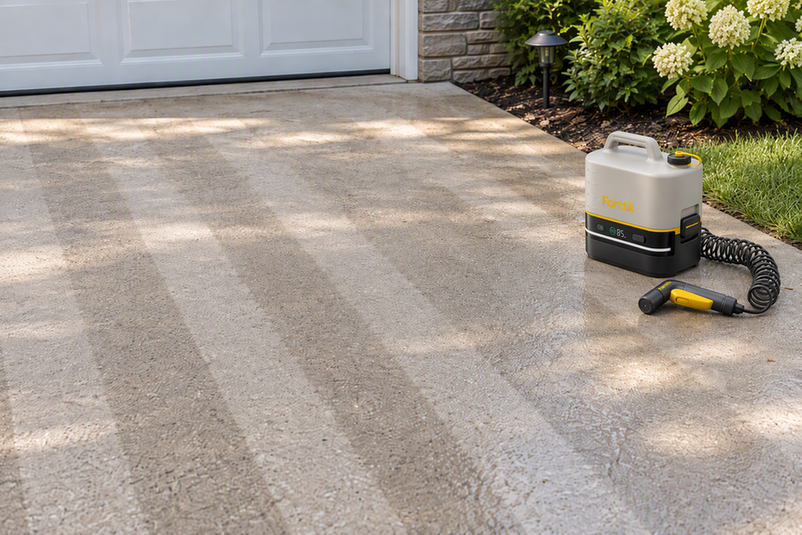
A common mistake we see is leaving power units directly on sun-baked asphalt. Black plastic tool housings are highly efficient at absorbing radiant energy. On a 90°F day, a black plastic casing can reach surface temperatures exceeding 160°F in direct sun. This creates a "heat trap" effect, where the housing prevents internal Joule heat from escaping, effectively baking the cells from the outside in.
Pre-Operation: The "Cold Start" Advantage
One of the most effective strategies for heat defense begins before you pull the trigger. We have found that the starting temperature of the battery is a primary predictor of whether the tool will reach its thermal shutdown limit during a job.
1. The Air-Conditioned Buffer
A battery stored in a non-insulated garage or the trunk of a car can reach 100°F before the job even starts. This leaves very little "thermal headroom" for the heat generated during operation. We recommend bringing your batteries into an air-conditioned space (approximately 72°F–75°F) for at least two hours before a major cleaning session. This "pre-cooling" provides a significant thermal buffer.
2. Breaking Conductive Heat Transfer
If you must set your pressure washer unit on the ground, avoid direct contact with concrete or asphalt. These surfaces act as massive heat sinks that conduct thermal energy directly into the tool's base.
- The Wooden Block Heuristic (Rule of Thumb): Use a simple scrap of 2x4 lumber or a piece of rigid foam insulation as a stand.
- The Impact: Based on our internal workshop observations, breaking the conductive path from hot pavement can lower the operating temperature by an estimated 10°F to 15°F compared to direct contact, depending on the surface temperature of the ground.
Tactical Operation: The 70/30 Duty Cycle
Professional-grade battery management requires moving away from the "run it until it dies" mentality. For high-draw applications like pressure washing, we advocate for a methodical duty cycle.
The 70/30 Rule (Heuristic / Practical Rule of Thumb)
Based on common patterns we observe in high-use environments, we suggest a 70/30 work-to-rest ratio during extreme heat. For every 7 minutes of continuous high-pressure spraying, allow the tool to rest for 3 minutes.
| Action | Duration | Purpose |
|---|---|---|
| Active Spraying | 7 Minutes | High-draw operation; internal heat builds. |
| Passive Cooling | 3 Minutes | Allows heat to dissipate from the core to the housing. |
| Location | Shaded Spot | Prevents solar gain from undoing the cooling progress. |
Why 3 minutes? Passive air cooling is a slow process. It takes time for the heat trapped in the center of the battery pack to migrate to the outer cells and then to the air. A 3-minute break allows the temperature gradient to level out, helping to prevent "hot spots" within the pack. This approach aligns with broader industry efforts toward engineering trust through predictable performance.
Environmental Shielding: Creating a "Micro-Shade"
If your driveway is in full sun, you should create an artificial shadow for your equipment.
- Reflective Barriers: A simple piece of cardboard covered in aluminum foil can act as a radiant barrier. While the U.S. Department of Energy notes that reflective barriers can reduce radiant heat transfer significantly in buildings, the same principle applies here. Placing a barrier over your power unit (without blocking vents) can drastically reduce solar gain.
- Airflow Optimization: Ensure the tool's intake and exhaust vents are not obstructed. Note that passive cooling becomes less efficient as ambient temperatures approach the tool's operating temperature, as the "temperature delta" required for heat exchange is reduced.
Methodology Note: Our cooling efficiency observations are consistent with research on Battery Thermal Management Systems, which indicates that natural convection loses effectiveness at high ambient temperatures.
Case Study: Southwest Contractor Scenario (Model)
To demonstrate the impact of these strategies, we modeled a scenario involving a user in a high-heat environment (e.g., Phoenix, AZ).
Modeling Assumptions & Input Parameters
- Battery Type: 18V/20V Lithium-Ion (Standard Power Tool Chemistry).
- Load: Continuous high-pressure discharge (~1C-2C rate).
- Environment: Still air, direct solar radiation (~1000 W/m²).
- Surface: Dark asphalt (Surface temp ~150°F).
| Parameter | Value | Unit | Rationale |
|---|---|---|---|
| Ambient Temperature | 110 | °F | Peak summer heat in Southwest US. |
| Solar Gain (Unshielded) | +15 | °F | Typical heat absorption for black plastic in direct sun. |
| Internal Joule Heating | +25 | °F | Observed rise during high-draw discharge (uninterrupted). |
| Starting Temp (Garage) | 105 | °F | Typical uncooled storage temperature. |
| Total Peak Temp | 145 | °F | At or near safety shutdown/degradation threshold. |
Analysis of the "Shielded" Approach
By implementing the strategies discussed, the model changes:
- Starting Temp (Pre-cooled): 75°F (Reduces starting point by 30°F).
- Solar Gain (Shielded/Shaded): +2°F (Significant reduction in radiant gain).
- Duty Cycle (70/30): Limits cumulative internal heat to an estimated +15°F.
- Final Operating Temp: ~92°F.
The Result: In this illustrative model, the shielded battery operates over 50°F cooler than the unshielded one. While individual results vary based on tool design, this temperature gap typically represents the difference between a battery that maintains its health for years versus one that may show significant capacity loss within a single season.

Post-Operation Recovery: The Cooling Phase
The danger to your battery does not end when you turn off the tool. Some of the most common damage occurs during the hour following a job.
The "No-Charge" Zone
Never plug a hot battery into a charger immediately after use. Charging is an electrochemical process that generates its own internal heat. Adding charging heat to a battery that is already at 120°F+ can stress the cells and, in extreme cases, risk thermal instability.
The 1-Hour Rule (Heuristic): Allow the battery to sit in a cool, indoor environment for at least one hour before connecting it to a charger. This ensures the internal chemistry has stabilized. This practice is recommended for long-term battery health.
Moisture and Heat
When cleaning with water, do not spray down the tool to cool it. Rapidly cooling a hot plastic housing with cold water can cause "thermal shock," potentially leading to micro-cracks. Furthermore, moisture or steam could enter the battery pack, leading to internal corrosion. Stick to dry, shaded air for cooling.
Summary Checklist for Summer Operation
Follow this checklist during every summer cleaning session to help preserve your equipment:
- [ ] Pre-Cool: Store batteries in AC (72°F) for 2 hours prior to use.
- [ ] Insulate: Place the power unit on a wooden block or foam board (Heuristic: avoid bare pavement).
- [ ] Shadow: Keep the battery unit in constant shade or under a reflective cover.
- [ ] Cycle: Follow the 70/30 rule (7 mins work / 3 mins rest) as a practical guide.
- [ ] Ventilate: Clear all debris from cooling vents before starting.
- [ ] Recover: Wait 60 minutes before charging in a cool, dry indoor space.
By treating heat management as a technical requirement, you transition from a casual user to a prosumer who understands the long-term value of tool maintenance. These small, methodical adjustments are designed to preserve the lithium-ion chemistry at the heart of your gear.
Disclaimer: This article is for informational purposes and is based on general engineering principles and field experience. Always refer to your specific tool's user manual for manufacturer-recommended operating temperatures and safety guidelines. High-temperature operation of lithium-ion batteries carries inherent risks; if a battery feels excessively hot, smells unusual, or shows signs of swelling, discontinue use immediately and consult a professional.
References
Continue reading
 Safety Certification Deep-Dive: Thermal Standards for Car Gear
Covers ISO 16750-4, IEC 62133-2, and SAE J1545 standards. Includes a professional checklist for battery and mechanical system...
Safety Certification Deep-Dive: Thermal Standards for Car Gear
Covers ISO 16750-4, IEC 62133-2, and SAE J1545 standards. Includes a professional checklist for battery and mechanical system...
 Deciding When a Weather-Beaten Battery Case is a Safety Risk
A guide to assessing weather-damaged tool batteries using the Thumbnail Test. Learn to identify structural cracks from cosmetic...
Deciding When a Weather-Beaten Battery Case is a Safety Risk
A guide to assessing weather-damaged tool batteries using the Thumbnail Test. Learn to identify structural cracks from cosmetic...
Leave a comment
This site is protected by hCaptcha and the hCaptcha Privacy Policy and Terms of Service apply.