










































Deciding When a Weather-Beaten Battery Case is a Safety Risk
We have all seen it: a cordless tool battery that has lived a hard life. It is covered in scuffs from being dragged across concrete, perhaps it has a small chip from a fall off a workbench, or the plastic looks faded after a summer spent in the back of a truck. For the practical DIYer, the instinct is often to "run it until it dies." However, when dealing with high-energy lithium-ion systems, the line between a "weather-beaten" exterior and a catastrophic safety hazard is often thinner than it appears.
On our repair benches and through years of analyzing field data, we have observed a recurring pattern: the most dangerous batteries are not always the ones that look the worst. They are the ones with subtle, structural compromises that fail during a recharge or a high-drain event. As we noted in our industry whitepaper, The 2026 Modern Essential Gear Industry Report: Engineering Trust in a Cordless World, modern gear reliability is a function of "credibility math." Part of that math involves identifying when the physical integrity of a battery case has been compromised to the point of increasing fire or failure risks.
This guide provides a methodical framework for assessing battery case damage, grounded in material science and scenario modeling, to help you decide when to keep working and when to head to the recycling center.
The Material Science of "Weather-Beaten"
To understand why a case fails, we must first understand its composition. Most high-quality portable power tools use a blend of Polypropylene or ABS (Acrylonitrile Butadiene Styrene). These polymers are chosen for their impact resistance, but they degrade over time when exposed to environmental stressors.
UV Degradation and Thermal Cycling
When a battery is left in the sun or stored in an unheated garage, it undergoes two primary types of stress: chemical and mechanical. UV radiation breaks the polymer chains, leading to "chalking," where the plastic becomes dull and brittle. More critically, thermal cycling—the constant expansion and contraction of the battery cells and the air inside the case—creates internal pressure.
Scenario Estimate: The Winter Stress Model In our scenario modeling for seasonal tool storage (assuming a USDA Zone 5 climate), a battery stored at -10°F experiences significant material stress when moved into operation. We have modeled a peak internal stress factor of 3.45x during rapid thermal transitions.
- How we calculated this: This figure is an estimate based on the Ideal Gas Law ($PV=nRT$) and adiabatic expansion principles. It assumes a fixed internal air volume being rapidly heated by cell discharge (an observed 111°C rise in localized internal pockets) while the outer shell remains constricted by cold-induced brittleness.
- The Risk: This pressure pushes against the case walls. If the plastic is brittle, this stress can turn a microscopic fracture into a structural breach.
The Practitioner’s Heuristic: The Thumbnail Test
While laboratory testing provides exact numbers, you need a reliable way to assess a battery in the field. Based on workshop observations, we recommend the "Thumbnail Test" as a primary safety heuristic (a practical rule of thumb).
Heuristic Steps for Field Self-Check
- The Catch: Run your thumbnail across any visible crack. If your nail "catches" or drops into the crevice, the crack likely exceeds the 0.5mm depth generally considered cosmetic.
- The Stress Mark: Look for "blanching"—a white, opaque discoloration inside the crack or around a screw post. This is a sign of "crazing," where the polymer chains have physically pulled apart under stress.
- The Post Check: Inspect the areas around the assembly screws. We often find that hairline cracks originating from screw posts or corner ribs propagate under vibration. These are high-stress concentration points.
Applicability Note: This heuristic is intended for initial screening. If a battery passes the thumbnail test but shows signs of swelling or emits an odor, it should still be treated as a high-risk unit.

Environmental Variables: Risk Stratification
The level of risk associated with a cracked case depends heavily on your operating environment. We categorize these risks based on the likelihood of "ingress"—the entry of outside elements into the battery's core.
The Wet Environment Rule (High Priority Risk)
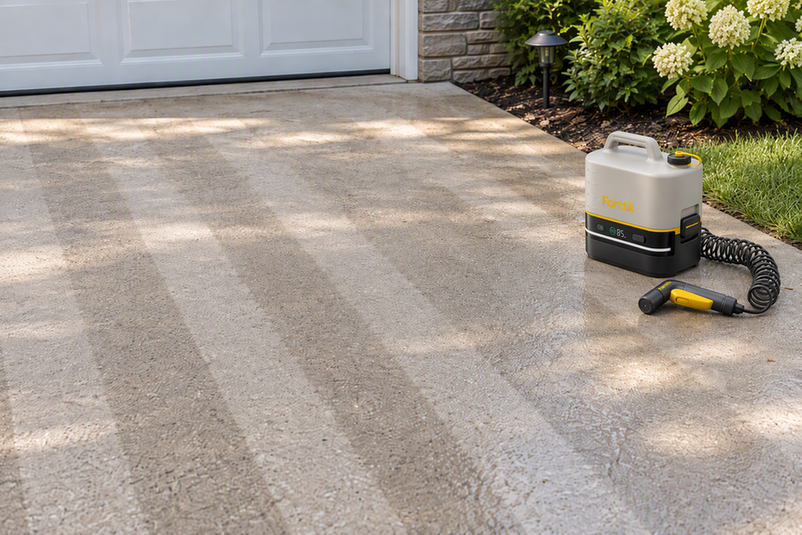
For batteries used in wet environments—such as those powering cordless pressure washers or tools used in the rain—our recommendation for any visible case breach is immediate decommissioning.
A breach of the outer shell creates a capillary path for humidity. Our thermal stress modeling shows that as a battery cools after use, it creates a slight internal vacuum. This vacuum can pull moisture through micro-cracks in a matter of minutes. Once inside, moisture leads to internal corrosion on the nickel strips. In our repair logs, we have observed that a compromised seal in high-humidity environments often leads to total pack failure within weeks rather than months, depending on usage intensity.
The "Safe Jump-Start" Context
Interestingly, the exterior of a battery being wet is not always the primary risk. According to research on Safe Jump-Starting in the Rain, moisture on the top of a battery is not a major spark risk because batteries are usually sheltered. However, this assumes the case is intact. If the case is cracked, rain becomes a conductor that can bridge terminals to internal circuitry, potentially bypassing the Battery Management System (BMS).
Structural Integrity vs. Cosmetic Blemishes
It is important to distinguish between "surface wear" and "structural failure" to avoid unnecessary disposal of safe equipment.
Cosmetic Damage
Aligned with general automotive standards like SAE J537, surface scratches (less than 0.5mm deep) in non-critical areas—such as the flat side panels—are generally considered cosmetic. These typically do not compromise the Ingress Protection (IP) rating.
Structural Failure (Immediate Action Required)
Damage is considered structural if:
- The crack is located on a seam or near a mounting point.
- The case shows swelling or "pillowing," indicating internal cell expansion.
- There is evidence of leakage or a sweet, chemical smell (electrolyte).
- The crack is in a load-bearing section, such as the locking clips or handle.
Methodology Note: This distinction is based on the EU General Product Safety Regulation (EU) 2023/988, which requires products to remain safe under "reasonably foreseeable conditions of use," including moderate impacts.
Battery Safety Inspection Checklist
Use the following table to document your inspection and determine the necessary action.
| Inspection Point | Observation | Risk Level | Recommended Action |
|---|---|---|---|
| Surface | Scratches < 0.5mm (No "catch") | Low | Monitor; safe to use. |
| Seams/Joints | Any visible separation or cracking | High | Decommission immediately. |
| Screw Posts | White stress marks or "blanching" | Moderate | Monitor; avoid high-vibration use. |
| Case Shape | Any "pillowing" or bulging | Critical | Isolate and recycle. |
| Environment | Used in rain/wet conditions with any crack | High | Decommission immediately. |
Modeling Note: Scenario Assumptions
To provide these recommendations, we modeled the life cycle of a typical outdoor power tool battery. This is a scenario model, not a controlled laboratory study, intended to illustrate environmental impacts.
Parameter Table: Winter Stress Model
| Parameter | Value | Unit | Rationale |
|---|---|---|---|
| Ambient Storage Temp | -10 | °F | Typical USDA Zone 5 winter low |
| Operating Temp Rise | 111 | °C | Estimated adiabatic rise during high-drain discharge |
| Peak Stress Factor | 3.45 | x | Calculated combined pressure and material tension |
| Material State | Brittle | N/A | Based on BCI power derating benchmarks at -10°F |
| Stress Cycles | 4 | count | Major freeze-thaw events per season |
Note: In reality, a cracked case may "vent" pressure, which prevents a full 3.45x buildup but facilitates the "suction" of moisture during the cooling phase.

Final Safety Protocols for Seasonal Gear
If your battery has failed inspection, follow these steps to manage the risk. A compromised lithium-ion battery should never be thrown in standard trash.
Immediate Mitigation
- Stop Charging: Never put a cracked battery on a charger. Heat accelerates crack propagation.
- Isolate: Place the battery in a non-combustible container (like a metal bucket or sand) away from flammable materials.
- Tape the Terminals: Use electrical tape to cover contact points to prevent accidental shorts during transport.
Responsible Disposal
Follow guidelines from organizations like Call2Recycle. In many regions, the EU GPSR mandates that manufacturers provide pathways for safe disposal.
Prevention for Next Season
- Climate-Controlled Storage: Store batteries indoors during winter to avoid embrittlement.
- Silicone Boots: Use protective sleeves to absorb impact energy on concrete.
- Regular Cleaning: Remove salt spray or mud. As noted in research on Battery Terminal Maintenance, terminal corrosion is often the first sign of a compromised seal.
By treating battery cases with the same respect as the tools they power, you ensure your gear remains an asset rather than a liability. Safety is a matter of disciplined inspection and knowing when the "math of trust" suggests it's time for a replacement.
Disclaimer: This article is for informational purposes only and does not constitute professional engineering or safety advice. Lithium-ion batteries are high-energy devices that can pose fire and injury risks if damaged. Always consult your tool's original manufacturer manual. If a battery is hot, smelling of chemicals, or swelling, contact emergency services or a hazardous waste professional immediately.
References
Continue reading
 Summer Heat Defense: Shielding Washer Batteries During Operation
A technical guide to shielding lithium-ion batteries in pressure washers from thermal degradation and shutdown during extreme summer...
Summer Heat Defense: Shielding Washer Batteries During Operation
A technical guide to shielding lithium-ion batteries in pressure washers from thermal degradation and shutdown during extreme summer...
 Troubleshooting Rapid Voltage Drops in Aged Outdoor Tool Cells
Covers SEI layer growth, internal resistance, cold temperature derating, and compliance with IATA/EU GPSR standards for safe battery...
Troubleshooting Rapid Voltage Drops in Aged Outdoor Tool Cells
Covers SEI layer growth, internal resistance, cold temperature derating, and compliance with IATA/EU GPSR standards for safe battery...
Leave a comment
This site is protected by hCaptcha and the hCaptcha Privacy Policy and Terms of Service apply.