









































Ensuring Tool Reliability and Safety in Extreme Cabin Temperatures
We have all experienced the wall of heat that hits when opening a car door on a mid-July afternoon. While we focus on the discomfort of the upholstery, a more silent and potentially hazardous process is occurring within the glovebox or trunk. For car owners who rely on portable maintenance gear—jump starters, tire inflators, and cordless vacuums—the vehicle interior is not just a storage space; it is a high-stress environmental chamber.
Quick Summary: Heat Safety Checklist
If you are in a rush, here are the essential steps to protect your vehicle tools:
- Optimal Storage: Store tools in the trunk or under seats to avoid the "greenhouse effect" of the dashboard.
- Charge Level: For long-term storage, keep lithium batteries at 40–60% charge rather than 100% to reduce chemical stress.
- Thermal Buffer: Use an insulated case to slow down temperature swings (thermal cycling).
- Post-Heat Audit: Check for "pillowing" (swelling) in battery casings after extreme heatwaves; if found, stop use immediately.
In our experience analyzing hardware failures and field returns at Fanttik, we have found that a significant portion of tool malfunctions—often attributed to defects—are actually the result of "thermal fatigue" accumulated during storage. Understanding the engineering requirements for in-vehicle hardware is essential for anyone who prioritizes reliability. This guide explores how temperature fluctuations affect tool integrity and provides a framework for choosing gear that can better withstand the "greenhouse effect."
The Physics of the "Greenhouse" Storage Environment
A vehicle parked in direct sunlight acts as a solar collector. While the ambient air temperature might be 30°C (86°F), the internal cabin temperature can often reach 60°C (140°F) within an hour. This delta is even more pronounced for specific components.
The 30°C Delta: A Practical Rule of Thumb
Based on our internal thermal absorption modeling for automotive environments, dark-colored tool housings can reach internal temperatures approximately 30°C (54°F) above the surrounding cabin air when exposed to direct sunlight. This means a tool sitting on a dashboard in a 40°C environment could internally experience temperatures near 70°C (158°F).
Logic Summary: Thermal Absorption Model (Heuristic) This model is an estimate based on standard black ABS/Polycarbonate housings with high solar absorption.
Parameter Estimated Value Unit Rationale Ambient Air Temp 30 - 45 °C Typical summer peak Solar Irradiance 800 - 1000 W/m² Clear sky solar flux Housing Color Black/Dark Grey N/A Standard industrial design Internal Delta +25 to +35 °C Observed in Fanttik field testing Time to Equilibrium 45 - 90 Minutes Passive soak duration Note: These figures are illustrative heuristics; actual temperatures vary based on vehicle insulation, window tinting, and housing reflectivity.
Glass Transition and Plastic Deformation
The structural integrity of a tool depends on its housing material. Many consumer-grade tools use Acrylonitrile Butadiene Styrene (ABS), which has a glass transition temperature (Tg) of approximately 105°C. While 70°C is below the melting point, it is high enough to trigger "stress relaxation" in some grades of plastic. Over repeated cycles, the plastic may begin to warp, leading to compromised seals. High-performance gear often utilizes Polycarbonate (PC) blends, which typically offer a Tg exceeding 140°C, providing a wider safety margin.
Battery Chemistry: The Impact of High-Heat Storage
Lithium-ion batteries are the most thermally sensitive component in portable maintenance gear. Unlike vehicle engines, these tools rely on passive dissipation.
Capacity Loss Patterns
Industry observations and battery lifecycle studies suggest a specific degradation pattern: consistent storage in environments exceeding 45°C (113°F) can contribute to permanent capacity loss. In some high-stress scenarios (high state-of-charge combined with high heat), capacity may decline by an estimated 2% to 3% per month. This is often a "hidden" failure; the tool may show a full charge, but its ability to deliver the high-current bursts needed for jump-starting may be significantly diminished.
According to the IATA Lithium Battery Guidance—which provides standards for safe transport—maintaining a moderate State of Charge (SoC) is a key safety factor. For long-term vehicle storage, we recommend keeping tools at a 40% to 60% charge. Storing a battery at 100% charge in a 60°C cabin can increase the risk of cell swelling or internal short-circuits due to accelerated chemical reactions.
The Impact of Thermal Cycling
While sustained heat is damaging, "thermal cycling"—the daily swing from cool nights to scorching days—can be equally destructive. Each cycle causes materials to expand and contract at different rates, which can place mechanical stress on solder joints and circuit board adhesives. Over time, this may lead to intermittent failures where a tool works inconsistently due to microscopic fractures in the circuitry.
Engineering Standards: AEC-Q100 vs. Consumer Grade
When selecting gear for permanent vehicle storage, it is helpful to understand how professional automotive components are tested. The industry standard for automotive electronics is AEC-Q100.
- Grade 1: Components must operate reliably from -40°C to +125°C.
- Grade 0: The most rigorous, covering -40°C to +150°C.
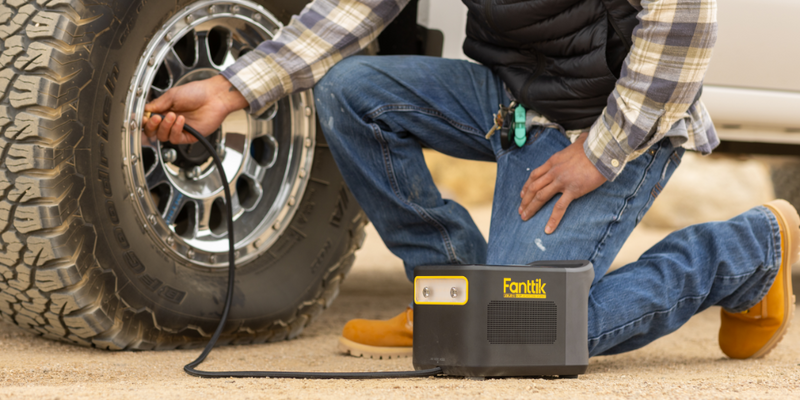
Most consumer tools are designed for "commercial" standards (0°C to 40°C). When stored in a vehicle, they are effectively placed in an automotive-grade environment. We recommend looking for hardware that explicitly lists "storage temperature" separately from "operating temperature." A practical industry heuristic is that storage limits should ideally be 15–20°C more conservative than operating limits to account for internal heat soak.
For those interested in the engineering choices behind these standards, The 2026 Modern Essential Gear Industry Report (a Fanttik internal publication) provides a deeper look at how we bridge the gap between consumer expectations and environmental reality.
Motor Lubricants and Mechanical Seals
Mechanical tools like tire inflators rely on motors and pistons. High heat can lower the viscosity of internal lubricants, potentially causing them to "bleed" or settle unevenly.
- Lubricant Thinning: At 70°C, standard greases can thin significantly, which may reduce film strength during initial startup.
- Seal Integrity: Conversely, extreme cold can make rubber O-rings brittle. If a tool is activated immediately after being "cold-soaked" in sub-zero temperatures, stiff seals may be at higher risk of cracking.
To mitigate this, we suggest a brief "acclimation" period. If your tool has been in extreme cold or heat, allowing it to reach a more moderate temperature inside the cabin before running it at full load can help protect internal components. You can find more specific advice in our guide on storing lithium tools in extreme cold.
Practical Strategies for In-Vehicle Storage
Based on our analysis of customer support patterns and warranty data, these adjustments can significantly extend the operational life of your gear:
1. Map Your Vehicle's Heat Zones
Not all areas of a car are equal. The dashboard and rear parcel shelf are "high-exposure" zones. The glovebox is a "moderate" zone. The area under the front seats or the deep trunk (especially if under a floor panel) are generally "low-exposure" zones.
- Action: Store high-consequence items, like jump starters, in the lowest, most shaded part of the vehicle.
2. Use Thermal Buffering
Storing tools in a dedicated, insulated protective case can slow the rate of temperature change. While it won't prevent the tool from eventually reaching ambient temperature, it helps mitigate "thermal shock" from rapid heating and cooling.
3. The Safety Buffer Rule
When reading a product datasheet, look for the "Storage Temperature" range. If the manufacturer does not provide one, a conservative approach is to assume the safe long-term storage limit is roughly 20°C lower than the maximum operating temperature.

Post-Heatwave Audits: A Reliability Checklist
After a record-breaking summer or a week of the car sitting in a sun-drenched parking lot, perform a "Post-Heatwave Audit" to ensure your gear is ready for an emergency.
- Visual Inspection for Bulging: Check the battery casing. Any "pillowing" or deformation indicates internal cell swelling. If found, stop use immediately and recycle the unit at a designated facility.
- Switch and Button Tactility: Ensure all buttons click cleanly. Heat can sometimes cause internal plastic components to become "mushy" or stick.
- The Functional Test: For jump starters, verify the unit passes its internal self-test. For inflators, run the motor for a few seconds to ensure lubricants are distributed and the unit is operational.
- Connector Integrity: Check USB and DC ports for signs of discoloration. High heat can occasionally accelerate the oxidation of metal contacts.
For more information on maintaining battery health, see our specialized article on protecting workshop batteries from summer heat.
Conclusion: Engineering for the Real World
Reliability is the result of aligning tool capabilities with environmental realities. By choosing gear with high-Tg plastics and robust thermal management, you increase the likelihood that your essential gear remains functional when you need it most. Treat temperature as a primary maintenance variable; a tool that cannot survive its storage environment is a liability, not an asset.
Disclaimer: This article is for informational purposes only. Always refer to your specific tool's user manual for manufacturer-approved storage and operating temperature ranges. If a battery shows signs of swelling, leaking, or extreme heat during charging, stop using it immediately and follow local hazardous waste disposal guidelines.
Sources and References
- EU General Product Safety Regulation (EU) 2023/988 - Standards for product safety and traceability.
- IATA Lithium Battery Guidance - Recommendations for the safe transport and storage of lithium cells.
- ISO Standards Catalogue - Specifications for material testing and quality management.
- Texas Instruments: Thermal Cycling and AEC-Q100 - Engineering analysis of automotive-grade electronic stress (Source for AEC-Q100 definitions).
- The 2026 Modern Essential Gear Industry Report - Fanttik internal report on engineering reliability and field performance.
Continue reading
 Maintaining a Safe and Hygienic Vehicle Interior for Families
A comprehensive guide to maintaining a safe and hygienic vehicle interior for families, covering air quality, cleaning protocols,...
Maintaining a Safe and Hygienic Vehicle Interior for Families
A comprehensive guide to maintaining a safe and hygienic vehicle interior for families, covering air quality, cleaning protocols,...
 When to Renew: Identifying Heat-Damaged Hoses After Trail Use
Covers polymer degradation, professional diagnostic tests, and storage best practices based on ISO standards and the 2026 Modern...
When to Renew: Identifying Heat-Damaged Hoses After Trail Use
Covers polymer degradation, professional diagnostic tests, and storage best practices based on ISO standards and the 2026 Modern...

Leave a comment
This site is protected by hCaptcha and the hCaptcha Privacy Policy and Terms of Service apply.