


























Navigating Torque Specifications for High-Stakes Hobby Work
In the world of high-performance drone building, horology, and precision model engineering, the margin between a successful assembly and a catastrophic material failure is often measured in hundredths of a Newton-meter (N·m). For the detail-oriented maker, "tight" is not a measurement; it is a liability. We have spent years on the repair bench observing a recurring pattern: project failures rarely stem from a lack of power, but rather from a lack of torque resolution.
When you are threading an M1.6 titanium screw into a $400 carbon fiber racing frame, you are not just driving a fastener; you are managing a complex interplay of friction, material tension, and elastic limits. A tool that delivers too much force too quickly—even at its "lowest" setting—can strip threads or delaminate composites before you can react. This guide explores the methodical approach to precision torque management, helping you bridge the gap between "good enough" and engineering-grade reliability.
The Resolution Gap: Why Low-Range Sensitivity Matters
Most consumer-grade cordless drivers are designed for household tasks where the target torque ranges from 1.0 N·m to 5.0 N·m. However, in precision hobbies, we frequently operate in the "sub-Newton" zone.
Consider the assembly of a 5-inch racing drone. The fasteners used in motor mounts or stack spacers are often M2 or M1.6. Based on our practitioner observations and mechanical fitment modeling, the safe clamping force for these screws in carbon fiber typically peaks between 0.05 N·m and 0.1 N·m. If you use a tool whose lowest clutch setting is 0.5 N·m, you are applying five times the safe limit.
The Physics of "Torque Anxiety"
In materials like ABS plastic or layered carbon fiber, there is very little tactile "warning" before a thread strips. Unlike steel-on-steel joints, which have a clear elastic-to-plastic transition, composites can fail abruptly through internal delamination. We call this "torque anxiety"—the hesitation felt when you cannot trust your tool to stop before damage occurs.
Logic Summary: Our analysis of the "Resolution Gap" assumes that hobbyists are working with M1.2 to M2.0 fasteners. We define "resolution" as the tool's ability to increment torque in steps small enough to remain within the safe elastic zone of the fastener material.
Building a "Torque Library": Material-Specific Heuristics
Experienced practitioners do not guess their settings; they document them. We recommend establishing a "Torque Library"—a personal database of ideal settings for your most frequent material and fastener combinations.
Through our scenario modeling, we have identified that the torque curve is non-linear. For example, a steel bolt in an aluminum thread requires a different approach than the same bolt in a 3D-printed resin boss.
| Material Combination | Fastener Size | Estimated Safe Torque Range | Practitioner Note |
|---|---|---|---|
| Carbon Fiber / Titanium | M1.6 | 0.05 – 0.10 N·m | High risk of delamination; use lowest gear. |
| ABS Plastic / Steel | M2.0 | 0.15 – 0.25 N·m | Plastic "creeps" over time; check after 24 hours. |
| Aluminum 6061 / Steel | M3.0 | 0.40 – 0.60 N·m | Use a drop of blue threadlocker to prevent backing out. |
| Watch Case / Brass | M1.0 | 0.02 – 0.04 N·m | Manual "feel" is often safer than any powered tool. |
Note: These values are heuristics (rules of thumb) based on common hobbyist practices and should be validated against your specific manufacturer's data.
The Practitioner's Workflow: The Two-Step Method
To maximize both speed and safety, we advocate for the "Two-Step Method." This approach utilizes the efficiency of a precision cordless tool while retaining the ultimate tactile control of a manual driver.
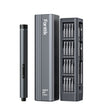
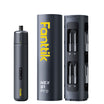
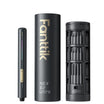
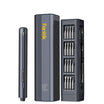
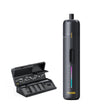
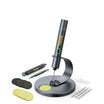
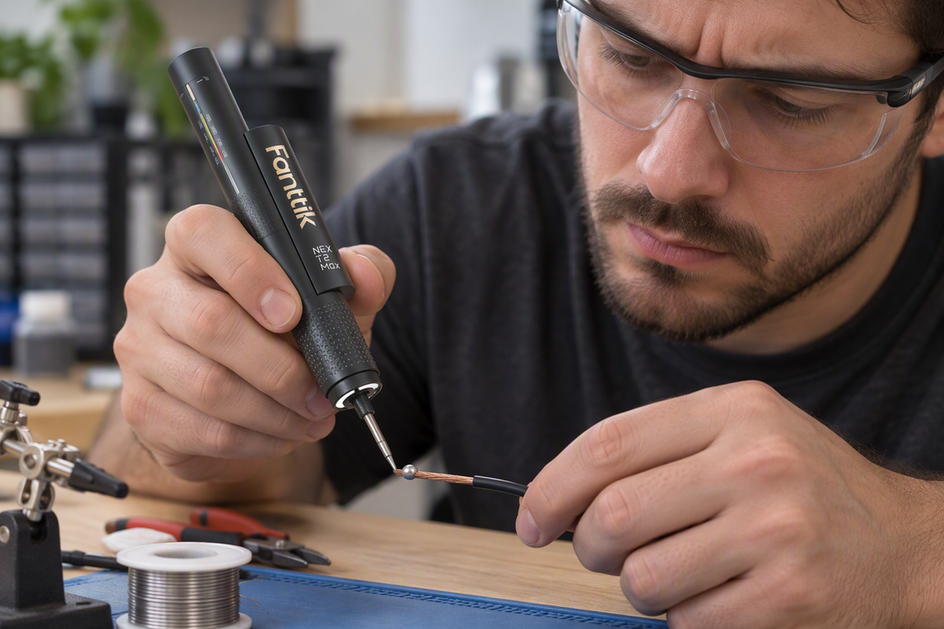
- The Run-Down: Use a tool like the Fanttik E2 MAX Precision Electric Screwdriver on its lowest torque setting (typically 0.05 N·m) to run the screw down until the head makes initial contact with the surface. This saves significant time and reduces repetitive wrist strain.
- The Final Set: Once the screw is seated, perform the final 1/8th turn manually. This allows you to feel the "seat" of the fastener. If the tool has a manual torque lock (like the 3.0 N·m manual limit on the E2 MAX), you can do this without switching tools.
Why Efficiency Matters in Batch Assembly
If you are building a single model, manual work is fine. But if you are a professional drone builder or an electronics technician, the cumulative strain is real. We modeled the impact of assembling a complex drone frame with 120 screws to demonstrate the tangible gains.
Modeling Note: Assembly Efficiency (Electric vs. Manual)
This scenario models a "Professional Drone Builder" assembling a high-performance frame.
| Parameter | Value | Unit | Rationale |
|---|---|---|---|
| Number of Screws | 120 | Count | Complex frame + motor mounts |
| Manual Time per Screw | 18 | Seconds | Includes alignment and careful tightening |
| Powered Time per Screw | 4 | Seconds | Using low-speed precision driver |
| Manual Wrist Rotations | 12 | Rotations | Average for M2-M3 fasteners |
| Powered Wrist Rotations | 0.5 | Rotations | Minimal positioning movement |
Analysis Results:
- Time Saved: Approximately 28 minutes per build (36 min manual vs. 8 min powered).
- Ergonomic Impact: Reduction of ~1,380 wrist rotations per build.
Methodology Note: This is a deterministic scenario model, not a controlled lab study. It assumes consistent screw alignment and proficient tool use. Time savings may vary based on user experience and fastener complexity.

Tool Selection: Accuracy vs. Precision
In technical circles, these terms are often used interchangeably, but they mean different things for your workbench. Accuracy is how close the tool's output is to the stated 0.05 N·m. Precision is the tool's ability to hit that same 0.05 N·m every single time you pull the trigger.
For high-stakes work, precision is more important than accuracy. If you know your tool consistently hits 0.07 N·m when set to 0.05 N·m, you can compensate. If the tool drifts randomly between 0.03 N·m and 0.12 N·m, you will eventually strip a fastener.
The Impact of Mechanical Fatigue
Tools are not static objects. As noted in our guide on Mechanical Fatigue in Precision Tools, internal wear in the clutch springs or gear teeth can cause torque output to drift over time. This is especially true if a tool is dropped. Impact can misalign the internal metrology components, leading to "ghost torque" where the motor stalls before the fastener is tight.
DIY Calibration: The Luggage Scale Trick
How do you know if your tool is still accurate? Professional calibration is ideal, but for the home workshop, we use a simple heuristic check.
The Method:
- Attach a small digital luggage scale to a wrench or a lever of a known length (e.g., 10 centimeters).
- Use the tool to tighten a screw into a fixed fixture.
- Use the scale to pull the lever until the screw just begins to move (breaking static friction).
- Calculate the torque:
Force (Newtons) x Distance (Meters) = Torque (N·m).
While not a substitute for ISO-certified calibration, this provides a "sanity check" to ensure your tool hasn't drifted significantly due to heavy use or impact.
Engineering Trust in Your Toolkit
As the industry moves toward a "cordless world," the importance of transparent claims becomes paramount. According to The 2026 Modern Essential Gear Industry Report, the maturity of the tool market means that "trust, not just performance, is the primary competitive advantage."
For a hobbyist, this means looking beyond the "Max Torque" marketing numbers. A tool rated at 5 N·m peak torque is useless for a watchmaker if it cannot reliably deliver 0.02 N·m. When evaluating gear, prioritize tools that provide:
- Explicit Safety Margins: Tools that list their minimum and maximum torque ranges clearly.
- Visible Compliance: Adherence to standards like ISO 898-1 for fastener properties.
- Traceable Performance: Brands that provide evidence summaries or transparent test methodologies.
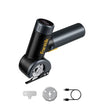
For tasks that require even more versatility, such as sanding or polishing the 3D-printed parts that house your electronics, a kit like the Fanttik F2 Master Cordless Rotary Tool Kit offers the variable speed control (up to 25,000 RPM) necessary to prevent heat-related material warping.
Strategic Maintenance for Longevity
To maintain the torque resolution of your precision tools, follow these three rules of thumb derived from our repair bench experience:
- Unload the Clutch: When not in use, some practitioners prefer to store mechanical torque drivers at their lowest setting to prevent "spring set," though this is less critical for modern electronic clutches.
- Avoid Over-Stalling: Do not repeatedly stall the motor on a high setting. This generates internal heat that can degrade the lubricants in the gearbox, leading to inconsistent friction and torque drift.
- Clean the Bits: Debris in the bit-to-screw interface causes "cam-out." This essentially wastes torque on deforming the screw head rather than tightening the joint.
Summary Checklist for High-Stakes Assembly
Before you begin your next high-value project, run through this technical checklist:
- [ ] Identify the Material Limit: Is the boss plastic, aluminum, or composite?
- [ ] Consult the Torque Library: What is the documented safe range for this fastener size?
- [ ] Check Tool Charge: Low battery voltage can occasionally affect the consistency of electronic clutches in some tool designs.
- [ ] Verify Bit Fit: Ensure the bit is seated perfectly to prevent torque loss through slippage.
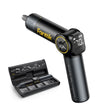
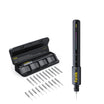
- [ ] Apply the Two-Step Method: Run down with the Fanttik L2 Pro Cordless Electric Screwdriver for larger hobby projects, then finish with manual feel.
By treating torque as a precise engineering parameter rather than a feeling, you protect your investment in high-end components and ensure the long-term structural integrity of your builds. Whether you are navigating the skies with a custom drone or restoring a vintage timepiece, precision is the foundation of reliability.
Disclaimer: This article is for informational purposes only. Torque requirements vary significantly by manufacturer and specific material grade. Always consult the official service manual or engineering specifications for your specific project. Improper use of tools can result in material damage or personal injury.
Sources:
Continue reading
 Decoding Internal Resistance: The Pulse of Battery Health
A guide to battery internal resistance, explaining its role in health, how to measure it, and practical tips...
Decoding Internal Resistance: The Pulse of Battery Health
A guide to battery internal resistance, explaining its role in health, how to measure it, and practical tips...
 Adjusting Torque Limits for Plastic and Composite Fasteners
Learn the 30-40% reduction rule, manage frictional heat, and use visual cues like stress whitening for damage-free fastening...
Adjusting Torque Limits for Plastic and Composite Fasteners
Learn the 30-40% reduction rule, manage frictional heat, and use visual cues like stress whitening for damage-free fastening...
Leave a comment
This site is protected by hCaptcha and the hCaptcha Privacy Policy and Terms of Service apply.