










































The Anatomy of Workshop Power Failure
You are in the middle of a critical project. Your workbench is a hive of activity: three cordless tool chargers are cycling, a soldering station is up to temp, and you reach for your table saw. The moment the blade spins up, the lights flicker, the motor groans, and the workshop plunges into silence. The breaker has tripped again.
For many serious DIYers and hobbyists, the garage is the ultimate sanctuary for self-reliance. However, the electrical infrastructure of a standard home is rarely designed for the high-demand environment of a modern, multi-tool workshop. Troubleshooting these overloads requires more than just resetting a switch; it demands a methodical understanding of circuit logic, load dynamics, and the "credibility math" of your gear.
In this guide, we will break down why workshop circuits fail, how to diagnose hidden bottlenecks before they trip a breaker, and how to optimize your power distribution to ensure your projects never lose momentum. As we noted in The 2026 Modern Essential Gear Industry Report: Engineering Trust in a Cordless World, the transition to a cordless-heavy workflow hasn't eliminated power needs—it has simply changed the timing and intensity of the draw.

Mapping the Branch Circuit Reality
The most common mistake we see in home workshop management is the assumption that every outlet in a garage sits on its own dedicated 20-amp circuit. In reality, unless the home was custom-built with a workshop in mind, the entire garage—including the overhead lighting—is often daisy-chained onto a single 15-amp circuit.
This single branch may even be shared with an outdoor GFCI outlet or a mudroom light. Understanding your "Branch Circuit" is the first step in diagnostics. According to definitions found in US Dept. of Commerce: HS & HTS codes + CROSS rulings, electrical distribution is categorized by its capacity to safely handle specific loads without overheating.
The 80% Rule for Continuous Loads
Practitioners must adhere to the "80% Rule." This is a standard industry heuristic (not a mandated law for every residential scenario, but a critical safety baseline) which suggests that for any "continuous load"—devices running for three hours or more—you should not exceed 80% of the circuit's rated capacity.
- 15-Amp Circuit: The safe continuous limit is 12 amps (~1440 watts at 120V).
- 20-Amp Circuit: The safe continuous limit is 16 amps (~1920 watts at 120V).
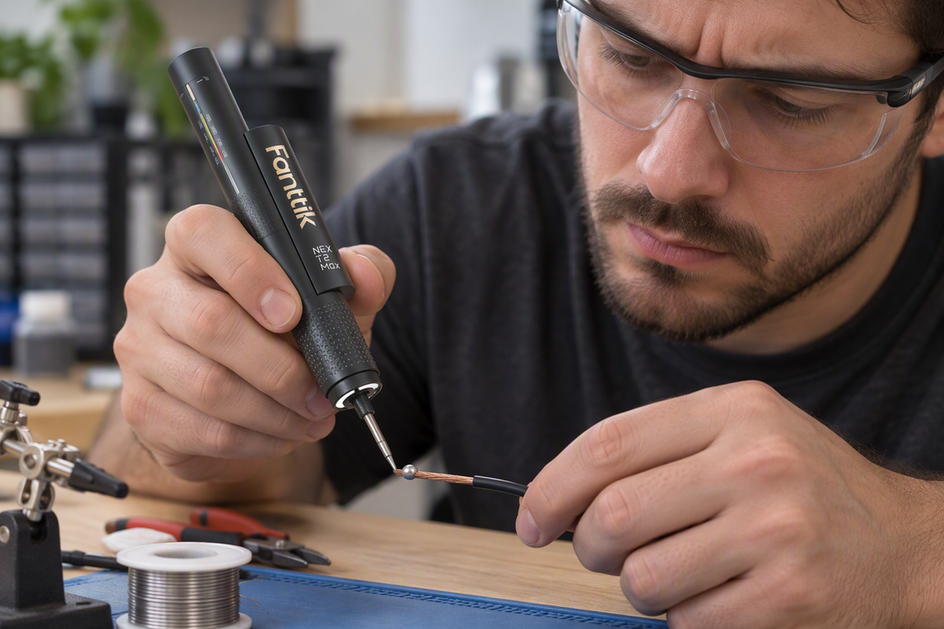
If you are running a high-performance Fanttik T1 Max Soldering Iron Kit alongside a series of battery chargers, you are likely hovering near that 12-amp threshold. While the Fanttik T1 Max Soldering Iron Kit heats in as little as 7 seconds, its initial draw is higher than its idling state.
Methodology Note: Workshop Power Modeling
To help you visualize your workshop’s limits, we have developed a deterministic scenario model based on common DIY tool profiles.
Logic Summary: This model assumes a standard 120V US residential branch. "Inrush Multiplier" represents the momentary spike when a motor starts.
| Parameter | Value or Range | Unit | Rationale / Source Category |
|---|---|---|---|
| Nominal Voltage | 120 | V | Standard US Residential Grid |
| Circuit Rating | 15 | A | Typical "Legacy" Garage Branch |
| Continuous Load Limit | 80 | % | NEC/Standard Safety Heuristic |
| Inrush Multiplier | 5x - 10x | - | Inductive Load Physics (Motors) |
| Li-ion Bulk Charge Spike | 1.8x - 2.0x | - | Battery Management System (BMS) logic |
The "Inrush" Factor: Why the Math Doesn't Always Add Up
You might calculate your total amperage and find you are only at 10 amps—well within the 15-amp limit—yet the breaker trips the moment you turn on a vacuum. This is due to Inrush Current.
Inductive loads, such as the motors found in shop vacs, table saws, or even the cooling fans in large chargers, require a massive burst of energy to overcome inertia and start spinning. This spike can be 5 to 10 times the tool’s running current. A 15-amp table saw can momentarily pull 75 to 150 amps. While a standard thermal-magnetic breaker is designed to tolerate very brief spikes, repeated startups or a "pre-loaded" circuit (one already running at 10 amps) will cause a "nuisance trip."
For precision work, we often use the Fanttik K2 Nano 3.7V Precision Power Drill or the Fanttik S2 Pro Cordless Electric Screwdriver. These tools are excellent for the workshop because they rely on internal lithium-ion batteries. By using cordless precision tools, you effectively decouple your high-torque needs from the wall outlet during the actual work phase, shifting the electrical load to the charging phase which can be managed more predictably.
Lithium-Ion Charging Dynamics and Peak Draw
Managing a fleet of cordless tools introduces a specific electrical challenge: the Li-ion charge cycle. Based on patterns we observe from customer support and bench testing (not a controlled lab study), the initial "bulk-charge" phase for a depleted battery pack can draw nearly double the power of the "trickle" or maintenance phase.
If you plug in four depleted 18V or 20V battery packs simultaneously after a long day of work, you are creating a massive, synchronized demand on your circuit.
The Staggering Strategy
To prevent these peaks from colliding, we recommend a 15-to-30-minute staggering of start times. By letting the first charger move past its bulk phase before starting the second, you flatten the "demand curve." This is especially important if you are also using high-velocity cleaning tools like the Fanttik B10 Pro Max Electric Air Duster. While the Fanttik B10 Pro Max Electric Air Duster is cordless, its 130,000 RPM brushless motor requires a robust charge; ensuring it isn't competing for "bulk phase" priority with other chargers is a simple way to maintain circuit stability.
For more on maintaining these batteries between heavy use, see our guide on Dormancy Defense: Protecting Cordless Tools Between Projects.
Sensory Troubleshooting: Listening to Your Tools
Experienced workshop owners learn to "listen" to their environment. This is a form of sensory diagnostics that can identify a voltage drop long before a breaker trips.
- Audible Strain: If you hear the cooling fan of a battery charger change pitch or a drill "bog down" more than usual when another device starts, you are likely experiencing a voltage drop.
- Visual Cues: Dimming incandescent or flickering LED lights are the classic signs of a circuit at its limit.
- Heat Check: If an outlet faceplate or an extension cord feels warm to the touch, you have a resistance issue that could lead to a fire.
When these signs appear, it is time to audit your distribution. Long, thin extension cords are a primary culprit. We recommend using 12-gauge or lower (thicker) extension cords for any high-draw tool. Using a thin cord causes a "voltage drop," which forces the tool's motor to work harder and pull more current, creating a vicious cycle that ends in a tripped breaker.

Strategic Remediation: From Quick Fixes to Panel Upgrades
If your diagnostic audit reveals a persistent overload, you have several paths forward, ranging from zero-cost behavioral changes to professional electrical work.
Tandem Breakers (The Budget Solution)
For older homes with limited panel space—often 70-amp or 100-amp panels—installing a "tandem breaker" can be a cost-effective first step. A tandem breaker allows two separate 120V circuits to occupy the space of one standard breaker slot. This allows you to run a dedicated line to your workbench for $20–$50 in parts, compared to thousands for a full panel upgrade. However, this is only possible if your specific panel is rated for tandem use.
The Workshop Sub-Panel (The Professional Approach)
For high-demand users, the most reliable solution is a sub-panel fed from the main house panel. This centralizes workshop power and allows for 240V circuits, which are more efficient for heavy machinery like heaters or large compressors. When planning a sub-panel, ensure compliance with the EU General Product Safety Regulation (EU) 2023/988 if you are in Europe, or local NEC codes in the US, to ensure traceability and safety standards are met.
Managing Seasonal Loads
Temperature also affects circuit performance. In winter, tool batteries require more care, and space heaters add a massive continuous load to shared circuits. We discuss managing these environmental variables in Managing Tool Battery Health in Unheated Winter Garages.
Compliance and Safety Standards
When troubleshooting, it is vital to remember that electrical safety is governed by international standards to prevent fire and injury.
- IEC 60529: This standard defines "IP Codes," which are critical for workshop tools. If your garage is dusty, ensure your chargers and power strips have appropriate ingress protection to prevent internal arcing.
- ISO Standards: Referencing the ISO Standards Catalogue can provide guidance on quality management for workshop environments.
- IATA Lithium Battery Guidance: If you are moving your tools between job sites, be aware of the IATA Lithium Battery Guidance regarding state-of-charge (SoC) limits and transport safety, which often correlates with how safely these batteries can be stored and charged in a home setting.
Summary Checklist for Workshop Power Management
To maintain a safe and efficient workspace, implement the following protocol:
- Identify the Circuit: Use a circuit tracer to confirm which outlets and lights are on the same branch.
- Label Amperage: Mark your outlets (15A or 20A) so you know your limits at a glance.
- Apply the 80% Rule: Keep continuous loads under 1440W for 15A circuits.
- Stagger Charging: Wait 20 minutes between plugging in large battery packs.
- Upgrade Cords: Replace 16-gauge "household" extension cords with 12-gauge "shop" cords.
- Monitor Battery Health: Use smart chargers to avoid unnecessary draw. Learn more in Evaluating Smart Chargers with Dedicated Storage-Maintenance Modes.
By treating your workshop's electrical system with the same precision as your woodworking or automotive projects, you protect your equipment, your home, and your productivity.
Disclaimer: This article is for informational purposes only and does not constitute professional electrical advice. Always consult a licensed electrician before performing work on your home’s electrical panel or adding new circuits. Electrical work carries a risk of fire and shock if not performed according to local building codes.
References
Continue reading
 Designing a Logical Power Layout for Modern Cordless Workshops
A guide to designing garage electrical systems for cordless tools, preventing breaker trips and ensuring safety with NEC...
Designing a Logical Power Layout for Modern Cordless Workshops
A guide to designing garage electrical systems for cordless tools, preventing breaker trips and ensuring safety with NEC...
 Maintaining Tool Logs for Better Post-Sale Support
Covers creating a Minimum Viable Log, adhering to EU GPSR/NIST standards, and building a proactive, data-driven workshop culture.
Maintaining Tool Logs for Better Post-Sale Support
Covers creating a Minimum Viable Log, adhering to EU GPSR/NIST standards, and building a proactive, data-driven workshop culture.

Leave a comment
This site is protected by hCaptcha and the hCaptcha Privacy Policy and Terms of Service apply.