












































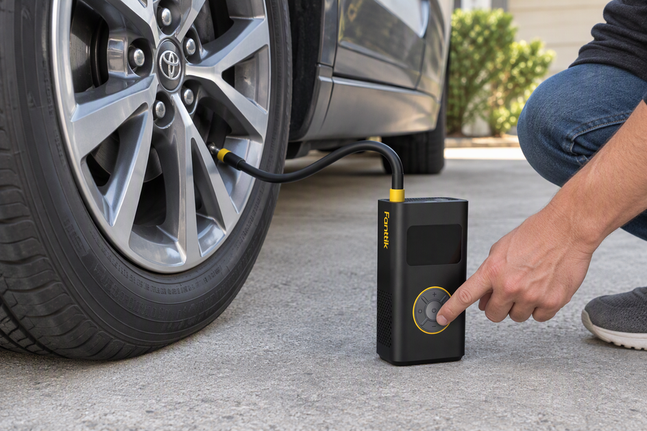
For routine top-ups, a digital tire inflator with pressure gauge may be enough if convenience is your priority. You can check pressure and add air with one tool. A separate gauge gives you another reading to compare, but that doesn't automatically make either reading more accurate.
The choice is between fewer steps and a second reading to check against. But when two readings disagree, a second gauge can't tell you which one is right.
Is a Built-In Tire Gauge Enough for Routine Top-Ups?
Yes, if you want a quick, simple top-up. Choose based on what you need from the reading, not on which type of gauge sounds more precise.
| Your priority | Setup that fits |
|---|---|
| Fewer steps for regular top-ups | Inflator's built-in gauge |
| A second reading to compare | Add a separate gauge |
| A proven, accurate reading | Gauge type alone can't establish accuracy |
The built-in display puts the reading right where you're working. Attach the chuck, watch the number, and stop when you reach your target. Fewer steps can make regular checks and top-ups easier to keep up with.

A separate tire pressure gauge gives you another reading to compare. That can be useful if you want a cross-check or share a gauge across several vehicles. But a second reading isn't proof that either tool is correct. The reviewed sources do not confirm that one gauge design or product documentation reliably establishes accuracy for consumer tire tools.

What Pressure Should You Compare Against?
Compare the reading with your vehicle's recommended pressure, not a general PSI number. NHTSA explains where to find the recommended pressure: on the vehicle's tire information placard, certification label, or in the owner's manual.
That recommendation is for a cold tire. NHTSA defines a cold tire as one that hasn't been driven for at least three hours. For a fair comparison with the recommended number, check the tire under that same condition.
The recommended pressure tells you what to aim for, but not which gauge is reading correctly. Our guide to proper tire inflation explains why getting close to the placard number matters for safety and fuel economy.
What Evidence Supports Confidence in a Gauge Reading?
The authoritative sources reviewed did not compare built-in inflator gauges against separate gauges to establish which category is more accurate, nor do they define an established consumer calibration standard for either type.
Independent testing shows that gauges in the same category can give different results. Consumer Reports found accuracy varied among the 17 handheld tire pressure gauges it tested. The tests covered room temperature, hot and cold extremes, and a fall from a tabletop. They included handheld gauges only, not gauges built into inflators. The results show that a separate gauge isn't automatically an accurate one.
An accuracy figure on a product page or box is the manufacturer's claim, not an independent check of your particular gauge.
NIST's general criteria for metrological traceability call for a documented, unbroken chain of calibrations, stated uncertainty for each measured value, a measurement system that is understood and under control, and dates and details for every link in the chain. These criteria outline general metrological traceability principles rather than a consumer tire-gauge standard, so they do not validate or certify individual tire-pressure gauges.
What If the Two Readings Disagree?
When readings are taken under identical pressure conditions, a mismatch indicates that at least one reading is off, though it does not show which one. If the readings were taken at different temperatures or times, they cannot be directly compared to evaluate gauge error. The authoritative sources reviewed don't establish a tested way to decide which reading to trust when an inflator display and a separate gauge disagree. Until you can identify a reliable reading, treat the tire's pressure as unconfirmed.
Available evidence does not provide a verified rule to determine which gauge is correct during a discrepancy. Do not average the numbers, as averaging combines unknown errors instead of resolving them. A higher retail price or longer ownership also does not prove one reading is accurate.
For a fair comparison, take both readings under the same conditions. A cold reading and one taken after driving aren't directly comparable. Even a matched cold comparison shows only that the readings differ; it doesn't identify the correct gauge.
The reviewed sources provide no verified field procedure to resolve a conflict between two gauges. For general upkeep, our tire maintenance tips cover care beyond gauge checks. If you find a low tire mid-trip, our guide on handling a low tire explains when to add air and when to call roadside assistance.
FAQs
Can I rely on the reading from my inflator's built-in gauge?
For routine top-ups, the built-in display is convenient because you can watch the pressure as you add air. To judge how much to trust its reading, check its stated accuracy and any calibration records. A built-in gauge isn't automatically more or less accurate than a separate one.
Does checking with a separate gauge prove my inflator is accurate?
No. Matching readings mean the two tools agree; they don't prove either one is accurate. Independent testing found accuracy varied among handheld gauges, so a separate gauge isn't automatically a reliable reference.
Should I split the difference when two gauges show different numbers?
No. Averaging combines unknown errors instead of correcting them. Because existing consumer guidelines do not provide a verified rule to prove which device is right, treat the actual tire pressure as unconfirmed.
Does a higher maximum PSI mean a more accurate gauge?
No. Maximum pressure tells you how high an inflator can pump, not how closely its gauge matches the tire's actual pressure. Accuracy is a separate specification, and the documentation behind it matters.
Which pressure should the digital tire inflator with pressure gauge be set to?
Set it to your vehicle's recommended cold pressure, listed on the tire placard, certification label, or in the owner's manual. Use that figure—not the maximum pressure printed on the tire sidewall or a general rule of thumb.
Continue reading
 Cleaning a Pet Travel Carrier With a Car Vacuum
A step-by-step method for lifting loose dry fur and crumbs from a hard-sided travel carrier with a car...
 How to Choose Between a Portable Tire Inflator and Roadside Assistance
A driver's guide to choosing between topping up a low tire yourself and calling roadside help, based on...

Leave a comment
This site is protected by hCaptcha and the hCaptcha Privacy Policy and Terms of Service apply.