









































Yes, sometimes. A heat gun may soften the adhesive under an intact sticker and help it peel away. That still doesn't show that heat is safe for the surface underneath, and it won't necessarily clear the sticky film left behind.

Before you use heat, you need three answers. What exactly is the surface and its finish? What is near the work area? What does the manual for your heat gun allow? If you can't answer any of these, skip the heat for now.
Can Heat Help Remove a Sticker or Adhesive?
Heat can help with one specific job: loosening a sticker that is still whole, so it lifts more easily. That is a narrow yes when using a tool such as our cordless mini heat gun. It is not a promise that every sticker will come off cleanly, and it is not a general method for every object in your home or shop.
Think of heat gun sticker removal as two separate tasks. The first is lifting the sticker itself, meaning the paper, vinyl, or film layer plus most of its glue. The second is cleaning up any adhesive residue that stays on the surface after the sticker is gone. A method that helps with the first task doesn't automatically solve the second. If you've already peeled the sticker and only a tacky layer remains, you're dealing with a residue problem, and you should treat it as its own decision.

Getting a sticker to lift also tells you nothing about how the surface below reacts to heat. A sticker can come off while the finish under it changes. So the useful question isn't just "Will heat work on the sticker?" It is "Can this surface take heat at all?" The next two sections answer that.
What Surface and Finish Are You Heating?
No general rule says a surface is fine to heat just because it's a common household material. The decision depends on the exact base material and whatever covers it, and you need documented heat limits for that combination before heat makes sense.
Start by separating two layers. The substrate is the base material, such as metal, glass, wood, or a type of plastic. The finish is what sits on top: paint, clear coat, sealant, laminate, a printed layer, or another coating. The finish may tolerate heat very differently than the base, so "it's metal" doesn't settle the question if the metal is painted. Use this sequence:
- Name the substrate precisely. "A plastic bin" is too vague. Look for a material code, a product label, or the maker's product page that identifies what the object is made of.
- Name the finish on top of it. Note whether the area under the sticker is painted, coated, sealed, printed, or bare. If you can't tell, treat the finish as unknown.
- Find a heat limit from the maker of that surface. Care guides, spec sheets, or cleaning instructions for the object, the paint, or the coating are the right places to look. General tips about removing stickers don't count, because they aren't written for your surface.
- Match the limit to what you plan to do. A documented limit only helps if it covers direct heat exposure like the kind a heat gun produces.
- No limit found, or the limit rules out heat? Don't use heat. An unknown tolerance is a no-go, not a green light to try a little and see.
This step matters most for heat gun on painted surfaces and other heat-sensitive surfaces, where the finish is the part you most want to protect. If you can't get a clear answer, go straight to a non-heat option that is documented for your exact surface (see the FAQs below).
What Around the Work Area Could Rule Out Heat?
Even when the surface checks out, the space around it can rule out heat. Your specific tool's instructions set the rest of the limits.
Nearby combustible or flammable materials
This is a firm stop. Princeton University's Environmental Health and Safety office advises against using a heat gun around combustible or flammable materials. If the sticker is on or near something that can burn, or the air may hold flammable vapors, don't use a heat gun there. Move the object to a clear area if you can. If you can't move it, choose a non-heat method.
The specific heat-gun instructions
Operating limits and warnings come from the manual for the exact heat gun you own. That includes how close to hold it, how long to aim at one spot, which nozzle to use, and which settings are allowed. Those details vary between models, so a number from someone else's tool or a general tutorial doesn't carry over to yours. If you don't have the manual, find it using the model number on the tool's label before you start. If you still can't get it, don't guess at a setting.
For background, our guide to heat gun controls explains what temperature control, airflow, and nozzles do on a heat gun. It helps you understand the settings, but your model's manual still sets the actual limits. A manual also only covers the tool. It won't tell you whether your surface can handle heat, so the surface check above still applies.
FAQs
Can a heat gun remove adhesive residue after the sticker is gone?
Don't assume it can. Leftover residue is a different job from lifting an intact sticker, and a sticker that peeled well with heat is no proof that heat will clean off the film it left behind. Handle residue as its own step, using instructions written for your specific surface and, when available, the type of adhesive. If the surface is glass, there are documented non-heat options, covered in the last question below.
Is there a universal heat-gun temperature for sticker removal?
No single temperature applies to every tool and every surface. The right setting depends on two things you have to look up: the limits in your heat gun's manual and the documented heat tolerance of the surface and finish you're working on. A number that isn't tied to both of those is guesswork. If either one is missing, the safer choice is to skip heat instead of picking a setting.
What should I do if heat is not suitable for the surface?
Switch to a non-heat method that is documented for that exact surface and finish. For sticker residue on glass, CRC's sticker residue guide lists warm soapy water, rubbing alcohol, and white vinegar as options. It also advises testing any cleaning solution on a small, hidden spot of the glass first. CRC sells its own adhesive remover, and its glass advice covers glass only. For painted, coated, plastic, or other surfaces, look for cleaning instructions from the maker of that object or finish before using any product on it.
Continue reading
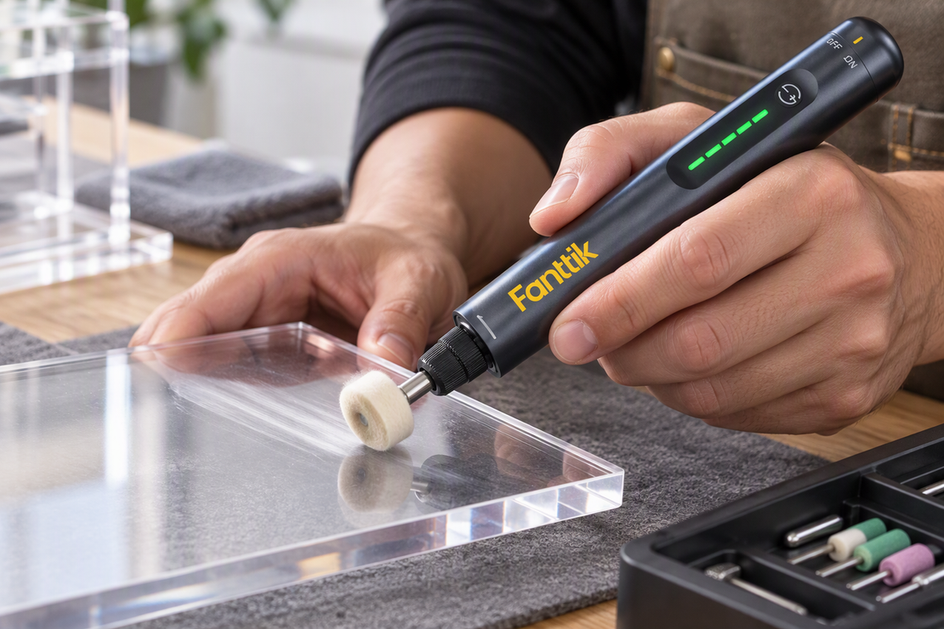 Polishing Plastic and Acrylic with a Rotary Tool: How to Avoid Melting and Swirls
A practical plan for buffing acrylic with a rotary tool: confirm the plastic, pick compound and speed, run...
Polishing Plastic and Acrylic with a Rotary Tool: How to Avoid Melting and Swirls
A practical plan for buffing acrylic with a rotary tool: confirm the plastic, pick compound and speed, run...
 How to Choose a Soldering Iron for Hobby Electronics
A task-first guide for hobby makers: why pencil-style irons suit general PCB work, how set point differs from...
How to Choose a Soldering Iron for Hobby Electronics
A task-first guide for hobby makers: why pencil-style irons suit general PCB work, how set point differs from...
Leave a comment
This site is protected by hCaptcha and the hCaptcha Privacy Policy and Terms of Service apply.