






















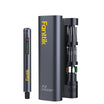
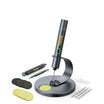
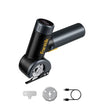

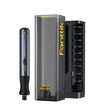

There's no single torque number that's safe for every piece of particle-board furniture. Published lab testing shows particle-board screws typically seat between about 5.8 and 17.2 in-lb, while stripping starts anywhere from 18.0 to 57.6 in-lb depending on the screw, hole, and panel tested. The practical rule that works across that spread is simple: start your electric screwdriver on its lowest controllable clutch setting, stop the moment the joint closes, and finish the last quarter-turn by hand instead of chasing more torque.
That rule matters because particle board has far less holding strength around a screw thread than solid wood. Once you understand where seating ends and stripping begins, you can set up your driver correctly before the first screw ever goes in.
What Torque Should You Use on Particle Board Furniture?
Particle board doesn't have one universal torque limit, but two independent lab studies give you a usable reference window. Both found that the torque needed to seat a screw is well below the torque that strips the hole, which is the real number to avoid.
What the Published Torque Ranges Actually Mean
| Study setup | Mean seating torque | Mean stripping torque | How to use it |
|---|---|---|---|
| Controlled particle-board test | 7.7–14.6 in-lb (0.87–1.65 N·m) | 24.0–46.0 in-lb (2.71–5.21 N·m) | Seating range is your realistic target; stripping range is a failure point, not a goal |
| Independent particle-board test | 5.8–17.2 in-lb (0.66–1.94 N·m) | 18.0–57.6 in-lb (2.03–6.51 N·m) | Wider spread confirms no single fixed setting applies to every panel or screw |
These figures come from a controlled particleboard study and a separate EPA-indexed particleboard study, each testing specific screws, panels, and pilot holes in a lab, not your exact furniture kit. Treat both ranges as evidence that stripping happens well above seating, not as a torque number to dial into your driver.
Why Maximum Torque Is the Wrong Setting
A screwdriver's maximum torque, its powered clutch setting, and the manual torque you can apply by hand are three separate numbers, and none of them converts directly into a "particle board setting." A clutch ring numbered 1 through 20 is a relative scale, not a calibrated newton-meter reading, so setting 5 on one driver isn't the same as setting 5 on another. The only target that matters in practice is seating the joint: getting the screw head to sit flush and the parts to pull tight, then stopping.
Which Joint and Tool Variables Change the Setting?
The right powered setting shifts with the joint you're fastening, not just the panel material. Be more conservative any time the joint looks smaller, thinner, or less supported than a typical broad-face connection.

Face, Edge, and Joint Location Matter
Testing found higher torque values on particle-board faces than on edges, which means edge and edge-adjacent screws have less material holding the threads. Treat any edge, corner, or narrow-rail joint as more sensitive to overdriving than a broad flat panel. Keep the piece firmly supported and the bit square to the screw so the fastener isn't forced sideways as it enters the edge.
Screw Depth and Pilot Holes Change the Result
In the same research, increasing screw penetration from about 12.7 mm to 19.1 mm raised both the seating and stripping torque measured in that setup. That means a longer screw or deeper pilot hole isn't automatically safer at a higher clutch setting; it changes the whole torque curve. Use the exact screws and factory-drilled holes supplied with the furniture rather than swapping in a longer fastener or widening a hole, unless the assembly instructions call for it.
Tool Capabilities That Improve Control
The best electric screwdriver for particle-board assembly isn't the one with the highest maximum torque; it's the one that lets you stop precisely at seating. Before you buy or reach for a driver, confirm it offers:
- Adjustable low-end torque or clutch settings, not just a high maximum rating
- Low-speed operation with a trigger or button that allows short, controlled bursts
- The correct bit type and size seated fully in the screw head
- A manual or hand-driving mode available for the final turns
A high maximum torque spec alone doesn't prove a driver is a good fit for particle board; without a verified low-end clutch scale, treat any numbered setting as a starting point to test, not a guarantee. Our furniture torque guide walks through setting selection for cams and chipboard hardware if you want a second reference point.
When Should You Stop Powering and Hand-Finish?
Stop the motor as soon as the joint closes and the screw head reaches its intended position, not when the driver simply stalls. A screw that's still turning isn't necessarily still improving the joint; past seating, extra powered torque trades holding strength for damaged fibers.
The Stop Conditions to Watch For
- Normal stop: the joint faces come together and the screw head sits flush or at its designed depth.
- Early warning: resistance rises suddenly, faster than the smooth increase you felt while driving.
- Immediate stop: the bit slips out of the screw head, the fastener spins without tightening, or you see the surrounding fibers deform or crumble.
Any of the last two conditions means stop the trigger right away and reassess before continuing.
How to Hand-Finish Without Stripping the Hole
Release the trigger once the joint is close to seated, then keep the correct bit fully engaged and square to the screw head. Apply firm, steady downward pressure and turn in short, controlled increments until the joint feels snug, not maximally tight. If the screw spins without tightening at any point, stop powered driving entirely and inspect the hole instead of trying to force it closed with more torque; repeated powered driving on a spinning screw makes the hole larger, not tighter.
A Short Assembly Checklist for Stable Flat-Pack Joints
Run through this sequence for each joint to keep particle-board fasteners seated correctly the first time.

- Match the screw and bit size to the hardware sheet before you start.
- Seat the bit fully and squarely in the screw head.
- Align and support the panels so the screw enters straight, especially near edges.
- Set the driver to its lowest controllable clutch or torque setting.
- Drive in short bursts, checking joint closure between each one.
- Stop the moment the joint seats, or immediately if resistance spikes, the bit slips, or the screw spins.
- Hand-finish the last turns and confirm the head sits flush, the joint is tight, and the panel shows no visible fiber damage.
If every screw in the joint passes that final check, the assembly is ready for the next panel.
FAQs
Can I convert a screwdriver clutch number into a particleboard torque limit?
No. Numbered clutch rings provide relative steps for that specific tool rather than a universal torque reading, meaning identical numbers deliver different force across various models. Start at the lowest setting that drives the screw cleanly toward seating, and never treat the tool's maximum rating as an assembly goal.
What should I do if a furniture screw spins without tightening?
Stop powered driving immediately rather than continuing to drive the same hole. Keep the bit aligned and check whether the screw is engaging any thread material at all; if it isn't, follow the furniture manufacturer's repair method, such as a larger screw, an insert, or wood filler, before attempting to retighten. Driving the same stripped hole with more torque only enlarges it further.
Why is an impact driver a poor choice for particle board furniture?
Impact drivers apply rotational concussions designed to drive large fasteners into dense lumber, delivering sudden torque spikes that can easily exceed the material's stripping threshold. Particle board lacks the resilient grain of solid wood, so high-impact pulses instantly crush the compressed core fibers and strip out the factory pilot holes.
Continue reading
 Cold Solder Joint Symptoms: How to Identify and Reflow Dull, Grainy Solder Connections
See the visual signs of a cold solder joint, the likely causes, and a safe flux reflow sequence...
Cold Solder Joint Symptoms: How to Identify and Reflow Dull, Grainy Solder Connections
See the visual signs of a cold solder joint, the likely causes, and a safe flux reflow sequence...
 Pop Up Camping Tent Wind Resistance: How to Stake and Guy Down Instant Frames in Gusts
A practical anchoring order for pop-up tents: stake windward first, angle stakes correctly, tension guy lines, and know...
Pop Up Camping Tent Wind Resistance: How to Stake and Guy Down Instant Frames in Gusts
A practical anchoring order for pop-up tents: stake windward first, angle stakes correctly, tension guy lines, and know...

Leave a comment
This site is protected by hCaptcha and the hCaptcha Privacy Policy and Terms of Service apply.