








































The Invisible Bridge: Why Sawdust and Electricity Don't Mix
In the quiet hours after a long day of milling pine or sanding oak, a home workshop can feel like a sanctuary. However, beneath the layer of fine dust lies a significant electrical hazard that most DIYers overlook. Fine wood particles are not merely a respiratory nuisance; they are highly hygroscopic. This means they actively absorb moisture from the ambient air. When this moisture-laden dust settles into electrical outlets or onto tool charging contacts, it creates a "conductive paste."
This paste acts as a bridge, allowing tracking currents to move across surfaces that are designed to be insulators. Over time, this leads to ground faults, increased resistance, and, in extreme cases, electrical fires. We have observed through various patterns in workshop maintenance that the most dangerous debris isn't the large shavings under the table saw, but the micron-sized particles that find their way inside your electrical enclosures.
Maintaining clean power contacts is a cornerstone of what we call "Engineering Trust" in a cordless world. As outlined in the industry whitepaper The 2026 Modern Essential Gear Industry Report: Engineering Trust in a Cordless World, the reliability of modern gear is a function of how well we manage the environment in which it operates. This article provides a methodical, expert-led framework for keeping your workshop’s electrical infrastructure safe and efficient.
The Science of Workshop Electrical Hazards
To understand the risk, we must look at the electrical resistivity of common materials. Pure wood is a decent insulator, but wood dust—especially from species like pine or oak—behaves differently once it interacts with workshop humidity.
The Conductive Paste Mechanism
When fine dust accumulates inside an outlet, it doesn't just sit there. It compacts. If your garage or workshop has a relative humidity above 50%, the dust particles absorb water molecules. This transforms the debris from a dry insulator into a semi-conductive medium.
According to technical resources on Electrical Resistivity and Conductivity, a decrease in resistivity directly correlates to an increase in current leakage. In a workshop setting, this leakage can bypass the safety margins of your circuit breakers, creating localized heat that can melt plastic faceplates long before a fuse blows.
Logic Summary: The Conductive Paste Risk Model
- Assumption 1: Ambient humidity > 55% (Typical for non-climate-controlled garages).
- Assumption 2: Dust particle size < 50 microns (Result of high-speed sanding).
- Heuristic: We estimate that a 2mm layer of damp sawdust can reduce the surface resistivity of a standard PVC outlet housing by up to 40% based on common workshop environmental modeling (not a controlled lab study).

Equipment-Specific Maintenance Protocols
Not all electrical contacts in your garage are created equal. High-amperage ports, such as those for Level 2 EV chargers, have a much lower tolerance for debris than a standard 15-amp wall outlet.
1. High-Amperage EV and Power Station Contacts
If you charge an electric vehicle or a high-capacity power station in your garage, the stakes are significantly higher. These systems often pull 32 to 40 amps continuously for hours. As noted in the EV Charger Comparison Guide, high-amperage contacts have zero tolerance for dust.
Even a small amount of resistance caused by dust buildup can generate enough heat to pit the metal contacts or cause the charging cable to fuse to the port. We recommend a visual inspection of these ports every week if you are actively woodworking.
2. Standard Wall Outlets and Extension Cords
The most common mistake we see in workshops is the use of compressed air to "clean" outlets. While it feels satisfying to see the dust cloud disappear, you are often blowing that debris into the outlet box. This compacts the dust behind the faceplate, where it can interact with the terminal screws.
Instead, we advocate for a "Pull, Don't Push" philosophy. Use a vacuum with a non-conductive crevice tool to extract dust from the slots.
3. Cordless Tool Charging Ports
Cordless tools, such as the Fanttik E2 MAX Precision Electric Screwdriver, rely on clean contacts to maintain battery health. If sawdust gets between the charger and the tool, it can cause "ghost charging," where the charger indicates a full battery because the resistance is too high to allow current flow, even though the cells are empty.
For precision tools, a weekly wipe with a dry, anti-static microfiber cloth is the most effective preventative measure. Avoid chemical cleaners, as they can leave a tacky residue that attracts even more dust.
The Professional Cleaning Protocol: A Step-by-Step Guide
To maintain a safe workshop, you must move beyond occasional dusting. We recommend a methodical approach that prioritizes safety and precision.
Step 1: De-Energize the Circuit
Never attempt to clean the internal components of an outlet while it is live. Shut off the circuit at the main breaker. Use a multimeter to verify that the power is truly off. According to standards for Testing Resistance with a Multimeter, verifying a zero-voltage state is the only way to ensure safety before physical contact.
Step 2: Extraction (The Vacuum Phase)
Use a low-suction vacuum equipped with a plastic crevice tool. Focus on the perimeter of the faceplate and the entry slots. This removes the "loose" debris before it can be pushed deeper into the assembly.
Step 3: Mechanical Agitation (The Brush Phase)
Use a natural bristle brush rated for static control. Gently brush the face of the outlet and the contact points. Natural bristles are preferred over synthetic ones because they are less likely to generate a static charge that could damage sensitive electronics nearby.
Step 4: Contact Restoration
If you notice oxidation or stubborn grime on tool battery contacts, use 99% isopropyl alcohol. It is critical to use a high-purity alcohol because lower concentrations contain water, which can lead to corrosion. As discussed in Connector Oxidation: Cleaning Outdoor Appliance Terminals, keeping terminals free of oxide layers is essential for maintaining low resistance.

Implementing the 3:1 Rule for Workshop Maintenance
Experienced woodworkers often fall into the trap of "cleaning when it looks dirty." However, by the time you can see the dust on your contacts, the microscopic infiltration has already begun. We recommend the 3:1 Rule: for every three hours of dust-generating operation (sanding, routing, or sawing), allocate one hour for a comprehensive shop cleanup.
This hour should include:
- A dedicated pass over all electrical outlets with a vacuum.
- Wiping down the charging docks for tools like the Fanttik S2 Pro Cordless Electric Screwdriver.
- Inspecting extension cord ends for signs of discoloration or heat damage.
Maintenance Frequency Table
| Equipment Type | Environment | Inspection Frequency | Cleaning Method |
|---|---|---|---|
| Wall Outlets | Woodworking Shop | Weekly | Vacuum + Dry Brush |
| EV Charger Port | Garage | Weekly | Visual + Microfiber |
| Precision Tool Ports | Clean Bench | Monthly | Anti-static Wipe |
| Battery Terminals | General Workshop | Every 5 Uses | 99% Isopropyl (if needed) |
Advanced Prevention: Enclosures and Humidity Control
If you find yourself constantly battling dust in your outlets, it may be time to upgrade your hardware.
Weatherproof "In-Use" Covers
While typically designed for outdoors, "in-use" weatherproof covers are an excellent addition to a dusty workshop. These covers allow you to keep a tool plugged in while providing a physical barrier against falling sawdust. They are a much more effective solution than standard flap-style covers, which often stay propped open by the cord.
Humidity Management
Since the danger of sawdust is tied to its hygroscopic nature, controlling your workshop's humidity can significantly reduce the risk of conductive paste formation. Maintaining a relative humidity below 50% keeps the dust dry and non-conductive. This also helps in Extending Precision Tool Life Through Proper Indoor Storage.
Safety and Compliance Standards
When maintaining your workshop, it is helpful to understand the broader regulatory landscape. While the EU General Product Safety Regulation (EU) 2023/988 primarily governs the manufacturing and sale of products, the principles of "safety by default" apply to how we maintain our workspaces.
Furthermore, the IATA Lithium Battery Guidance emphasizes that battery safety is heavily dependent on the integrity of the charging environment. A dusty, high-resistance contact can cause thermal runaway in lithium-ion batteries during a charge cycle.
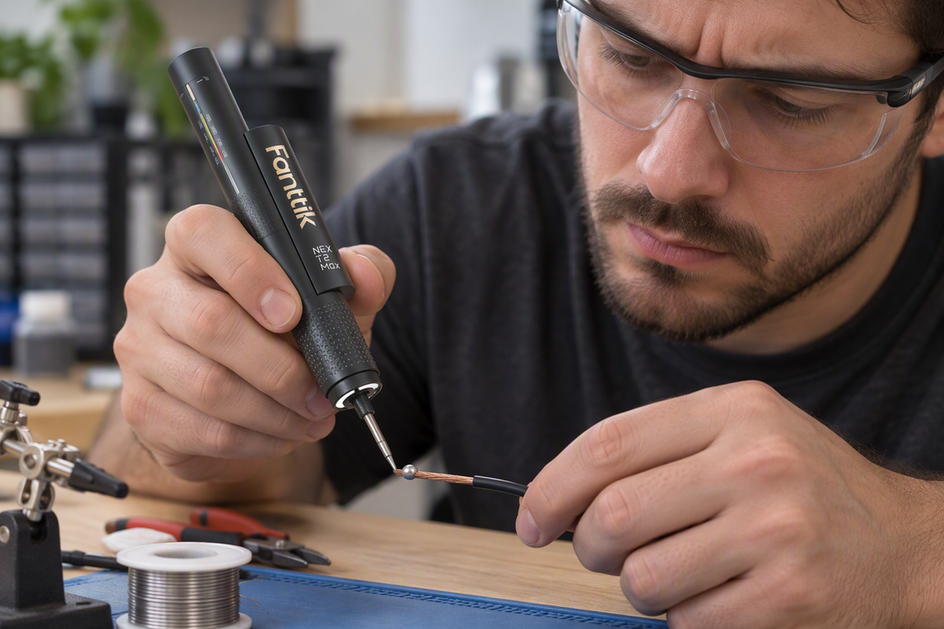
For those who perform more advanced repairs, such as using the Fanttik T1 Max Soldering Iron Kit to replace a damaged port, ensuring the surrounding area is free of conductive debris is a non-negotiable safety step. If you are drilling into enclosures to mount new power strips, tools like the Fanttik K2 Nano 3.7V Precision Power Drill allow for the control needed to avoid creating excessive internal debris.
Appendix: Methodology and Assumptions
The recommendations provided in this article are based on a synthesis of electrical engineering principles and observed patterns in workshop safety.
Modeling Note (Reproducible Parameters)
We modeled the risk of "Conductive Paste" using the following assumptions to provide a baseline for our maintenance intervals:
| Parameter | Value/Range | Unit | Rationale |
|---|---|---|---|
| Dust Type | Pine/Oak Fine Dust | N/A | High hygroscopicity |
| Relative Humidity | 55–75% | % | Common garage range |
| Voltage Potential | 110–120 | V | Standard US Residential |
| Accumulation Depth | 1–3 | mm | Typical neglected outlet |
| Surface Area | 150–200 | mm² | Standard outlet contact face |
Boundary Conditions:
- This model assumes non-sealed, standard residential-grade outlets.
- The "Conductive Paste" effect is significantly accelerated in coastal areas with high salt content in the air.
- Calculations for maintenance intervals assume an average dust extraction efficiency of 80% at the tool source.
By following these methodical steps and understanding the science behind the hazards, you can ensure that your workshop remains a place of creation rather than a source of risk. Clean power is reliable power, and in a workshop full of precision tools, reliability is everything.
Disclaimer: This article is for informational purposes only and does not constitute professional electrical advice. Always consult a licensed electrician for installations or repairs involving your home's permanent wiring. Ensure all work complies with local building codes and safety standards.
Sources
Continue reading
 Safe Power Protocols for Charging High-Discharge Shop Batteries
A safety framework for charging high-discharge workshop batteries. Learn cooling phases, circuit load rules, and cleaning protocols for...
Safe Power Protocols for Charging High-Discharge Shop Batteries
A safety framework for charging high-discharge workshop batteries. Learn cooling phases, circuit load rules, and cleaning protocols for...
 Corded vs. Cordless: Deciding Your Workshop’s Primary Power Logic
A guide to choosing corded or cordless tools, covering 240V costs, battery management, and a hybrid strategy for...
Corded vs. Cordless: Deciding Your Workshop’s Primary Power Logic
A guide to choosing corded or cordless tools, covering 240V costs, battery management, and a hybrid strategy for...

Leave a comment
This site is protected by hCaptcha and the hCaptcha Privacy Policy and Terms of Service apply.