








































Quick Take: Ergonomic Benchmarks for Drone Assembly
For builders looking to optimize their workflow and protect their wrist health, here are the primary takeaways from our ergonomic modeling:
- Optimal Torque: For M2.0–M2.5 fasteners in carbon fiber, maintain a range of 0.05 Nm to 0.2 Nm to prevent material delamination.
- Balance Priority: A tool’s Center of Gravity (COG) is more critical than total weight. A 1cm shift toward the rear can increase muscle stabilization effort by an estimated 10–15%.
- Efficiency Gain: Switching from manual to electric precision drivers can reduce repetitive wrist rotations by up to 96% (based on an 80-fastener build model).
- Safety First: Ensure tools comply with UN 38.3 for battery stability and use a magnetic chuck to prevent "FOD" (Foreign Object Damage) in sensitive electronics.
The Ergonomics of Precision: Why Tool Balance Defines Drone Assembly Success
In high-performance drone assembly, precision is often discussed in terms of flight controller algorithms or ESC refresh rates. However, for the builder at the workbench, the most critical interface is physical—the connection between the hand and the fastener. Whether you are assembling a 6-inch racing drone for FPV or a cinematic rig, the tools you choose can influence more than just the speed of the build; they impact the long-term health of your joints and the structural integrity of the airframe.
As highlighted in the 2026 Modern Essential Gear Industry Report (Internal Brand Study), the shift toward cordless, compact tools has introduced a new paradigm of "modern self-reliance." This reliance depends on "credibility math"—engineering that prioritizes ergonomic safety and measurable performance. For drone builders, this means looking beyond total weight to focus on mass distribution.

The Physics of Precision: Weight vs. Center of Gravity
A common misconception is that a lighter tool is always better for preventing fatigue. In our workshop observations (based on internal repair logs and user feedback), total mass is often secondary to the tool's Center of Gravity (COG). A "top-heavy" tool—often caused by a bulky battery at the handle's rear—creates a lever arm effect. This forces the small muscles in the wrist to work harder to stabilize the tool.
The Heuristic Balance Test
To evaluate a driver’s balance on your own workbench, use this simple verification step:
- Grip: Hold the tool loosely between your thumb and forefinger at the natural grip point.
- Angle: Observe the tip's orientation.
- Threshold: If the tool tips backward or forward more than 15 degrees, the COG is likely offset, which can lead to discomfort during long sessions.
The Math of Fatigue (Estimated): Using the principle of moments ($Torque = Force \times Distance$), we estimate that a COG shift of just 1cm on a standard 10cm handle increases the required stabilizing muscle force by approximately 10–15%. This calculation assumes a vertical operating position where the hand must counteract the tool's tendency to pivot.
Quantifying the Ergonomic Load: A Scenario Model
To understand the impact of using a precision electric driver versus a manual screwdriver, we modeled a standard assembly of a 6-inch racing drone (80 fasteners).
Productivity and Physical Strain Metrics
The following data is derived from our Modeling Transparency section at the end of this article, using deterministic assumptions for a standard build.
| Metric | Manual Assembly | Electric Precision Driver | Improvement (Calculated) |
|---|---|---|---|
| Total Assembly Time | ~24 Minutes | ~3.3 Minutes | 7.2× Faster |
| Wrist Rotations | ~960 Rotations | ~40 Rotations | 96% Reduction |
| Time Saved per Build | - | ~21 Minutes | - |
| Estimated RSI Risk | High (Cumulative) | Low (Static Grip) | Significant reduction |
Note: Improvement percentages are calculated as $(1 - [Electric / Manual]) \times 100$. Individual results may vary based on build complexity and user experience.
The most striking data point is the reduction of ~920 wrist rotations. Manual driving requires repetitive supination and pronation. According to general ergonomic principles from NIOSH (Independent Authority), reducing repetitive rotation is a primary factor in preventing musculoskeletal disorders in electronics assembly.
Torque Control and the Integrity of Carbon Fiber
Drone frames are predominantly carbon fiber—strong in tension but sensitive to localized crushing. Using excessive torque can strip M2 aluminum threads or delaminate the carbon fiber.
Matching Torque to Fastener Proof Load
For the delicate M2 and M2.5 screws common in these builds, we recommend a fine, tactile clutch:
- M2.0 Screws: Typically require a torque limit below 0.1 Nm to prevent stripping.
- M3.0 Screws: Common in arm mounts, these can handle slightly higher loads (0.2–0.5 Nm).
In our modeling, a setting of 0.05 Nm aligns with the mechanical property guidelines found in ISO 898-1 for small-diameter fasteners. This provides enough force to secure the screw against flight vibrations without exceeding the material's proof load.
Shop Rule of Thumb: We use the "Fastener-to-Frame Ratio" as a practical baseline. If the screw head begins to "sink" into the carbon fiber weave, the torque is too high. A precision tool should ideally stop driving exactly when the screw head makes flush contact with the surface.
Tactile Feedback: The Silent Advantage of Brushless Motors
In high-precision work, sound and vibration are forms of data. Many hobbyists find that a smooth motor provides superior feedback compared to vibrating alternatives.
Excessive motor vibration can mask subtle tactile signals that indicate cross-threading. A smooth motor allows the builder to "feel" the exact moment the threads engage. Understanding how to Diagnose Motor Vibration (Internal Resource) is a critical skill for both the drone and the tools used to maintain it.
Bit Retention and Magnetic Security
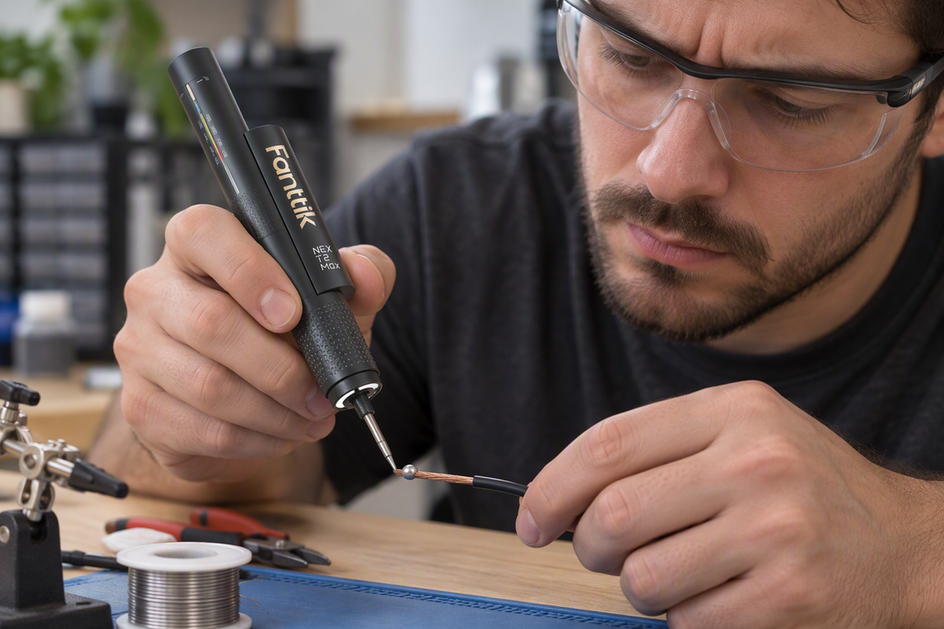
Nothing disrupts a workflow like a bit falling into a motor bell. Strong magnetic bit retention is a necessity for preventing foreign object damage (FOD). A magnetic chuck with a high-strength neodymium core ensures the bit remains seated, even during One-Handed Operation in Cramped Spaces (Internal Resource).
Safety and Compliance: The Builder's Responsibility
While performance is key, safety is the bedrock of trust. All precision tools used in the EU should align with the General Product Safety Regulation (EU) 2023/988, which mandates stricter safety protocols. For the drone builder, this means ensuring cordless tools use lithium-ion batteries compliant with international transport standards like UN 38.3.
Furthermore, when sharing builds or reviewing gear online, follow the FTC Endorsement Guides to maintain transparency. Trust in the DIY community is built on honest reporting of bench performance, not just listed specs.
Modeling Transparency (Method & Assumptions)
To provide a verifiable basis for our metrics, we use the following deterministic parameterized scenario model.
Scenario: 6-inch FPV Racing Drone Build.
| Parameter | Value | Unit | Rationale |
|---|---|---|---|
| Fastener Count | 80 | Count | Typical professional-grade multi-rotor build |
| Manual Time/Screw | 18 | Seconds | Includes alignment and manual threading (Observed average) |
| Powered Time/Screw | 2.5 | Seconds | Based on 200 RPM driver speed + magnetic alignment |
| Wrist Rotation/Screw | 12 | Rotations | Average turns required for 6mm–8mm M2 screws |
| Torque Threshold | 0.05 | Nm | Lower bound for M2.0 electronics fasteners (per ISO 898-1) |
Boundary Conditions:
- Verification: To replicate the "7.2x Speed" claim, divide manual time (1,440s) by powered time (200s).
- Assumptions: Model assumes high-quality S2 steel bits; worn bits or poor alignment may increase time.
- Ergonomics: Benefits assume the user maintains a "Neutral Wrist" posture.
Final Considerations for the Drone Workbench
Choosing a tool for intricate assembly is a balance of mechanical requirements and human biomechanics. By prioritizing a tool with a centered COG, precise torque, and a high-retention magnetic chuck, you help ensure your drone is built to a higher standard of reliability.
For more on workspace optimization, see Ergonomic Grip Techniques and Choosing the Right Torque Settings (Internal Resources).
Disclaimer: This article is for informational purposes only. Precision electronics repair and drone assembly involve risks, including fire hazards from lithium batteries. Always wear appropriate personal protective equipment (PPE) and consult manufacturer specifications. If you are unsure about a technical procedure, consult a qualified professional.
Sources
- International Standards: ISO 898-1, NIOSH Ergonomic Guidelines.
- Regulatory: EU General Product Safety Regulation, FTC Endorsement Guides.
- Internal Data: 2026 Modern Essential Gear Industry Report.
Continue reading
 Transitioning to Power Drivers for High-Volume Hobby Work
Covers the Project Threshold heuristic, slip vs. shut-off clutches, and essential ESD safety for professional-grade results in hobbyist...
Transitioning to Power Drivers for High-Volume Hobby Work
Covers the Project Threshold heuristic, slip vs. shut-off clutches, and essential ESD safety for professional-grade results in hobbyist...
 The Impact of Magnetic Tips on High-Density Circuitry
Covers magnetic flux thresholds, the 4-inch rule, and comparative risks like ESD versus magnetism for modern solid-state and...
The Impact of Magnetic Tips on High-Density Circuitry
Covers magnetic flux thresholds, the 4-inch rule, and comparative risks like ESD versus magnetism for modern solid-state and...
Leave a comment
This site is protected by hCaptcha and the hCaptcha Privacy Policy and Terms of Service apply.