










































The Anatomy of a Roadside Crisis: Why Placement is Your First Line of Defense
Imagine the scenario: it is 9:00 PM on a Tuesday, and you are leaving a late shift in a dimly lit parking garage. You turn the key or press the start button, and instead of the familiar hum of the engine, you hear the dreaded rhythmic clicking of a dying battery. In that moment, your heart rate spikes. You know you have a portable jump starter somewhere in the car, but as you open the trunk, you realize it is buried under a week's worth of groceries, a gym bag, and a stroller.
In our experience assisting users through these high-stress moments, we have identified a critical pattern: the technical specifications of your gear matter far less than your ability to find it. In a roadside emergency, time is not just a convenience—it is a safety metric. Every minute spent rummaging through a cluttered trunk is a minute spent in a vulnerable position, often on the shoulder of a busy road or in an isolated area.
This guide focuses on the "Emergency First" placement strategy. We will move beyond generic storage advice to explore the engineering logic of the "Golden Zone," vehicle-specific logistics, and the environmental factors that can silently kill your battery before you even need it. By the end of this article, you will have a professional-grade blueprint for organizing your vehicle’s most critical safety tool.

The 30-Second Rule: Defining the "Golden Zone"
In the world of professional emergency response, equipment placement is dictated by the speed of retrieval. Whether it is a fire extinguisher or a medical kit, the benchmark is often the "30-second rule." For a car owner, this means your jump starter should be retrievable and operable within 30 seconds, using one hand, from outside the vehicle.
Why 30 seconds? This threshold is based on the psychological reality of "stress-induced cognitive tunnel vision." When we are panicked, our fine motor skills degrade, and our ability to solve complex puzzles—like unlatching a hidden seat compartment or digging through a deep trunk—drops significantly.
The Heuristic of the "Golden Zone"
We define the "Golden Zone" as any storage area that meets three criteria:
- Direct Visibility: You can see the tool immediately upon opening the primary access point (trunk or door).
- No-Unload Access: You do not need to remove other items to reach it.
- One-Handed Retrieval: The tool is not locked behind complex latches that require two hands or a tool to open.
Modeling Note (Emergency Retrieval Parameters): This model assumes a high-stress state where cognitive load is increased, and environmental conditions are sub-optimal.
Parameter Value Rationale / Source Category Retrieval Target < 30 Seconds Industry standard for emergency equipment [4] Ambient Light < 5 Lux Simulating nighttime roadside failure Obstruction Level 2-3 Layers Average trunk clutter for suburban users Operation Mode One-Handed Assuming the other hand holds a phone or light Success Rate > 95% Target for critical safety gear Note: This is a scenario model based on common industry heuristics, not a controlled lab study.
Vehicle-Specific Placement: Where Your Car Wants You to Store Gear
Not all vehicles are created equal. A placement that works in a subcompact sedan might be a "death sentence" for accessibility in a large SUV. Based on patterns from customer feedback and vehicle architecture analysis, here is how to optimize for your specific ride.
1. The Modern Sedan: The Side-Pocket Priority
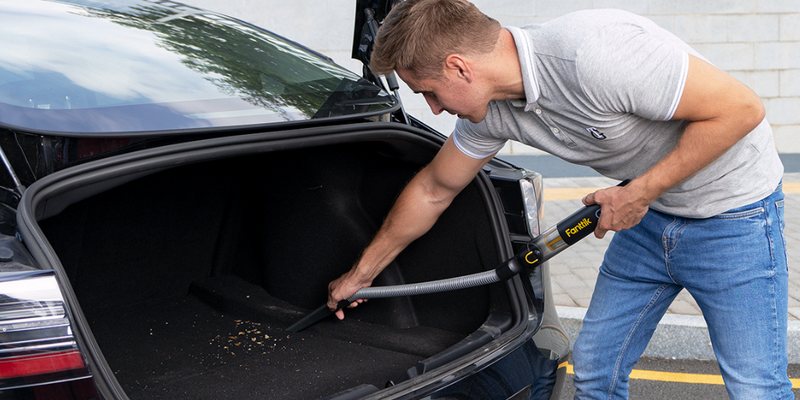
In most sedans, the "front-of-trunk" area (closest to the bumper) is the most accessible. However, it is also where groceries and bags tend to slide.
- The Solution: Utilize the recessed side pockets often found behind the wheel wells. If your sedan lacks these, use heavy-duty adhesive hook-and-loop strips to "mount" your jump starter case to the side carpet wall. This keeps it off the floor and in the "Golden Zone."
- The "Gotcha": Avoid the spare tire well unless your trunk is consistently empty. If you have a flat tire and a dead battery simultaneously (a common "bad luck" pairing), you will be forced to unload the entire trunk on the roadside just to get started.
2. SUVs and Crossovers: The "D-Pillar" Strategy
SUVs offer more vertical space but also more "cargo creep."
- The Solution: The area near the D-pillar (the rear-most roof support) often has small cubbies or netting. This is the ideal spot. Alternatively, many modern SUVs have under-floor storage bins. If you use these, ensure your jump starter is in the rear-most bin so you only have to lift the edge of the floor mat, not the whole floor.
- The Expert Tip: Many professionals who manage fleets suggest secured storage under or behind the rear seats. For two-door models or those with folding seats, this can offer faster retrieval than a buried trunk.
3. Electric Vehicles (EVs): The Frunk Advantage
EVs often feature a "frunk" (front trunk). This is a game-changer for emergency gear.
- The Solution: Keep your jump starter and a portable tire inflator in the frunk. Since the frunk is rarely used for heavy daily cargo like groceries, your emergency gear remains "top-of-stack" and immediately accessible.
Environmental Killers: Protecting the Battery from the Elements
While placement is about accessibility, it is also about preservation. A jump starter that you can find in 5 seconds is useless if the battery has been cooked by the sun or drained by the cold.
The Heat Threshold (The Silent Capacity Killer)
Lithium-ion batteries are sensitive to thermal stress. According to the IATA Lithium Battery Guidance, sustained exposure to high temperatures accelerates chemical degradation. While many users focus on winter performance, heat is the far more dangerous long-term enemy.
Interior car temperatures can easily exceed 120°F (49°C) on a 90°F day. Many manufacturers warn against sustained storage above 113°F (45°C).
- Practical Heuristic: Avoid placing your jump starter against metal body panels that conduct heat from the exhaust or engine.
- The Thermal Buffer: Store your gear in a padded, insulated case. This doesn't stop the tool from reaching ambient temperature eventually, but it "buffers" the extreme peaks of a car sitting in direct sunlight, potentially adding years to the battery's lifespan.
The Cold Factor: Voltage Sag
In extreme cold, the internal resistance of a battery increases, leading to "voltage sag." If you live in a climate where temperatures regularly drop below freezing, we recommend the "Inside-Out" rotation. During the coldest weeks of the year, keep the jump starter inside your home and only bring it to the car for commutes. If you must keep it in the car, ensure it is fully charged; a battery at 100% state-of-charge (SoC) handles cold far better than one at 40%.
The Integrated Kit: Reducing Decision Fatigue
When a crisis hits, your brain's processing power drops. This is why we advocate for a "Modular Get-Me-Going Kit." Instead of having a jump starter in one corner, a tire inflator in another, and a flashlight in the glovebox, integrate them into a single, labeled, and organized case.
This approach solves two problems:
- Decision Fatigue: You don't have to think about which tool you need. You just grab the "Emergency Kit."
- Functional Redundancy: Many modern jump starters include built-in LED work lights. By storing your tire inflator in the same kit, you ensure you have a light source while you are checking your tire pressure at night.
As noted in The 2026 Modern Essential Gear Industry Report: Engineering Trust in a Cordless World, the shift toward "modern self-reliance" requires tools that reduce friction. A modular kit is the pinnacle of friction reduction.
Safety, Compliance, and the "Rental Car Trap"
Before you finalize your placement, you must consider the legal and safety framework of the vehicle you are driving.
The Rental Car Prohibition
A common misconception is that portable jump starters are a perfect companion for rental cars. However, research into the policies of major rental companies (like Hertz or Enterprise) reveals a strict prohibition against using personal jump starters. Connecting external devices to a rental's electrical system can be flagged as a violation of the rental agreement, potentially shifting liability for any ECU (Engine Control Unit) damage directly to you. If you are driving a rental, your "placement" should be in the glovebox—not for use on the car, but to keep the tool safe until you return to your own vehicle.
Standards and Regulations
When choosing where to mount or store gear, ensure your setup doesn't interfere with safety systems.
- ISO Standards: Ensure your storage doesn't block access to first-aid kits or fire extinguishers required by local regulations.
- EU General Product Safety Regulation (EU) 2023/988: This regulation emphasizes the importance of clear labeling and traceability. Ensure your emergency kit is clearly labeled so that even a passenger who isn't familiar with your car can find it in an emergency.
Decision Matrix: Optimizing Your Storage Location
To help you decide, we have created a logic-based comparison of the most common storage spots.
| Storage Location | Accessibility Score | Battery Health Risk | Best For |
|---|---|---|---|
| Glovebox | High | High (Heat) | Small pocket-sized units / Urban commuters |
| Under-Seat | Medium | Low | SUVs / Trucks with dedicated bins |
| Trunk Side-Pocket | High | Medium | Sedans / Daily drivers |
| Spare Tire Well | Low | Low | Long-term storage (Not recommended for primary gear) |
| EV Frunk | Very High | Low | Electric Vehicle owners |
Logic Summary: The "Accessibility Score" is a qualitative estimate based on the number of physical movements required to reach the tool. The "Battery Health Risk" accounts for proximity to glass (sunlight) and metal panels (heat conduction).
Maintenance: The "Quarterly Audit"
Placement is not a "set it and forget it" task. Even the best-placed jump starter is useless if it is dead. We recommend a quarterly audit aligned with the change of seasons:
- Check SoC: Ensure the battery is above 80%.
- Inspect Cables: Look for fraying or corrosion on the clamps.
- Verify Placement: Ensure the tool hasn't been buried by seasonal gear (e.g., snow shovels in winter or beach chairs in summer).
- Temperature Check: In peak summer, feel the case. If it’s hot to the touch, move it to a more insulated spot.
The Road Ahead: Your Preparedness Roadmap
Your jump starter is more than a battery; it is a piece of "modern essential gear" designed to provide autonomy. By applying the 30-second rule and choosing a location that respects both human psychology and battery chemistry, you transform a simple tool into a reliable safety system.
Don't wait for the next "click-click" moment to realize your gear is out of reach. Take five minutes today to move your jump starter into the "Golden Zone." Your future self—standing on a cold roadside at midnight—will thank you.
For more insights on optimizing your vehicle for self-reliant travel, explore our guides on Maximizing Cargo Room and Solo Driving Confidence.
Disclaimer: This article is for informational purposes only and does not constitute professional automotive, legal, or safety advice. Always refer to your vehicle's owner manual and the specific safety instructions provided by your tool's manufacturer. Lithium-ion batteries can pose a fire risk if damaged or stored improperly; consult a professional if you notice swelling or leaking.
Sources
Continue reading
 Protecting Device LCD Displays from Dust Scratches in Bags
Covers the sandpaper mistake, three-step cleaning, and advanced storage with IP/IK ratings to ensure display clarity in harsh...
Protecting Device LCD Displays from Dust Scratches in Bags
Covers the sandpaper mistake, three-step cleaning, and advanced storage with IP/IK ratings to ensure display clarity in harsh...
 Choosing Soft-Sided Organizers for Irregular Trunk Shapes
A guide on using soft-sided organizers to maximize storage in car trunks with irregular shapes. The article explains...
Choosing Soft-Sided Organizers for Irregular Trunk Shapes
A guide on using soft-sided organizers to maximize storage in car trunks with irregular shapes. The article explains...

Leave a comment
This site is protected by hCaptcha and the hCaptcha Privacy Policy and Terms of Service apply.