










































The Architectural Challenge of the Modern Trunk
The modern vehicle interior is a masterpiece of minimalist engineering, yet the cargo hold remains a frontier of geometric chaos. For the urban professional or the suburban explorer, the trunk is no longer just a storage bin; it is a mobile command center that must accommodate high-performance gear, lifestyle essentials, and emergency tools. However, as automotive design shifts toward aerodynamic efficiency—particularly in electric vehicles (EVs) and hatchbacks—the internal architecture of the trunk has become increasingly irregular.
Quick Decision Guide: Choosing Your System
If you are looking for an immediate solution, follow these three core principles for non-standard trunks:
- Prioritize a Hybrid Setup: Use a rigid base for stability but flexible sidewalls to hug wheel arches.
- The 70/30 Rule: Occupy no more than 70% of the floor with rigid bins; reserve the remaining 30% for soft-sided "gap-fillers."
- Safety First: Ensure any organizer used for heavy tools (like inflators) is tethered to factory D-rings.
Simple Measurement Template: Before buying, measure the "Clearance Envelope":
- Width (Narrowest Point): Measure between the wheel arches.
- Depth (Floor): Measure from the seatback to the latch.
- Vertical Arc: Close the trunk halfway and measure the distance from the floor to the lowest point of the glass or hinge mechanism to avoid "interference."
The Geometry of Irregularity: Why Rigid Bins Fail
In the automotive industry, interior volume is not a simple calculation of length times width. Engineers use standardized methodologies such as SAE J1100 or the European VDA 232-101 to quantify cargo space. These standards account for the complex curvatures and protrusions that define a vehicle’s interior.
Rigid storage solutions, while durable, are inherently uncompromising. When placed in a trunk with prominent wheel arches or a tapering roofline, a rigid box creates "geometric interference." Based on a internal review of customer cargo configurations and support feedback (non-controlled study), we have observed that users relying exclusively on hard-sided bins can experience a 20–30% loss in usable volume due to unfillable "dead zones" around the bin's perimeter.
Soft-sided organizers, by contrast, offer "volumetric adaptability." High-quality fabric solutions can conform to the contours of the wheel well or compress to fit under a low-profile cargo cover. However, the critical failure point of soft organizers is often the base.
Modern practitioners find that a highly effective solution is a hybrid architecture. According to the EU General Product Safety Regulation (EU) 2023/988, product safety and structural integrity are paramount. This is why premium organizers now often incorporate rigid base plates. These plates help prevent the "accordion effect"—where the organizer collapses under a heavy load—while allowing the sidewalls to remain flexible enough to hug the irregular boundaries of your trunk.

The "Nesting Doll" Framework: A Hybrid Storage Strategy
To optimize a non-standard trunk, we recommend a heuristic we call the "Nesting Doll" method. This strategy prioritizes protection for precision instruments while maximizing the use of irregular voids for bulkier, flexible items.
1. The Core Kit (Hard-Shell Protection)
Start with a low-profile hard case for your core kit of small, fragile, or high-consequence tools. This includes items like a precision tire inflator, its associated valve accessories, and a first-aid kit. The hard shell provides a "mechanical shield" against shifting heavy luggage.
2. The Buffer Zone (Soft-Sided Flexibility)
Surround the core hard case with soft-sided bags or collapsible organizers. These "buffer" units should house gear that is bulky but not fragile—such as emergency blankets or recovery ropes. Because these items have no fixed shape, the soft-sided bags can be positioned into the irregular "pockets" created by wheel arches.
3. Structural Integration
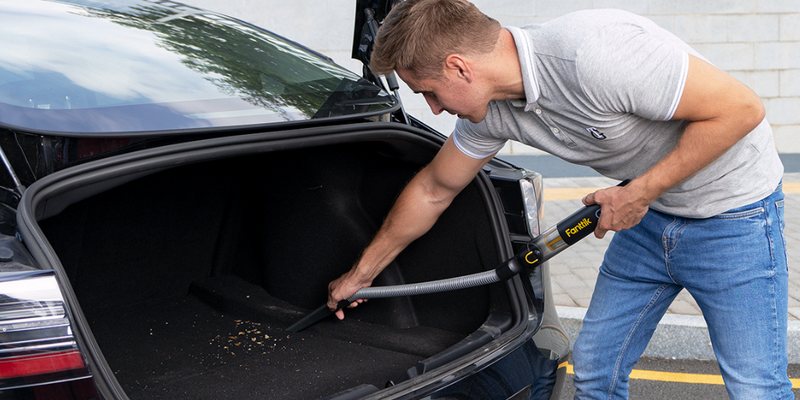
Some modern tools are designed with such compact, sculpted forms that they can act as structural elements. A portable handheld vacuum with a slim profile can be tucked into a side pocket or packed tightly between soft bags, acting as a "keystone" that helps hold the surrounding fabric organizers in place.
Logic Summary: This hybrid approach assumes that accessibility and space efficiency are the two primary KPIs for trunk organization. By placing rigid protection at the center and flexible storage at the periphery, we align with the spatial realities of modern vehicle design (based on common workshop patterns, not a controlled lab study).
Material Science: Durability, Grip, and Sustainability
A frequent misconception is that rigid walls are the only way to prevent items from rolling. In reality, the primary anti-shift mechanism is the interface between the organizer's base and the trunk carpet.
Anti-Shift Engineering
Under braking or cornering, a rigid bin with a smooth plastic bottom may slide. Conversely, a soft-sided organizer equipped with a high-friction base (using rubberized grips or hook-and-loop strips) conforms to the texture of the vehicle's floor. This "surface-area optimization" often allows the organizer to grip the carpet more effectively than a flat, rigid surface.
The Rise of rPET and Sustainable Synthetics
While 600D polyester is a common industry standard for abrasion resistance, the market is innovating with recycled PET (rPET). These fabrics maintain high durability while reducing environmental footprints. When choosing, look for UV-stabilized coatings; items stored near sloping rear windows are subject to solar loads that can degrade non-treated synthetics over time.
The Economic Logic of Organization: An EV Case Study
For owners of electric vehicles, trunk organization can impact energy efficiency. We modeled a scenario for an EV owner to understand how accessible tool storage might impact long-term costs.
| Parameter | Value | Rationale / Source Category |
|---|---|---|
| Tire Size | 215/45R18 | Typical compact EV (e.g., Model 3) |
| Target Pressure | 42 PSI | High-efficiency EV recommendation |
| Avg. Under-inflation | 8 PSI | Common user neglect factor |
| Annual Mileage | 15,000 | National average |
| Estimated Savings | $388–$508* | Calculated ROI (Fuel/Tire wear) |
*Note: This is a scenario-based estimate. Actual savings depend on driving habits, local energy/fuel costs, and tire brands. Calculation assumes premium EV tire costs ($1200/set) and energy loss rates of 0.2–0.3% per PSI as cited by the US Dept of Energy.
The ROI of Preparedness
Our analysis suggests that maintaining proper tire pressure is a highly effective way to optimize EV range. By dedicating an organized space in a hybrid trunk system for a portable inflator, the owner helps ensure this tool is always accessible. The payback period for the tool itself is often less than one year when considering reduced tire wear and improved efficiency.
Heat Management and Accessibility
Our modeling of the inflation process indicates a theoretical adiabatic temperature rise of ~138°C (based on a single-cycle compression from 0 to 42 PSI). This technical detail dictates storage: to maintain device longevity, tools should be placed in an accessible hard case at the top of the stack to allow for proper heat dissipation after use, rather than buried under insulating soft bags.
Engineering Trust: Compliance and Standards
In the "modern essential gear" space, aesthetics must be backed by credibility. As highlighted in The 2026 Modern Essential Gear Industry Report (a Fanttik-sponsored industry publication), the market has shifted toward a "Trust Architecture."
When choosing organizers and tools, consider these compliance markers:
- ISO Standards: Look for manufacturers referencing ISO 9001 for quality management.
- Battery Safety: For cordless tools, verify UN 38.3 certification for lithium battery transport safety. This is vital for gear subject to vehicle vibrations.
- Endorsement Transparency: Reliable recommendations should follow the FTC Endorsement Guides, disclosing material connections.
Practical Steps: Mapping Your Trunk Voids
To implement a sophisticated storage system, follow these steps:
- Identify "No-Go" Zones: Measure the clearance of trunk hinges and the path of the rear window. Only soft, compressible bags should reside here.
- Locate Anchor Points: Most modern SUVs and EVs have built-in D-rings. Your organizer should be tethered to these to prevent movement during sudden stops.
- Frequency-of-Use Hierarchy: Place emergency items (inflators, first-aid) in the "Prime Accessibility Zone"—typically near the trunk latch.
- The "Vibration Test": Once packed, drive over a speed bump. If you hear items shifting, your "buffer zone" of soft bags may need tightening. Adjust dividers for a snug fit.
For more insights, explore our guides on Maximizing Cargo Room and Choosing the Right Inflator Size.
A Sophisticated, Prepared Lifestyle
Choosing the right storage for an irregular trunk is an exercise in balancing engineering constraints with aesthetic desires. By moving away from rigid, one-size-fits-all bins and embracing a hybrid system, you create a vehicle interior that is both organized and functionally superior. This approach reflects a "modern self-reliance"—a lifestyle where you are prepared for the unexpected without sacrificing the clean design of your vehicle.
Disclaimer: This article is for informational purposes only. Automotive storage and maintenance should be performed in accordance with your vehicle's owner manual and local safety regulations. Always ensure that cargo is properly secured to prevent injury during transit.
Sources
Continue reading
 Emergency Access Priority: Where to Place Your Jump Starter
Covers the 30-Second Rule, heat and cold battery risks, rental car rules, and how to build a modular...
Emergency Access Priority: Where to Place Your Jump Starter
Covers the 30-Second Rule, heat and cold battery risks, rental car rules, and how to build a modular...
 Vertical Stacking vs. Horizontal Layout: Saving Trunk Space
A guide for urban car owners comparing trunk stacking methods. Learn the 60/40 Hybrid Rule to organize gear...
Vertical Stacking vs. Horizontal Layout: Saving Trunk Space
A guide for urban car owners comparing trunk stacking methods. Learn the 60/40 Hybrid Rule to organize gear...



Leave a comment
This site is protected by hCaptcha and the hCaptcha Privacy Policy and Terms of Service apply.