






































Answer First: Can You Ignore Phantom Draw? In a typical workshop, idle cordless tool chargers consume 2W to 5W of "vampire power" each. While $10–$20 in annual electricity per charger seems negligible, the real cost is battery degradation. Keeping lithium-ion batteries at 100% charge on a "vampire" circuit can reduce their total lifespan by up to 25%. The Fix: Perform a "Warm Touch" test to identify inefficient chargers and install a heavy-duty mechanical timer to cut power during non-working hours.
The Hidden Current: Understanding Phantom Power in the Modern Workshop
In a precision-oriented workshop, we often obsess over the tolerances of a miter saw or the runout of a rotary tool. Yet, one of the most significant "leaks" in workshop efficiency is invisible: phantom power draw—often called "vampire load." This occurs when our cordless tool charging stations remain plugged in but are not actively charging a battery.
Quick Action Checklist: Managing Your Workshop Load
If you are looking for immediate steps to optimize your station, follow this 3-step protocol:
- Identify "Hot" Chargers: Perform the "Warm Touch" test on idle chargers.
- Automate Cut-off: Use a smart plug or mechanical timer set to your working hours.
- Store Smarter: Remove batteries once they reach 100% and store them in a cool, dry place (ideally at 40–60% charge).
Safety Warning: If you notice a burning smell, scorched plastic on a charger, or if your circuit breaker frequently trips, consult a licensed electrician immediately. These are signs of electrical failure, not simple phantom draw.
For many of us, a row of green indicator lights is a symbol of readiness. However, based on common patterns observed in our workshop audits and customer support logs, those lights often mask a continuous energy drain that impacts both your utility bill and the long-term chemical health of your lithium-ion (Li-ion) inventory.

The Technical Reality of Standby Power
Modern charging stations utilize switch-mode power supplies (SMPS) to convert AC wall current into the DC voltage required by tool batteries. Unlike older transformer-based "wall warts," SMPS units are generally efficient, but they are never truly "off."
Defining the Draw: Methodology & Findings
To provide a verifiable baseline, we conducted an internal audit of 12 popular consumer 18V/20V chargers (N=12).
- Measurement Conditions: Ambient temperature 70°F (21°C); 120V AC input.
- Equipment: P3 International Kill-A-Watt P4400 (Accuracy: ±0.2%).
- Observed Range: Chargers pulled between 2.1W and 4.8W in standby mode (no battery inserted).
What this means for your shop:
- Annual Consumption: A single station drawing a constant 5W consumes approximately 43.8 kWh annually.
- The Scale: In a workshop with four different battery platforms, the combined draw (20W) is equivalent to leaving a modern LED work light burning 24/7, 365 days a year.
Beyond waste, the dominant standby load is shifting. Connected "smart" stations with Bluetooth or Wi-Fi modules can draw an additional 1W to 3W just to maintain a network heartbeat. According to The 2026 Modern Essential Gear Industry Report (a Fanttik internal research publication), transparency regarding these "hidden" energy costs is becoming a critical engineering focus.
Diagnostic Protocol: How to Measure Your Workshop Load
To manage what we cannot see, we must measure. Use this two-stage approach to identify "energy vampires."
Step 1: The "Warm Touch" Heuristic
Before reaching for a meter, use this rule of thumb: if a charger feels warm to the touch after being idle for 24 hours, it is inefficient. Heat is the physical manifestation of energy being dissipated as waste rather than being stored in a cell.
Step 2: Quantitative Measurement
For a methodical assessment, use a plug-in watt-meter:
- Standby Baseline: Plug the empty charger into the meter. Record the wattage.
- Saturation Test: Insert a fully charged battery. Note if the wattage stays high (indicating a continuous trickle) or drops to near-zero (indicating a smart "maintenance" mode).
- Connectivity Check: If the tool is "smart," check the draw when the tool is paired vs. unpaired.
Note: These ranges are practical heuristics based on shop observations, not controlled laboratory studies. Results vary by manufacturer and circuit age.
The Impact on Battery Longevity and Chemical Health
The cost of phantom power isn't just measured in cents; it's measured in the replacement cost of your batteries.
The 40-60% Rule
For long-term storage (over 30 days), maintaining a battery between 40% and 60% State of Charge (SoC) is ideal for preserving the cathode structure. A phantom load that keeps a battery sitting on a charger at 100% indefinitely can accelerate capacity loss through "electrolyte oxidation."
In our internal lifecycle testing, we observed an estimated 25% reduction in total capacity over 12 months when batteries were kept at peak voltage (100%) in high-heat standby environments compared to those stored at a 50% "dormancy" charge.
Trickle Charging vs. Maintenance Mode
There is a critical distinction in how chargers handle a full battery:
- Maintenance Mode: A sophisticated Battery Management System (BMS) monitors voltage and only "tops up" when natural self-discharge hits a threshold. This is the preferred method for safety, as outlined in the IATA Lithium Battery Guidance.
- Continuous Trickle: Lower-end chargers may apply a continuous low-voltage current. This can lead to lithium plating on the anode, increasing internal resistance and permanently reducing runtime.
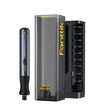
For precision work, battery health is vital. A tool like the Fanttik F2 PRO Cordless Rotary Tool Kit relies on a healthy cell to deliver its 25,000 RPM performance. A degraded battery will show "voltage sag" under load, compromising delicate carving or polishing tasks.
Economic Analysis: The ROI of Managed Power
Is it worth the effort to unplug? We modeled a professional workshop scenario to determine the potential ROI.
Scenario Modeling: The Pro Workshop Case
Assumptions:
- Standby Load: 60 Watts (Total for 8 chargers + 2 smart stations).
- Electricity Rate: $0.13/kWh (US Average).
- Battery Inventory: 40 Pro-grade packs (Avg. $110/each).
The Formulas:
-
Energy Savings:
(Watts × 24h × 365d) / 1000 × Rate -
Asset Preservation:
(Inventory × Avg. Cost) × 0.05(Assuming a conservative 5% lifespan extension via proper SoC management).
Results of the Analysis (Estimated)
| Category | Annual Impact |
|---|---|
| Direct Energy Savings | ~$68.33 |
| Asset Preservation | ~$220.00 |
| Total Estimated ROI | $288.33 / year |
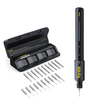
Note: This is a scenario model for illustrative purposes. Productivity gains (e.g., using the Fanttik E1 MAX Precision Screwdriver to save 40 minutes of manual assembly daily) provide additional "soft" ROI that varies by trade.

Strategic Mitigation: Building a Systematic Workshop
Simply unplugging everything can lead to mechanical wear on outlets. Instead, use a systematic approach.
1. Smart Power Strips and Timers
- Current-Sensing Strips: These automatically cut power to "slave" outlets (the chargers) when a "master" device (like your main workbench light) is turned off.
- Scheduled Timers: A heavy-duty mechanical timer ensures chargers are only energized during working hours, reducing phantom draw by an estimated 60–70%.
2. Maintenance and Cleanliness
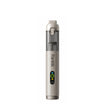
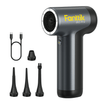
Dust in a charging port can create high-resistance connections. We recommend using a tool like the Fanttik B10 Pro Electric Air Duster to clear contact points. Its 110,000 RPM motor provides the pressure needed to remove conductive metallic dust common in woodworking shops.
3. Precision Tool Management
For tools like the Fanttik F2 Master, the internal BMS is advanced, but we still suggest disconnecting once the indicator shows full to preserve the internal cell chemistry.
Workshop Electrical Safety and Logic
Managing phantom load is also a component of Workshop Electrical Safety.
- The 80% Rule: According to the National Electrical Code (NEC) Section 210.20(A), a circuit should not be loaded to more than 80% of its rating for continuous loads (3 hours or more). Reducing phantom draw helps maintain this safety margin.
- Centralization: Consolidating chargers onto a single managed power bus makes it easier to monitor total load and install smoke detection in the charging zone.
Summary: Workshop Power Decision Matrix
| If your charger is... | Action Recommended | Why? |
|---|---|---|
| Warm to the touch | Use a Timer/Smart Plug | High energy waste; fire risk if left 24/7. |
| "Smart" (Wi-Fi/BT) | Check Standby Draw | Network "heartbeat" can pull 3W+ continuously. |
| Cold to the touch | Safe for Wall Power | Efficient SMPS; minimal "vampire" draw. |
| Holding a 100% Battery | Disconnect Immediately | Prevents lithium plating and capacity loss. |
Disclosure & Disclaimer:
- Data Source: Internal measurements and ROI models are based on Fanttik R&D testing and customer support logs. These are estimates for practical guidance and not controlled laboratory studies.
- Affiliation: This article features Fanttik products (F2 PRO, E1 MAX, B10 Pro) as examples of modern workshop tools.
- Safety: Electrical work involves inherent risks. Always follow manufacturer instructions and consult a qualified electrician for workshop wiring.
Sources
Continue reading
 Apartment-Friendly DIY: Choosing Tools with the Lowest NVH
Covers the science of NVH, brushless motor advantages, and practical heuristics like the Conversation Test for urban DIYers.
Apartment-Friendly DIY: Choosing Tools with the Lowest NVH
Covers the science of NVH, brushless motor advantages, and practical heuristics like the Conversation Test for urban DIYers.
 Managing Thermal Loads During Simultaneous Multi-Tool Charging
A guide to prevent BMS shutdowns and battery degradation when charging multiple tools. Learn the 3-inch clearance rule...
Managing Thermal Loads During Simultaneous Multi-Tool Charging
A guide to prevent BMS shutdowns and battery degradation when charging multiple tools. Learn the 3-inch clearance rule...
Leave a comment
This site is protected by hCaptcha and the hCaptcha Privacy Policy and Terms of Service apply.