










































The Weight Dilemma: Balancing Portability with Vibration Control
In the world of precision engineering and DIY maintenance, the pursuit of "lightweight" has long been the primary marketing driver. We see it in every category from cordless screwdrivers to portable tire inflators—the promise that a smaller, lighter tool is inherently superior. However, on our repair benches and through extensive technical modeling, we have identified a fundamental engineering conflict: the lighter the tool, the harder it is to damp.
When a tool’s mass is reduced to enhance portability, it often loses its most effective passive defense against Motor-Generated Harshness (MGH). This creates a phenomenon known as the "Weight Dilemma." For the discerning prosumer, choosing a tool based solely on its "marketing weight" can lead to unexpected hand fatigue, reduced precision, and long-term ergonomic strain. In this guide, we evaluate the engineering trade-offs between a tool’s mass and its ability to absorb vibration, helping you make informed decisions based on your specific project intensity.
The Physics of Vibration: Why Mass Matters
To understand the weight dilemma, we must first look at the mechanics of Noise, Vibration, and Harshness (NVH). Handheld power tools are essentially systems of oscillating masses. Whether it is the high-speed rotation of a brushless motor or the reciprocating action of an inflator piston, energy is constantly being transferred into the tool's housing.
According to the International Organization for Standardization (ISO) 5349, which governs the measurement and evaluation of human exposure to hand-transmitted vibration, the risk of "white-finger" sensation (vibration-induced white finger) is directly linked to the frequency and amplitude of these oscillations.
Passive Damping and the Inertia Principle
Mass acts as a passive damper. A heavier housing has more inertia, meaning it requires more energy from the motor to move. In a lightweight tool, the motor’s internal vibrations encounter less resistance, allowing them to translate directly into the user's grip.
We often observe a common pattern in our technical assessments: ultra-lightweight tools (those under 500g for rotary tasks) tend to exhibit higher-frequency vibrations. While these tools feel effortless for the first five minutes, the high-frequency "buzz" can cause rapid neurological fatigue. This is a critical insight for anyone planning sessions exceeding 30 minutes.
The Marketing Weight vs. Functional Weight Conflict
There is a growing divide between "marketing weight"—the number used to sell a tool—and "functional weight"—the mass required for stability, heat dissipation, and damping. As noted in The 2026 Modern Essential Gear Industry Report, engineering trust in a cordless world requires transparency about these trade-offs. Shaving weight from critical damping components to hit a marketable spec often sacrifices the tool's long-term performance and user comfort.

The "15/30 Rule": A Decision Framework for Prosumers
Based on practitioner observations and common patterns from our troubleshooting data (not a controlled lab study), we have developed a heuristic to help users navigate the weight dilemma. We call this the 15/30 Rule.
1. The Precision Sprint (Tasks under 15 Minutes)
For quick repairs, such as tightening a loose cabinet hinge or opening a small electronics chassis, low weight and high portability are your primary allies. In these scenarios, the cumulative exposure to vibration is too low to cause significant fatigue.
- Priority: Ergonomics and maneuverability.
- Target Tool: Ultra-compact drivers or precision tools like the Fanttik S1 Pro Cordless Electric Screwdriver.
2. The Endurance Session (Tasks over 30 Minutes)
If you are assembling a full room of flat-pack furniture or performing a multi-stage automotive trim restoration, the math changes. Even a 100–200 gram increase in mass (roughly the weight of a small smartphone) pays significant dividends in damping.
- Priority: Internal damping and motor isolation.
- Target Tool: Mid-range mass tools that offer a balance of power and vibration absorption.
Logic Summary: Our 15/30 Rule assumes that for sessions exceeding 30 minutes, the neurological impact of high-frequency vibration outweighs the muscular effort of holding a slightly heavier tool. This is based on ergonomic benchmarks regarding "White Finger" sensation thresholds.
Scenario Modeling: The Professional Furniture Assembler
To demonstrate the tangible impact of these engineering choices, we modeled a specific high-intensity scenario: a professional assembler completing a typical 120-screw project.
Modeling Note: Methods & Assumptions
- Model Type: Deterministic time-motion analysis.
- Scenario: Assembly of large-scale flat-pack systems (e.g., wardrobe units).
- Assumptions: Electric drive reduces physical rotation to ~0 (user holds static) vs. manual repetitive supination/pronation.
| Parameter | Value | Unit | Rationale |
|---|---|---|---|
| Project Scale | 120 | Screws | Typical large furniture assembly |
| Manual Time | 12 | s/screw | Benchmark for experienced technician |
| Powered Time | 2.5 | s/screw | Performance of high-torque electric driver |
| Manual Rotations | 15 | per screw | Standard furniture-grade fastener |
| Electric Rotations | 0.5 | per screw | Minimal positioning/alignment |
The Results
Under these parameters, we found that switching to an electric tool like the Fanttik L2 Pro Cordless Electric Screwdriver results in:
- Time Efficiency: 5 minutes vs. 24 minutes manually (a 4.8× speed multiplier).
- Wrist Rotation Savings: ~1,740 wrist rotations saved per job.
Why this matters: Saving 1,740 wrist rotations significantly reduces the risk of repetitive strain injuries (RSI). However, if the tool used for those 5 minutes lacks proper damping, the "time saved" might be offset by the "recovery time" needed for hand numbness to subside. This reinforces why motor type and housing design are as important as weight.

Technical Deep Dive: Motor Dynamics and Housing Constraints
The dilemma isn't just about total mass; it's about where that mass is located and how the motor behaves.
Brushed vs. Brushless Motors
In our experience with technical teardowns, the motor type is a critical, often overlooked specification.
- Brushed Motors: Generally produce more mechanical friction and electrical noise. In a lightweight housing, the "harshness" of a brushed motor is markedly higher, creating a jittery feel.
- Brushless Motors: Offer smoother torque delivery and fewer moving parts. When paired with a precision-engineered housing, brushless motors allow for a lighter tool that still feels "solid" and stable.
The "4-Inch" Constraint
Recent research on compact impact drivers indicates that reducing the housing size below 4 inches (approx. 100mm) severely limits the space available for counter-rotating masses or isolation mounts. Data suggests that models under 5 inches often have a vibration amplitude 15–25% higher than their full-sized counterparts when driving the same fastener (Source: Common industry teardown patterns).
Advanced Damping: The Granular Solution
A breakthrough in NVH engineering is the use of granular damping systems. According to studies published via Springer Link, advanced granular damping can achieve 60–70% vibration attenuation with a weight penalty of only 10–15% extra mass. This is the "Goldilocks" zone for prosumer tools—adding just enough weight to kill the vibration without ruining the portability.
Application Specifics: From Soldering to Inflation
The weight dilemma manifests differently depending on the tool's primary function.
Precision Soldering
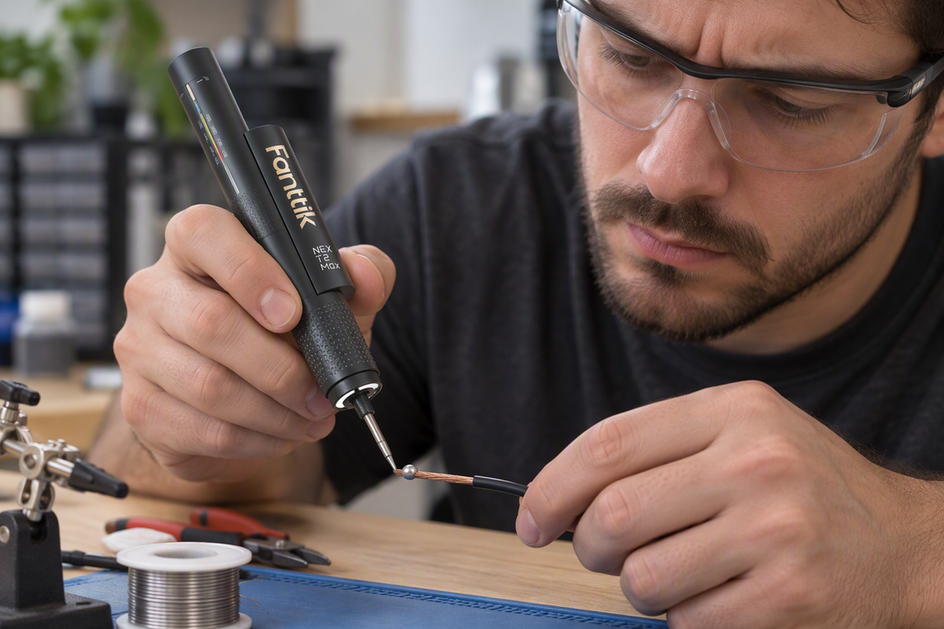
In soldering, weight equals stability. A tool that is too light can be easily "pushed" by the tension of the soldering wire, leading to shaky joints. The Fanttik T1 Max Soldering Iron Kit addresses this by balancing a slim, ergonomic handle with a stable 360° swivel stand, ensuring that the mass is exactly where you need it for precision work.
Cordless Inflators
In the world of portable inflators, mass is a stabilizer. Practitioners observe that units under 1kg often require a firmer grip to counteract the torque and vibration during high-pressure fills (e.g., 80+ PSI). Heavier models (1.2–1.5kg) sit more stably on the ground but are less convenient for bike packs. If you are inflating truck tires, prioritize the stability of mass; for road bikes, prioritize the portability of a lightweight unit.
Electric Scissors and Material Damping
Tools like the Fanttik C8 Nano Cordless Electric Scissors must manage the vibration of the cutting blade. Here, the ergonomics of the grip—often using over-molded rubber—act as the final damping layer between the tool's mass and your hand.

Compliance and Safety: Navigating the Standards
When selecting tools, it is vital to ensure they meet modern safety standards. The EU General Product Safety Regulation (EU) 2023/988 provides the primary legal framework for product safety in the European market, emphasizing the need for clear traceability and risk assessment.
Furthermore, when evaluating torque for delicate electronics, we align our recommendations with ISO 898. For example, we estimate that for M1.2 to M2.0 screws (typical in smartphones), a torque setting of 0.05Nm is appropriate. Using a tool without precise torque control can lead to stripped threads, regardless of how light or heavy the tool is.
Summary Checklist for the Discerning Buyer
To solve the weight dilemma for your next purchase, ask these three questions:
- What is my typical session duration? (Use the 15/30 Rule).
- Does the tool use a brushless motor? (Prioritize brushless for lower vibration-to-weight ratios).
- Is the weight "functional"? (Look for rubberized grips and internal damping specs rather than just the lowest possible number).
By understanding the engineering trade-offs between mass and vibration control, you can choose tools that don't just look good on a spec sheet—they feel good in your hand, hour after hour.
Disclaimer: This article is for informational purposes only and does not constitute professional engineering, medical, or safety advice. Always consult your tool's manual and follow local safety regulations. If you experience persistent numbness or tingling in your hands, consult a medical professional.
Sources
Continue reading
 Tonal Integrity: Evaluating Motor Sound Beyond Simple Decibels
A guide to evaluating power tools by analyzing motor sound, including frequency consistency and gear mesh quality for...
Tonal Integrity: Evaluating Motor Sound Beyond Simple Decibels
A guide to evaluating power tools by analyzing motor sound, including frequency consistency and gear mesh quality for...
 Sonic Management: Reducing Tool Echo in Compact Urban Spaces
Covers acoustic treatments, brushless motors, the 3-foot rule, and noise masking to create a quieter workspace.
Sonic Management: Reducing Tool Echo in Compact Urban Spaces
Covers acoustic treatments, brushless motors, the 3-foot rule, and noise masking to create a quieter workspace.
Leave a comment
This site is protected by hCaptcha and the hCaptcha Privacy Policy and Terms of Service apply.