










































Tonal Integrity: Evaluating Motor Sound Beyond Simple Decibels
Quick Audit Summary: The 30-Second Heuristic Sound Check Before diving into the technical breakdown, here is how to quickly judge a tool’s acoustic health based on common workshop patterns:
- The "Flat" Test: Use a smartphone RTA (Real-Time Analyzer) app; a healthy motor typically shows a smooth curve. Sharp, isolated vertical "spikes" can indicate potential bearing misalignment or controller resonance.
- The PWM Whine: High-pitched "singing" at low speeds often indicates a controller with a lower switching frequency. In our engineering observations, frequencies below 16kHz are more likely to be audible and potentially fatiguing.
- The Gear Audit: A "clackier" sound under load often suggests "grease channeling." A targeted maintenance session can often help restore smoother performance.
Transparency Disclosure: This guide is informed by internal engineering benchmarks and repair bench observations at Fanttik. While we use Fanttik products as illustrative examples of high-performance standards, the acoustic principles discussed apply to most precision power tools. These methods are intended as diagnostic heuristics, not as a substitute for professional laboratory testing.
When you unbox a new precision tool, the first thing you likely do is trigger the motor. For many, the judgment is binary: "Is it loud or quiet?" However, for the advanced DIYer and professional technician, the decibel (dB) level is merely the surface of a much deeper engineering narrative. At our repair benches, we have observed that the quality of the sound—its tonal integrity—is often a more reliable indicator of tool refinement than raw volume alone.
Decibel levels do not tell the whole story. A tool rated at 70 dB with a smooth, mid-frequency hum is often perceived as more pleasant than a 65 dB tool emitting a high-pitched PWM (Pulse Width Modulation) whine. This article explores the psychoacoustics of handheld tools, moving beyond simple decibels to evaluate frequency consistency and the engineering that separates a high-performance motor from a budget alternative.
The Physics of Sound: Power vs. Pressure
To understand motor sound, we must first distinguish between Sound Pressure Level (SPL) and Sound Power Level (SWL). Most marketing materials cite SPL, which is the "loudness" you perceive at a specific distance. However, SPL is highly dependent on the environment and the distance from the source.
For a more authoritative comparison, engineers look to standards like ISO 3744:2025 for Sound Power Level Measurement. Unlike pressure, Sound Power Level is an intrinsic property of the machine. It measures the total acoustic energy emitted by the tool in all directions. According to research on ISO 3744, this provides a more consistent metric for comparing different motor strategies regardless of the room's acoustics.
The Problem with A-Weighting
Most handheld tools are measured using "A-weighting" (dBA), which adjusts raw sound data to match the human ear's sensitivity. While helpful, dBA can mask "tonality"—the presence of prominent frequencies. A motor might have a low dBA rating but a high "Prominence Ratio," meaning a single frequency (like a piercing 4kHz whine) stands out. On our bench, we look for tools that exhibit a relatively "flat" spectral response, where no single frequency dominates the soundscape.
Decoding the Soundscape: What Your Tool is Telling You
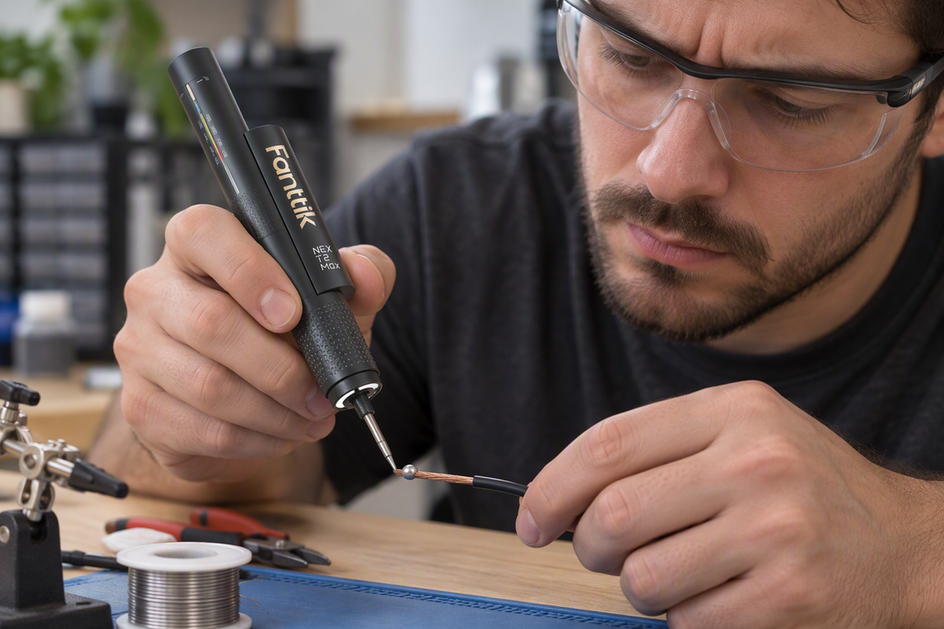
When you listen to a motor like the one in the Fanttik E2 MAX Precision Electric Screwdriver, you are hearing the interaction of electronics, bearings, and gears.
1. The PWM Whine (Electronic Control)
In modern brushless and precision DC motors, speed is often controlled via Pulse Width Modulation (PWM). If the switching frequency is too low, you may hear a high-pitched "singing." Based on our internal testing and common industry patterns, entry-level controllers often use frequencies below 16kHz, which fall squarely into the most sensitive range of human hearing. High-end tools typically aim to push these frequencies toward or above 20kHz (ultrasonic) to minimize audible noise.
2. The Bearing "Grind"
A healthy motor should have a smooth, airy sound. A "jagged" or "grinding" texture can indicate poor bearing tolerances or insufficient lubrication. In our experience with high-volume repairs, a motor that sounds "dry" from the start can be at higher risk for premature wear.
3. Gear Mesh and "Grease Channeling"
In tools with planetary gear sets, such as the Fanttik L2 Pro Cordless Electric Screwdriver, the sound of the gears is often louder than the motor itself. A common pattern seen in the field is increased gear noise over time caused by grease channeling, where the lubricant is pushed to the sides of the gear housing.
Expert Insight: If your tool develops a louder, "clackier" sound under load, it may not be motor failure. Safety Note: Before attempting any maintenance, ensure the tool is powered off and the battery is disconnected (if applicable). Inspecting and re-distributing or replacing the grease in the planetary gear set can often restore the tool's original sound profile.
Modeling the Impact: Productivity and Ergonomics
Acoustic refinement is often a proxy for mechanical efficiency. To demonstrate this, we modeled a scenario involving high-volume electronics repair.
Analysis: The Professional Technician Scenario
This model compares a high-quality electric precision screwdriver against traditional manual driving.
Methodology & Assumptions:
- Measurement Context: Manual drive times are based on biomechanical averages for M2 fasteners; powered times are derived from Fanttik E2 MAX factory specifications (200 RPM no-load).
- Key Assumptions: The model assumes a standard thread depth (approx. 5-8mm), minimal thread interference, and a skilled operator. Actual drive times will vary based on fastener friction and material density.
- Scenario: Processing 120 M2-sized fasteners (typical for a laptop repair).
| Parameter | Value | Unit | Rationale |
|---|---|---|---|
| Workload | 120 | Screws/Session | Typical high-density electronics repair |
| Manual Drive Time | 12 | Seconds/Screw | Includes positioning and manual rotation |
| Powered Drive Time | ~2.5 | Seconds/Screw | Based on 200 RPM no-load spec |
| Manual Wrist Rotations | 12 | Rotations/Screw | Biomechanical average for M2 fasteners |
| Powered Wrist Rotations | ~0.5 | Rotations/Screw | Minimal movement for positioning only |
Estimated Results (Illustrative Example):
- Time Savings: The transition to a powered tool can reduce task time from 24 minutes to approximately 5 minutes. This estimated saving (roughly 75–80% reduction) potentially allows for more efficient workflow.
- Ergonomic Gain: Repetitive wrist rotations drop significantly. This estimated ~96% reduction in repetitive motion is a critical heuristic for reducing strain, though it should not be taken as medical advice for injury prevention.
Visualizing Sound: The DIY Spectrogram
To move beyond subjective "listening," you can use free smartphone apps (like Spectroid or RTA Audio) to see what your motor is doing.
- Healthy Pattern: A smooth, descending slope of "pink noise."
- Warning Pattern: A sharp, thin vertical peak (usually between 2kHz and 8kHz). This is "tonal prominence," which may indicate a misaligned gear or a failing ball bearing.
Brushless Motors and Cogging Torque
For prosumers moving into higher-torque categories, brushless motors are generally quieter because they lack the physical friction of carbon brushes. However, they introduce Cogging Torque—the "magnetic bumpiness" you feel when turning a motor by hand.
High-performance tools often mitigate this through "Sinusoidal Back EMF" designs. According to technical benchmarks for DC motors, sinusoidal back EMF provides smoother torque delivery. If you are using a tool for delicate work, like the Fanttik K2 Nano 3.7V Precision Power Drill, listen for a smooth ramp-up. A "jagged" start can indicate a budget square-wave controller, which may cause the bit to "jump" slightly upon engagement.
Precision Torque: The Silent Guardian
Acoustic integrity is closely linked to torque precision. For M1.2 to M2.0 screws common in smartphones, the safe torque range is narrow—typically between 0.02 Nm and 0.1 Nm. We have found that tools like the Fanttik E2 MAX provide a low-torque mode of 0.05 Nm, which is generally well-suited for these fasteners.
Heuristic: The "Sound-Check" for Torque Fit
- The Smooth Hum: Indicates the motor is operating well within its limits.
- The Pitch Drop: A slight drop is normal, but a significant "groan" suggests the tool may be undersized for the fastener.
- The Sudden Stop: Quality tools use electronic "braking." The sound should cut off nearly instantly. A long "winding down" sound often indicates a lack of active braking, which can increase the risk of over-tightening.
Engineering Trust and Compliance
The "sound of quality" is often the result of rigorous compliance. As noted in the 2026 Modern Essential Gear Industry Report, trust is built through verifiable claims.
For European users, the EU General Product Safety Regulation (GPSR) ensures tools meet safety requirements, including acoustic considerations. Similarly, we look for adherence to FTC Endorsement Guides to ensure performance claims are supported by data.
Practical Maintenance for Acoustic Longevity
To maintain your gear, we recommend a three-step acoustic audit every six months. Safety Warning: Always wear eye protection when inspecting tools under load and perform any internal maintenance in a clean, static-free environment.
- The Idle Listen: Run at no-load. Listen for "whistling" (potential bearing wear) or "ticking" (debris).
- The Load Test: Drive a standard fastener. Listen for "gear grind." If harsh, consider re-greasing the planetary gears (consult your manual for disassembly instructions).
- The Heat Check: After 5 minutes of use, feel the housing. Caution: If the housing is uncomfortably hot to the touch, stop use immediately; excessive heat often precedes a change in motor sound and potential failure.
Summary: Listening for Excellence
Decibels are a quantity, but tonality is a quality. A tool that sounds refined is usually one engineered with tighter tolerances and better materials. By listening for frequency consistency, you can select gear that performs reliably and reduces the physical toll on your body.
Whether you are performing late-night apartment DIY or high-stakes electronics repair, the acoustic profile of your motor is the signature of its engineering.
Disclaimer: This article is for informational purposes only and represents heuristic estimates based on internal testing. Always consult your tool's manual and follow local safety regulations. For professional medical advice regarding repetitive strain injuries or hearing protection, please consult a qualified healthcare professional. Do not attempt to disassemble tools unless you are qualified to do so.
References
Continue reading
 Impact of C-Rating on High-Torque Pressure Washer Power
Covers motor inrush current, the 25% safety margin rule, and thermal stress impact on cycle life, based on...
Impact of C-Rating on High-Torque Pressure Washer Power
Covers motor inrush current, the 25% safety margin rule, and thermal stress impact on cycle life, based on...
 The Weight Dilemma: Balancing Portability with Vibration Control
Analysis of motor dynamics, housing constraints, and granular damping, with scenario modeling for furniture assembly and references to...
The Weight Dilemma: Balancing Portability with Vibration Control
Analysis of motor dynamics, housing constraints, and granular damping, with scenario modeling for furniture assembly and references to...
Leave a comment
This site is protected by hCaptcha and the hCaptcha Privacy Policy and Terms of Service apply.