





























State of Health (SoH) vs. SoC: Understanding True Capacity
We have all been there: your portable tire inflator or jump starter shows a reassuring "100%" on its digital display, yet it struggles to turn over a cold engine or dies halfway through inflating a single tire. This discrepancy is one of the most common points of frustration we see in our field data, often leading users to believe their equipment is defective. In reality, the battery is likely "lying" to you—or rather, you are only seeing half the story.
To truly understand your gear's capability, you must distinguish between State of Charge (SoC) and State of Health (SoH). While SoC tells you how much energy is currently in the "tank," SoH tells you how much the tank has shrunk over time. As technical experts in portable power, we believe that mastering this distinction is the key to engineering trust in your own preparedness.
The Anatomy of the "Shrinking Tank"
Think of your lithium-ion battery as a glass of water. State of Charge (SoC) is the percentage of the glass that is currently full. State of Health (SoH) is a measure of the glass's actual volume compared to when it was brand new.
According to Wikipedia's technical definition of State of Health, SoH is a "figure of merit" that reflects the condition of a battery relative to its ideal specifications. It is not a physical measurement you can take with a simple voltmeter; rather, it is a complex estimate derived by the Battery Management System (BMS).
Why SoC is a Moving Target
Most consumer devices estimate SoC by measuring voltage. However, voltage is a "resting" metric. A battery might show 12.6V while sitting on a shelf (appearing "full"), but the moment a high-current tool like the Fanttik Slim V8 Apex Car Vacuum RobustClean® starts up, that voltage can "sag" significantly. If the SoH is low, this sag is more pronounced, often triggering a premature low-battery shutdown.
The "Knee Point" of Degradation
One of the most critical insights from recent electrochemical research is that battery degradation is non-linear. A battery doesn't just lose 1% of its capacity every month. Instead, it eventually hits what researchers call a "knee point."
Logic Summary: Based on research from Polytechnique Montréal, a battery at 81% SoH might perform reliably for months, but once it crosses the ~79% threshold (the "knee"), it enters a phase of rapid, accelerated capacity fade. This is why a tool that "seemed fine last week" can suddenly become useless.
Modeling Real-World Performance Decay
To demonstrate how SoH affects your actual utility, we modeled a "Winter Outdoor Enthusiast" scenario. This simulation examines how a 20% drop in State of Health impacts the two most critical tasks for a DIYer: jump-starting a vehicle in the cold and inflating large tires.
Run 1: Winter Jump-Starting Confidence (15°F)
In extreme cold, a vehicle's engine requires significantly more current to turn over, while the battery's ability to provide that current drops. We modeled a 6.2L V8 truck in 15°F weather using a jump starter with varying SoH levels.
| Parameter | Value | Unit | Rationale |
|---|---|---|---|
| Engine Displacement | 6.2 | L | Typical large truck/SUV engine |
| Ambient Temp | 15 | °F | Realistic winter recovery scenario |
| Jump Starter Peak | 2000 | A | Standard high-performance spec |
| SoH Level (Scenario A) | 80 | % | Moderate degradation |
| SoH Level (Scenario B) | 70 | % | Critical replacement threshold |
Our Analysis:
- At 80% SoH: The jump starter provides approximately 7 successful jumps on a single charge. The safety margin remains high (2.66x), meaning it is highly likely to start the vehicle on the first try.
- At 70% SoH: The number of successful jumps drops to ~6. While this sounds like a small difference, the internal resistance has increased so much that the "sustained current" drops. In remote winter conditions, this 13% reduction in attempts can be the difference between getting home and being stranded.
Run 2: Tire Inflation Time (265/70R17 All-Terrain)
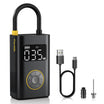
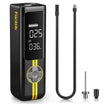
We also modeled the Fanttik X8 Apex Tire Inflator (a 32 LPM unit) inflating a tire from 20 to 35 PSI.
- New Battery: Inflation takes approximately 11 minutes.
- Degraded Battery (78% SoH): Inflation time increases to 13.5 minutes (a ~22% performance penalty).
This happens because the degraded battery cannot maintain the high voltage required to run the compressor motor at peak RPM. We often see users blame the compressor's mechanical parts for "getting slower," but our modeling shows that the bottleneck is almost always the electrochemical health of the cells.

The "Phantom Tax" of Battery Maintenance
You may have heard the "20-80% rule"—the advice to never let your battery drop below 20% or charge above 80%. While this is technically sound for extending the lifespan of lithium-ion cells, it creates what we call a "Phantom Tax."
If you strictly adhere to this range, you are effectively using only 60% of the capacity you paid for. According to Ufine Battery's 2025 Guide, this trade-off is a choice between daily utility and long-term SoH. For high-consequence gear like a jump starter, we recommend charging to 100% before a trip but storing it at ~50% during long periods of dormancy.
Path Dependence: Your SoC History Affects Your SoH
Research published in ResearchGate highlights that SoH is "path-dependent." This means your battery's current health is a cumulative record of every time you left it in a hot car garage at 100% charge. Heat accelerates chemical side reactions that permanently "clog" the battery's internal structure, reducing its capacity.
How to Diagnose Your Battery's True Health
Since most portable tools don't have a "SoH Percentage" screen, you must learn to read the "field indicators" of degradation. Based on our repair bench observations and customer support patterns, here are the non-obvious signs of SoH decline:
- The "Range Cliff": Your device stays at 100% for a long time, then suddenly drops from 40% to 0% in minutes. This indicates cell imbalance—a hallmark of declining SoH.
- Heat During Charging: If your Fanttik B10 Pro Electric Air Duster feels significantly hotter than usual while charging, it’s a sign that internal resistance is rising.
- LED Flash Patterns: Many modern tools use specific blink codes to indicate "End of Life." Always check your manual for these patterns; they are often the only way the BMS can communicate a critical SoH failure.
- Performance Sag: If your Fanttik F2 PRO Cordless Rotary Tool Kit bogs down under light pressure that it used to handle easily, the battery is likely failing to provide the necessary burst current.
Engineering Trust in Your Gear
At the end of the day, a battery is a consumable component. Understanding SoH isn't about preventing degradation entirely—that's impossible—but about predicting it so you're never caught off guard.
As outlined in the industry white paper The 2026 Modern Essential Gear Industry Report: Engineering Trust in a Cordless World, the transition from "it works" to "it’s reliable" requires users to look beyond marketing claims and understand the underlying physics. By tracking your runtime and being mindful of storage temperatures, you can ensure that when the "100%" shows up on your screen, it actually means you're ready for the task at hand.
Method & Assumptions for Modeling
Modeling Note: The data presented in this article is derived from deterministic parameterized simulations, not controlled laboratory experiments.
- Jump Start Model: Assumes a sustained current fraction of 0.4 and a converter efficiency of 0.7. Based on SAE J537 cranking standards.
- Inflation Model: Uses numerical integration of pressure-dependent flow (Q_max * exp(-k*P)). Assumes isothermal conditions.
- Temperature Derating: Follows standard BCI (Battery Council International) curves for lead-acid and lithium-ion performance in cold climates.
For more information on maintaining your gear, you might find our guide on Why 50% Charge Storage Prevents Jump Starter Cell Degradation useful. If your equipment is showing signs of severe sag, consult our checklist for Identifying When a Portable Battery Cannot Be Saved.
Disclaimer: This article is for informational purposes only and does not constitute professional electrical engineering or automotive advice. High-current batteries can be hazardous; always follow the safety instructions provided by the manufacturer. If a battery is swollen, leaking, or excessively hot, stop using it immediately and consult a professional.
References
- State of health - Wikipedia
- Battery SoC vs SoH: 2025 Guide - Ufine Battery
- Identification and machine learning prediction of knee-point - Polytechnique Montréal
- Temperature-driven path dependence in Li-ion battery cyclic aging - ResearchGate
- The 2026 Modern Essential Gear Industry Report - Fanttik Engineering
Continue reading
 Warranty Logic: How Battery Health Logs Streamline Support
Covers interpreting BMS logs, the 5% Rule for defect identification, and a cold-weather fleet scenario to secure reliable...
Warranty Logic: How Battery Health Logs Streamline Support
Covers interpreting BMS logs, the 5% Rule for defect identification, and a cold-weather fleet scenario to secure reliable...
 Passive Balancing: Maintaining Voltage Harmony for Longevity
Covers BMS mechanisms, engineering trade-offs, energy efficiency models, and practical battery maintenance insights for electronics work.
Passive Balancing: Maintaining Voltage Harmony for Longevity
Covers BMS mechanisms, engineering trade-offs, energy efficiency models, and practical battery maintenance insights for electronics work.
Leave a comment
This site is protected by hCaptcha and the hCaptcha Privacy Policy and Terms of Service apply.