




















Value Engineering: Balancing Tool Costs with Project Needs
Building a DIY toolkit from scratch is often a lesson in compromise. For the beginner, the temptation is to either over-invest in professional-grade machinery that exceeds actual project requirements or under-invest in "bargain" tools that fail during first use. Based on patterns observed in our workshop audits and customer support feedback, the most successful makers aren't those with the most expensive gear, but those who apply Value Engineering (VE) to their purchasing strategy.
Quick Start: The Value Engineering Checklist
If you are looking to build a high-utility kit today, follow these three "Quick Wins" to maximize your budget:
- The 70/20/10 Rule: Allocate 70% of your budget to core drivers (electric screwdrivers/rotary tools), 20% to specialized entry tools (soldering/inflators), and 10% to premium S2 steel bits.
- Phase 1 Priority: Start with a mid-torque (5-6 Nm) electric screwdriver. It covers 80% of household tasks without the risk of stripping delicate fasteners.
- Precision First: If your hobby involves electronics, prioritize a driver with a low-torque setting (0.05 Nm) over one with high RPM.
Value Engineering is not merely about cutting costs. According to Investopedia, it is a systematic method to improve the "value" of goods or services by examining function. In a home workshop, value is the ratio of a tool's performance to its total cost of ownership. For a budget-conscious beginner, this means identifying which features are essential and which are "gold-plating"—features that add cost without improving the outcome of your specific DIY tasks.
The 70/20/10 Budgeting Heuristic
When we consult with new hobbyists, we suggest a specific allocation of their initial investment to ensure maximum utility. While traditional advice often suggests buying "the best you can afford," we find a surgical approach prevents "tool bloat."
- 70% to Core Drivers and Rotary Tools: These are your primary force multipliers. An electric screwdriver and a versatile rotary tool handle the majority of tasks in furniture assembly, light automotive work, and hobbyist crafting.
- 20% to Specialized Entry Tools: This includes basics like a soldering iron for electronics or a portable inflator for vehicle maintenance.
- 10% to High-Quality Consumables: This is the most overlooked category. Experience suggests a $30 tool with a $5 premium bit often outperforms a $100 tool with a dull, generic bit.
Logic Summary: This 70/20/10 heuristic is a shop-level practical rule of thumb designed to maximize "functional uptime." It assumes the user is starting from zero and prioritizes versatility over specialization.

The Torque Trap: Why More Power Isn't Always Better
A common mistake for beginners is purchasing a high-torque impact driver for general household assembly. While a 150 Nm driver is impressive, using it on a particle-board bookshelf or plastic housing can be a recipe for disaster. Excessive torque frequently strips screws or cracks soft materials before the user can react.
Practitioners in our network generally start with a mid-torque screwdriver, typically in the 5–8 Nm range. This provides sufficient power for driving screws into softwoods and pre-drilled hardwoods without the destructive potential of industrial-grade tools.
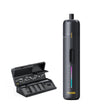
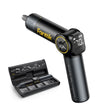
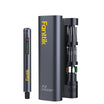
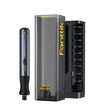
For example, the Fanttik S1 Pro Cordless Electric Screwdriver (manufacturer example) offers a maximum torque of 6 Nm. This is a deliberate "sweet spot" for value engineering, providing three adjustable settings to downshift for delicate tasks.
Modeling Note: Assembly Efficiency
We modeled a standard furniture assembly task to quantify the ergonomic benefits of transitioning from manual to electric driving. These figures are based on internal workshop observations of beginner-level assembly speeds.
| Parameter | Value | Unit | Rationale/Assumption |
|---|---|---|---|
| Project Scale | 60 | Screws | Typical large flat-pack assembly |
| Manual Time | 18 | Minutes | ~18s/screw (Manual positioning + driving) |
| Powered Time | 4 | Minutes | ~4s/screw (Electric driver) |
| Manual Rotations | 720 | Rotations | ~12 full wrist rotations per screw |
| Powered Rotations | 30 | Rotations | ~0.5 rotations for initial positioning |
Calculated Benefit: In this scenario, using a powered driver reduces wrist rotations by 690 motions ($[12 - 0.5] \times 60 \text{ screws}$). Note: This is a heuristic model for illustrative purposes; individual speed and technique will vary.
Precision Engineering: The Value of Low-Torque Control
When projects move to electronics—such as repairing a smartphone or drone—the value equation shifts from "power" to "precision." The "hidden cost" here is the risk of damaging a $500 device with a $0.50 screw.
According to ISO 898-1 standards for fastener mechanical properties, small screws (M1.2 to M2.0) have extremely low failure thresholds. A common error is applying 0.2 Nm of torque to a screw that requires only 0.05 Nm. This 100% over-torque is a leading cause of "stripped heads" in DIY electronics.
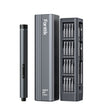
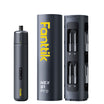
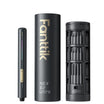
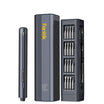
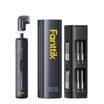
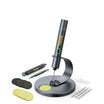
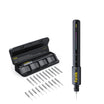
For these tasks, we recommend a dedicated precision tool like the Fanttik E1 MAX Precision Electric Screwdriver (manufacturer example). It provides low-torque settings (0.05 Nm to 0.2 Nm) necessary to stay within the safety margins of delicate hardware.

Rotary Tools: Collets Over Raw RPM
For engraving, sanding, or light cutting, many beginners focus on maximum RPM as the primary value metric. However, experienced practitioners note that fine detail work rarely happens at 35,000 RPM. Most controlled carving occurs below 15,000 RPM.
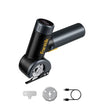
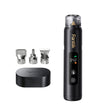
The real value often lies in the collet system. A kit that includes collets for 1/32" to 1/8" shanks is vastly more useful than a tool that only accepts a single size. We suggest looking at options like the Fanttik F2 PRO or F2 Master (manufacturer examples). These utilize brushless motors to maintain torque at lower speeds—a critical factor for precision sanding where high RPM might melt plastic workpieces.
The Economics of Tool Ownership: TCO vs. Purchase Price
To master Value Engineering, you must look past the sticker price using two economic concepts: Total Cost of Ownership (TCO) and Life Cycle Cost Analysis (LCCA).
- The Innovation Cycle Risk: While some workstation TCO models suggest a 3-5 year span, applying this to rapidly evolving battery tech requires caution. A tool with a proprietary, non-replaceable battery may have a lower purchase price but a higher "cost per year" if the battery fails early.
- The Principal-Agent Problem: Your "inner agent" might want the prestige of a professional brand, while your "inner principal" wants to save money for materials. Buying a feature-rich tool you only use twice a year is a systematic over-investment.
- The LCCA Threshold: While a rigorous Life Cycle Cost Analysis is standard for industrial projects, for a home DIYer, use a simple heuristic: if a tool costs less than $100, focus on versatility over a 10-year durability forecast.
Safety, Compliance, and the "Trust Architecture"
As you build your kit, safety cannot be "value-engineered" away. The EU General Product Safety Regulation (GPSR) emphasizes that products must be safe under "reasonably foreseeable conditions of use."
We align our recommendations with principles found in the 2026 Modern Essential Gear Industry Report (manufacturer-affiliated source). For a beginner, this means:
- Checking for Visible Compliance: Look for international standards like ISO or IEC.
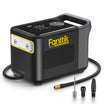
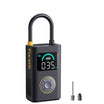
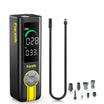
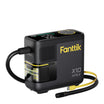
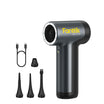
- Thermal Margins: When using tools like portable inflators, respect the duty cycle. For instance, internal manufacturer testing under high-load scenarios (such as inflating four SUV tires consecutively) has shown internal air temperatures reaching approximately 124°C (255°F). A tool with robust thermal cut-offs is a significant value-add to prevent motor burnout.
- Traceability: Reliable brands maintain accessible manuals and safety warnings.
Strategic Planning for Progressive Projects
We recommend a "progressive" acquisition strategy to ensure every dollar spent is tied to a specific project need:
- Phase 1: The Assembly Kit. Focus on a versatile electric screwdriver and a basic hand tool set for furniture and home repairs.
- Phase 2: The Precision/Hobby Kit. Add a precision driver and a rotary tool for electronics repair and crafting.
- Phase 3: The Preparedness Kit. Invest in a portable tire inflator or jump starter for automotive maintenance.
Summary of Value-Driven Selection
| Tool Category | Value Driver | Gold-Plating (Save Money Here) | Recommended Logic |
|---|---|---|---|
| Electric Screwdriver | Adjustable Torque, S2 Bits | Ultra-high RPM, Heavy metal casing | Prioritize control to prevent stripping. |
| Precision Driver | Magnetic bits, <0.2 Nm settings | Digital torque displays, OLED screens | Focus on bit variety and low-torque accuracy. |
| Rotary Tool | Multi-size collets, Variable speed | 35,000+ RPM, Corded power | Versatility in shank sizes is key for hobbyists. |
| Tire Inflator | Thermal cut-off, Accuracy | Fast-charge (USB-C is usually enough) | Accuracy saves money on tire wear. |
Final Thoughts on Workshop Maturity
Building a workshop is an exercise in engineering your own self-reliance. By focusing on function over prestige and applying the 70/20/10 rule, you can create a highly capable environment without the financial strain of professional-tier overhead.
For more on optimizing your workspace, see our guide on Selecting Tool Footprints for Efficient Apartment Storage or explore how to Transition to Power Drivers for High-Volume Hobby Work.
Disclaimer: This article is for informational purposes only. Always read and follow the manufacturer's safety instructions and local regulations before operating power tools. These recommendations are based on general workshop heuristics and manufacturer-provided data; always cross-reference with third-party reviews for your specific use case.
References
Continue reading
 Modular Workshop Logic: Building a Scalable Tool Collection
Covers precision drivers, semantic clustering, industry standards, and the 10-Project Rule for transitioning from basic to professional projects.
Modular Workshop Logic: Building a Scalable Tool Collection
Covers precision drivers, semantic clustering, industry standards, and the 10-Project Rule for transitioning from basic to professional projects.
 Grip Geometry: Selecting Drivers for All-Day Project Comfort
This guide explains how grip geometry, tool balance, and force classes reduce wrist strain during long projects. Learn...
Grip Geometry: Selecting Drivers for All-Day Project Comfort
This guide explains how grip geometry, tool balance, and force classes reduce wrist strain during long projects. Learn...
Leave a comment
This site is protected by hCaptcha and the hCaptcha Privacy Policy and Terms of Service apply.