





















The Professional Threshold: Moving Beyond "Good Enough"
For the urban maker, the transition from a weekend hobbyist to a professional taking paid commissions is a significant milestone. It marks the moment where your work is no longer just for personal satisfaction, but for a client who expects precision, reliability, and a flawless finish. In our experience working with makers in compact workshop environments, we have observed that the primary bottleneck to scaling a commission-based business isn't a lack of skill, but rather the performance limits of entry-level DIY tools.
When you are building for yourself, a slightly stripped screw or a minor vibration in a rotary tool is a nuisance. When you are building for a client, these issues become "rework cascades" that eat into your profit margins and threaten your reputation. Professional-grade gear isn't just about higher specs; it is about credibility math. It is the ability to predict exactly how a tool will behave after eight hours of continuous use.
In this guide, we will analyze the technical performance bottlenecks—from torque repeatability to ergonomic fatigue—that indicate your current kit is holding back your professional growth.

1. The Torque Consistency Bottleneck
In professional electronics repair and small-scale furniture assembly, "torque" is often misunderstood. Entry-level tools frequently market their "peak torque," but for professional commissions, the critical metric is repeatability. We often see makers assume that a high-torque rating guarantees performance; in reality, maintaining that specific torque after the first 20 screws is what separates professional gear from hobbyist toys.
The Risk of Voltage Sag and Thermal Drift
Entry-level drivers often exhibit significant torque drop-off as the battery depletes or the motor heats up. This is caused by "voltage sag"—a phenomenon where the battery's output voltage drops under load, leading to inconsistent power delivery. In a professional workflow, this inconsistency leads to stripped screws in critical assemblies.
Based on our scenario modeling for a professional electronics repair commission, we compared the safety margins for common M1.2 to M2.0 fasteners.
| Fastener Class | Min Required Torque | Max Safe Torque (Heuristic) | Entry-Level Risk |
|---|---|---|---|
| M1.2 - M2.0 | 0.02 Nm | 0.1 Nm | High (Drift > 0.1 Nm) |
| M2.5 - M4.0 | 0.2 Nm | 0.5 Nm | Moderate |
Logic Summary: This fit checker uses mechanical engineering heuristics aligned with ISO 898-1: Mechanical properties of fasteners. We assume a "Strip Risk" occurs when tool torque drift exceeds the max safe torque for delicate plastic or metal bosses.
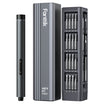
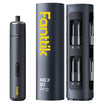
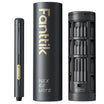
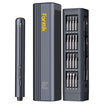
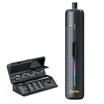
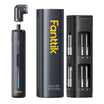
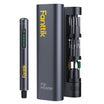
For high-precision work on smartphones or laptops, the Fanttik E2 MAX Precision Electric Screwdriver provides the necessary control. With a dual-torque design (0.2 Nm for high-speed and 0.05 Nm for delicate work), it allows you to stay within the safe thresholds defined by ISO standards, preventing the catastrophic logic board damage that can occur with uncalibrated tools.
2. Ergonomic Efficiency and the "All-Day Test"
A common heuristic among professional makers is the "all-day test": if you wouldn't want to use the tool continuously for eight hours, it isn't suited for a professional workflow. Ergonomics is not just about comfort; it is a critical component of business efficiency.
Quantifying the Physical Cost of DIY Gear
Using entry-level tools often requires more physical effort to compensate for poor bit engagement or vibration. This leads to repetitive strain and faster fatigue. We modeled the physical impact of a typical professional commission involving the assembly of a custom modular shelving unit (120 screws).
- Manual/Entry-Level Tool: ~36 minutes of active driving time and ~1,380 wrist rotations.
- Professional Precision Tool: ~8 minutes of active driving time and ~60 wrist rotations.
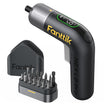
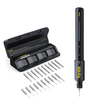
By upgrading to a tool like the Fanttik L2 Pro Cordless Electric Screwdriver, a professional can save approximately 28 minutes per commission (a 4.5x speed multiplier). More importantly, avoiding over 1,300 wrist rotations per project directly impacts your ability to take on back-to-back commissions without injury.
Methodology Note: This model is based on industrial engineering time-motion principles. We assume manual driving requires 18 seconds per screw due to re-gripping, while professional electric tools reduce this to 4 seconds. Wrist rotations are estimated based on standard supination/pronation cycles for manual fasteners.
Vibration Control in Rotary Work
For makers specializing in carving, engraving, or polishing, vibration is the enemy of precision. Entry-level rotary tools often lack the internal balancing required for high-RPM stability. Even minor vibrations lead to imprecise cuts and "user fatigue," where the muscles in your hand begin to twitch from the constant micro-corrections required.
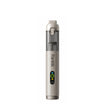
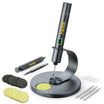
Professional solutions like the Fanttik F2 PRO Cordless Rotary Tool Kit utilize high-efficiency magnetic motors that maintain stability up to 25,000 RPM. This allows for the "client-ready" finish required in professional jewelry or model-making.
3. The Economics of Tool Reliability
Transitioning to professional work changes the math of tool failure. For a hobbyist, a tool breaking is a reason to visit the hardware store. For a professional, it is a financial crisis.
The "Failure Rate" Profit Killer
Conventional wisdom suggests upgrading when a tool "hinders progress." However, data from manufacturing adoption suggests a more brutal reality: a 20-25% failure rate on a DIY-grade machine during a paid commission can destroy 100% of the project's profit margin. This is due to material waste (e.g., ruined leather or expensive hardwoods), machine downtime, and missed client deadlines.
Cash Flow and Professional Integrity
Professionalism also extends to how you manage your business. According to the Jobbers Global Freelance Client Payment Delay Report 2025, the average freelancer faces a 31-day payment delay. If your entry-level tools fail and require immediate replacement, this cash flow gap can be devastating.
Investing in tools with predictable, non-catastrophic failure modes is essential. Professional tools are designed to show signs of wear (like reduced battery runtime) long before they stop working entirely, allowing you to plan your maintenance.
4. Unified Ecosystems and Urban Workspace Optimization
Urban makers face the unique constraint of limited square footage. In these environments, the "hidden cost" of DIY gear is the space it occupies. Professionals often waste significant time managing disparate chargers and incompatible bits between tools.
The Power of a Unified Ecosystem
A unified battery and accessory ecosystem allows you to maintain a functional capability in an apartment-based workshop without the clutter. Transitioning to professional gear often means moving to a system where one charging standard (like USB-C) and one bit standard (like 1/4" or 5/32" hex) cover your entire kit.
For those working with heavy fabrics, leather, or cardboard templates, the Fanttik C8 Nano Cordless Electric Scissors represent this shift. They replace bulky, manual shears with a compact, rechargeable solution that fits into a modular drawer system, supporting the goal of Selecting Tool Kits with the Smallest Storage Footprint.
Noise and Air Quality Compliance
Operating a workshop in a residential building requires adherence to strict safety and noise standards. The EU General Product Safety Regulation (EU) 2023/988 emphasizes the importance of product safety and traceability, which is often superior in professional-grade tools. Furthermore, professional tools are generally engineered for lower decibel output and better dust management, which is vital for Managing Micro-Dust: Maintaining Air Quality in Small Studios.
5. Decision Framework: When to Pull the Trigger?
If you are unsure whether to upgrade, use this three-point checklist derived from our "Trust Architecture" principles:
- The Rework Frequency: Does your current tool cause a mistake (stripped screw, jagged cut) in more than 2% of your tasks? If yes, it is costing you more in materials than the cost of an upgrade.
- The Fatigue Limit: Do you find yourself stopping work because of hand cramps or wrist strain rather than being finished with the task? Professional tools are designed for Ergonomics to extend your effective work hours.
- The Compliance Gap: Are you taking commissions for products that require specific safety standards (e.g., children's toys or electronics)? Professional tools offer the Engineering Trust and documented performance required to meet legal obligations like the FTC Endorsement Guides for product claims.
Modeling Note: Battery Performance Under Load
To understand the "why" behind professional battery performance, we modeled the energy efficiency of an entry-level 1.5Ah (1500mAh) battery under sustained professional use.
| Parameter | Entry-Level Value | Professional Expectation |
|---|---|---|
| Pack Capacity | 1.5 Ah | 2.0 Ah+ |
| Voltage Sag (under load) | ~3.3 V | ~3.6 V |
| Efficiency Factor | 0.5 (High thermal loss) | 0.8+ (Cooler operation) |
| Usable Energy | ~2.78 Wh | ~6.4 Wh+ |
Logic Summary: Based on Joule's Law, entry-level tools often lose 50% of their energy to heat due to poor power management circuits. Professional tools use higher-quality cells and efficient controllers to deliver more "work" per charge.
Upgrading your kit is not an expense; it is an investment in your business's infrastructure. By choosing tools that prioritize torque consistency, ergonomic health, and ecosystem unity, you move from being a hobbyist with a side-hustle to a professional with a sustainable career.
Disclaimer: This article is for informational purposes only. When performing repairs or assemblies, always refer to the manufacturer's specific service manuals and safety guidelines. Professional tool use may require specific training and personal protective equipment (PPE).
References
Continue reading
 Evaluating Portable Soldering Irons for Desktop Electronics
Covers the 20-second rule, EU/IATA compliance, calibration costs, and insights from the 2026 Essential Gear Report.
Evaluating Portable Soldering Irons for Desktop Electronics
Covers the 20-second rule, EU/IATA compliance, calibration costs, and insights from the 2026 Essential Gear Report.
 Optimizing Desktop Lighting for High-Precision Maker Projects
Covers technical specs like CRI, R9, lumen calculations, and the Cross-Fire layout technique for SMD soldering and micro-mechanics.
Optimizing Desktop Lighting for High-Precision Maker Projects
Covers technical specs like CRI, R9, lumen calculations, and the Cross-Fire layout technique for SMD soldering and micro-mechanics.
Leave a comment
This site is protected by hCaptcha and the hCaptcha Privacy Policy and Terms of Service apply.