









































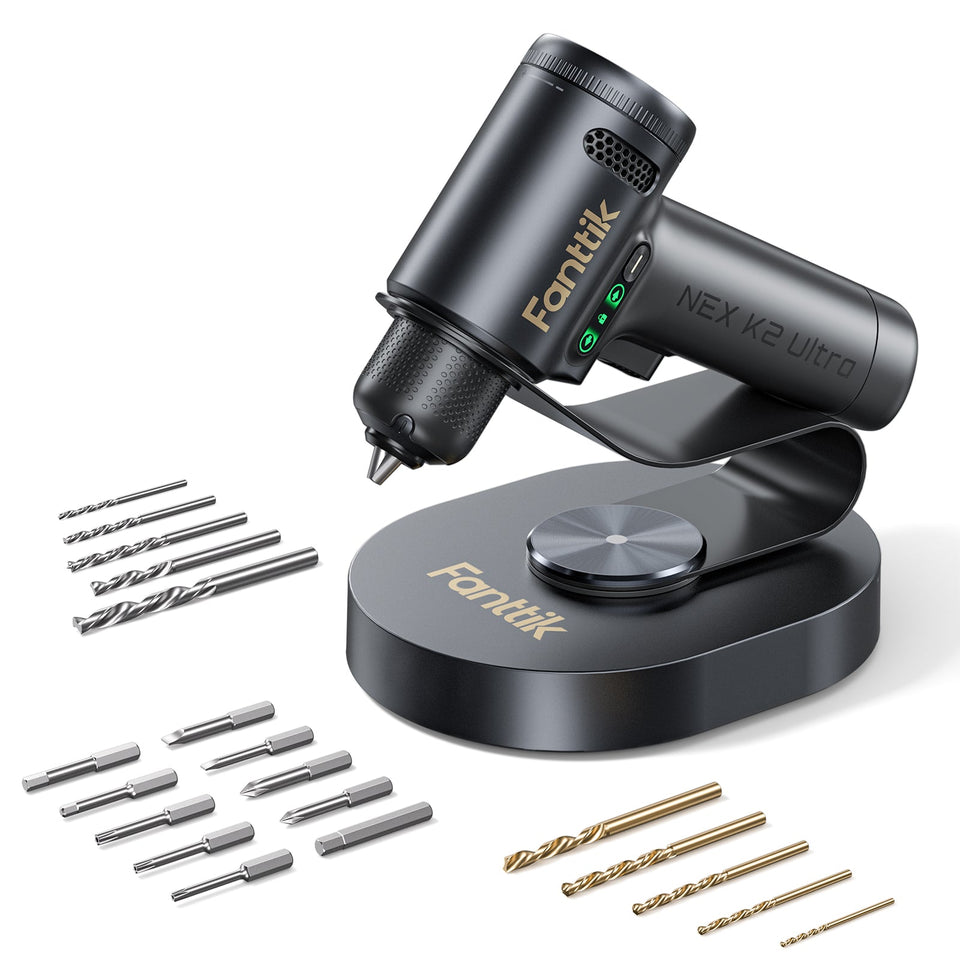
This practical guide covers the Fanttik K2 Ultra 7.4V Cordless Power Drill, a 7.4V cordless power drill for light drilling and fastening tasks. It is designed for owners looking for a clear setup and care reference. It does not substitute for the official user manual or the safety leaflet supplied with the product.
Before First Use
- Inspect the selected bit for damage and confirm it suits the material.
- Open the chuck, center the bit, and tighten it evenly before touching the trigger.
- Secure the workpiece and check behind the drilling point for wires, pipes, or hidden hardware.
Photograph the product label and keep the order details before the first job. Those details make model confirmation and warranty support much easier if the tool later needs service.
Safe Operating Workflow
- Choose forward or reverse before starting; change direction only after rotation stops.
- Begin at low speed to establish the hole or seat the driver bit.
- Keep the tool square to the work and let the bit cut instead of forcing it.
- Release the trigger immediately if the bit binds, then remove the cause with the tool stopped.
- Allow the bit to stop fully before setting the drill down or changing accessories.
If a control, icon, or indicator on your unit differs from this overview, stop and follow the labeling on the product and the documentation supplied in its box. Do not borrow button sequences or indicator meanings from a sibling Fanttik model.
Charging and Storage
Charge in a dry, ventilated place with the connection specified for the product. Inspect the cable and port before use, and stop if a connector becomes unusually hot or loose. For storage, switch the product off, clean away working debris, and keep it away from direct sun, standing water, and temperature extremes. If it will sit unused, check it periodically rather than allowing the battery to remain deeply discharged.
Routine Care
- Brush dust from the chuck and ventilation openings without pushing debris inside.
- Remove the bit before long storage.
- Store the drill dry and recharge it periodically rather than leaving it deeply discharged.
Routine care should stay external: cleaning accessible surfaces, checking consumables, and keeping connections dry. Opening a sealed battery or drive housing can create a safety risk and should be left to Fanttik support.
When the Product Does Not Behave Normally
| Symptom | First safe check | Next action |
|---|---|---|
| No power | Confirm charge state and control position | Test a known-good charging source, then contact support if there is still no response |
| Stops under load | Remove the load and let the product cool | Check for binding, debris, or an unsuitable accessory |
| Unusual heat, odor, or noise | Switch off and move away from combustible material | Do not continue testing; request service |
Manual and Support Options
Fanttik publishes the official K2 Ultra user manual (PDF), and the product page lists the current specifications for this exact model. Keep the printed documentation supplied with the product and use the Fanttik Support Center to request model-specific documentation when needed. The Fanttik manual hub also collects official manuals for other Fanttik models.
Choose the Operation Before Choosing Speed
Drilling a hole and driving a screw place different demands on the K2 Ultra. For drilling, use a bit intended for the work material and create a stable starting point. For fastening, use a driver bit that fills the recess and begin slowly so the screw enters straight. Do not treat a drill bit as a driver or improvise an accessory whose shank cannot be centered securely in the chuck.
Preventing a bind
Secure the workpiece, keep both hands clear of the bit path, and stand so a sudden stop will not twist your wrist into an obstacle. A bind often happens when the bit exits the far side, chips pack in a deep hole, or the tool is tilted. Release the trigger immediately. Wait for all rotation to stop, withdraw the bit, clear chips, and restart with alignment corrected. Reversing direction while the chuck is still moving can stress the drive.
Better fastening control
Use a pilot hole when the material or screw calls for one. Start at low speed, keep the bit square, and reduce trigger pressure as the screw head approaches the surface. Stop before the head crushes soft material or the bit begins to slip. If a fastener needs more force than the compact drill can deliver cleanly, change the pilot hole, bit, or hand tool rather than leaning harder on the K2 Ultra.
After the job
Remove the bit only after it cools; cutting edges can become hot. Brush dust away from the chuck and vents, check that no bit fragment remains trapped, and store sharp accessories separately from the drill body. Note any repeated stall, unusual chuck wobble, or burning odor before the next use, because those signs need troubleshooting rather than another loaded test.
FAQ
Is this an official manual PDF?
No. It is a setup and care guide based on the official product page. For the official document, use the K2 Ultra user manual PDF linked in the Manual and Support Options section above.
Can I use instructions from a similar Fanttik model?
Use sibling-model advice only for general care. Controls, chargers, accessories, and indicator behavior can differ, so confirm instructions for the exact model.
What should I record before contacting support?
Record the model label, order details, charging source tested, accessory installed, and a short description or video of the symptom.
Should I open the housing to replace the battery?
No. This guide does not treat an internal battery or sealed drive assembly as user-serviceable.
Related Support
Continue reading
 Fanttik E2 Ultra Manual: Setup, Bits & Charging
A safe Fanttik E2 Ultra manual for setup, bit selection, charging, controlled fastening, storage, and official support.
Fanttik E2 Ultra Manual: Setup, Bits & Charging
A safe Fanttik E2 Ultra manual for setup, bit selection, charging, controlled fastening, storage, and official support.
 Fanttik K2 Ultra Not Turning On? Troubleshooting
Troubleshoot a Fanttik K2 Ultra that will not turn on by checking charge state, controls, chuck binding, temperature,...
Fanttik K2 Ultra Not Turning On? Troubleshooting
Troubleshoot a Fanttik K2 Ultra that will not turn on by checking charge state, controls, chuck binding, temperature,...
Leave a comment
This site is protected by hCaptcha and the hCaptcha Privacy Policy and Terms of Service apply.