
























Don't automatically set a space-saver donut spare to 60 PSI. The correct target is whatever pressure is printed on the spare itself, listed on your vehicle's tire and loading label, or specified in your owner's manual. Some vehicles do call for 60 PSI, but treat that number as a possibility to confirm, not a default to apply blindly.
Once you know the target, the rest of the job is straightforward: dig the spare out of the trunk well, check it cold, inflate it gradually with a car tire air pump, recheck the reading, and put everything back where it belongs.
What PSI Should a Space-Saver Spare Have?
The number that matters is the one documented for your specific vehicle and spare, not a number you've seen quoted online. Check three places, in this order: the sidewall of the spare itself, the Tire and Loading Information Label on the driver's door edge or post, and the owner's manual. Whichever value appears on your vehicle's documentation is the one to use.
This is different from the tire's maximum sidewall pressure, which is a ceiling rating rather than the pressure you should actually run. NHTSA's tire guidance recommends using the vehicle manufacturer's recommended inflation pressure, found on that door label or in the manual, rather than the number stamped as the tire's maximum. That same guidance also calls for checking every tire on the vehicle, including the spare, as part of routine maintenance.
Measure cold, meaning the spare hasn't been driven on for at least three hours. A warm reading runs higher than the true pressure and can lead you to underfill the tire.

Why Do Some Donut Spares Call for 60 PSI?
A donut spare can require a higher pressure than your regular tires because it's a separate, temporary-use tire with its own specification, not a smaller version of your regular tire. Its size and internal construction differ enough that the vehicle manufacturer sets inflation pressure for it independently. A tire maintenance and safety manual notes that a temporary-use spare "may differ in size and construction from the other tires on your vehicle," and that its pressure must be set to the specification the manufacturer establishes for it.
That's why 60 PSI shows up often in searches about compact spares: it's a common documented figure for this category of tire, not a universal engineering rule. Your vehicle's spare could specify 60 PSI, or it could specify something else entirely. Recommended pressure, sidewall maximum pressure, and how fast the tire fills are three separate specs, and none of them substitute for the others. A higher recommended pressure doesn't automatically mean faster inflation; that depends on your pump's airflow and the tire's internal volume, not the target PSI alone.
How to Check and Inflate a Donut Spare
Work through the spare in order: expose it, confirm the target pressure, measure cold, inflate gradually, and recheck before you put it away. Stop before inflating or relying on the spare if you spot damage or can't confirm which pressure applies.

- Park on level ground and set the parking brake. This keeps the vehicle stable while you open the trunk floor.
- Clear the trunk well. Remove cargo, the trunk floor panel, and any retaining wing nut or bracket holding the spare down, then lift the spare enough to expose its sidewall and valve stem.
- Find the pressure marking. Check the spare's sidewall stamp, then confirm it against the door-jamb label or owner's manual as described above.
- Inspect before you inflate. Look over the tread and sidewalls for cuts, cracks, bulges, or other visible damage. NHTSA advises against using a tire showing these signs and recommends having a tire service professional assess it instead. If you see damage, stop here and do not inflate or rely on this spare.
- Check the current cold pressure. Remove the valve cap and press a gauge onto the valve stem to get a baseline reading.
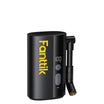
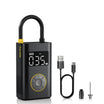
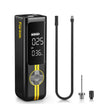
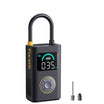
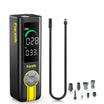
- Connect your car tire air pump. Make sure its hose or chuck fits the valve stem and that its documented pressure range covers your target PSI.
- Set the target and inflate gradually. If your pump has a target-PSI function, set it to the documented figure; otherwise add air in short bursts and recheck often so you don't overshoot.
- Disconnect and recheck. Remove the hose, then take a fresh gauge reading. Repeat brief top-ups if it reads low.
- Replace the valve cap. This keeps moisture and debris out of the valve stem between checks.
- Secure the spare and stow your tools. Reseat the spare, tighten the retaining hardware, replace the trunk floor panel, and put the jack, gauge, and pump back in their storage spots.
If you're inflating for the first time, our portable tire inflator guide walks through connecting the hose, setting a target PSI, and rechecking the reading step by step.
How Often Should You Check a Temporary Spare?
Check your donut spare monthly and again before any long trip, the same cadence recommended for your regular tires. A tire maintenance manual instructs drivers to check tire pressure with a gauge every month and before long trips, and specifically says not to forget the spare.
Add one more check before you actually use it: since a donut spare can sit unused for months or years, confirm its pressure and condition before mounting it, even if you checked it recently. After each check, finish by returning the tire, valve cap, retaining hardware, and any tools to their storage positions in the trunk well so everything is ready if you need it. Follow your vehicle's documentation for how the spare should be used once mounted; that guidance is specific to your car and isn't something a general maintenance routine can substitute for.
FAQs
What should you do if the donut spare loses pressure repeatedly?
Repeated pressure loss after an inflation indicates a slow leak, damaged valve core, or bead issue rather than regular seepage. Do not rely on quick top-ups to compensate. Stop using or storing the tire for emergency use until a qualified tire service technician inspects and repairs or replaces it.
Can I use any tire pump to inflate a space-saver spare?
Not automatically. A pump's category or headline maximum PSI doesn't by itself prove it will work for your spare. Confirm two things before you connect it: the valve connector matches your spare's valve stem, and the pump's documented pressure range covers the specific target PSI your vehicle documentation lists for that spare.
Why is keeping a valve cap on the donut spare necessary?
The valve cap seals out road dirt, moisture, and fine grit from the valve core while the spare sits in the trunk well or underbody carrier. Leaving the valve stem uncapped allows debris to foul the spring-loaded seal inside, which can lead to slow air leaks over months of storage.
Leave a comment
This site is protected by hCaptcha and the hCaptcha Privacy Policy and Terms of Service apply.