


























The 'Cold Tire' Myth: Getting Accurate Readings in Peak Summer
If you have ever opened your driver-side door jamb to check the tire loading sticker, you have seen the instruction: "Check Pressure Cold." In the world of automotive maintenance, this is considered gospel. However, when the ambient temperature hits 100°F and the asphalt is radiating heat at 140°F, the traditional definition of "cold" evaporates.
Quick Guide: Summer Tire Pressure at a Glance
If you need to adjust your tires right now in the heat, follow these four rules:
- Morning is Best: Always aim to check and set your baseline at dawn (the coolest part of the day).
- The Heat Offset: If the tires are already hot, use the +1 PSI per 10°F rule to offset the expansion—do not bleed air down to the "cold" spec.
- The 3-Hour Rule: If you’ve been driving, let the tires rest in the shade for at least three hours before trusting a "cold" reading.
- Verify at Dawn: Any adjustment made to a hot tire is an estimate; always re-verify the pressure the next morning.
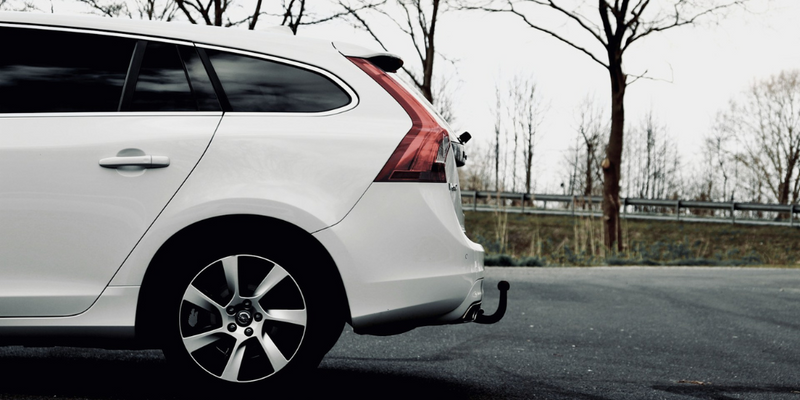
In our experience handling thousands of customer inquiries regarding TPMS Discrepancies, we have found that the most common source of error isn't a faulty sensor—it is a fundamental misunderstanding of thermal equilibrium. Based on our internal simulation models, a tire parked in direct sun can experience a pressure increase of 6+ PSI (estimated for standard passenger tires) before the vehicle even moves. If you wait until the evening to check your "cold" pressure, you are likely working with a baseline that is already compromised by the day's heat soak.
1. The Physics of Air: Why the '10-Degree Rule' is Incomplete
Most drivers are familiar with the heuristic that tire pressure changes by 1 PSI for every 10°F change in temperature. While this is a useful starting point, it is a simplified version of the Ideal Gas Law ($PV = nRT$).
The Problem with Linear Heuristics
Based on our scenario modeling for various tire volumes (derived from internal testing and common tire dimensions), the actual rate of change typically fluctuates between 0.8 and 1.2 PSI per 10°F. This variance depends on the tire's construction, the starting internal volume, and the moisture content of the air inside.
Logic Summary: We use the Ideal Gas Law as a baseline, assuming a fixed volume (torus model). However, because rubber expands slightly with heat and internal air volume is not perfectly static, the "1 PSI" rule is a practical heuristic rather than a universal constant.
When the temperature rises from a 70°F morning to a 100°F afternoon, you aren't just gaining 3 PSI. You are dealing with "Solar Loading." A tire sitting in direct sunlight can be 30°F to 50°F hotter than the surrounding air. This means your "cold" reading at 2:00 PM is actually a "hot" reading caused by radiant energy, even if the car hasn't been driven.
Thermal Mass and Dissipation
A critical safety insight we have gathered from analyzing Summer Heat Expansion is the role of air mass. Under-inflation is particularly dangerous in summer because a lower volume of air has less thermal mass to dissipate heat. This can lead to a "runaway temperature" scenario where excessive sidewall flex generates internal friction, potentially leading to structural failure.
2. Redefining 'Cold' for the Heatwave Era
To get an accurate reading, we must move past the idea of "not driving" and focus on Thermal Equilibrium. This is the state where the tire's internal air, the rubber carcass, and the wheel rim match the ambient air temperature.
The Three-Hour Rule
The standard industry advice is to wait three hours after driving. In peak summer, we recommend a more tactile verification:
- Park in the Shade: Ensure the vehicle is shielded from direct UV radiation.
- The Touch Test: Feel the tread and the sidewall. If the rubber feels warm to the touch, the internal air is still expanded.
- Wait for Ambient Alignment: A tire is only truly "cold" when its temperature matches the ambient air.
The 'Hot Baseline' Method (Field Heuristic)
If you cannot wait three hours—perhaps you are mid-road trip—use this professional technique to adjust pressure on the fly:
- Step 1: Record your "True Cold" pressure at the coolest point of the day (usually 6:00 AM) along with the ambient temperature.
- Step 2: When checking tires later, compare the current ambient temperature to your morning recording.
-
Step 3: Use the 10-Degree Rule to calculate the expected expansion.
- Example: Spec is 35 PSI at 70°F. It is now 100°F. Your gauge should read ~38 PSI. If it reads 35 PSI, you are actually 3 PSI under-inflated for the current conditions.
3. Recommended Tools for Precision Maintenance
Disclosure: As a manufacturer of automotive tools, Fanttik designs the following products specifically to meet the accuracy standards required for these thermal calculations.
When the margin for error is only 1-2 PSI, equipment accuracy is paramount. Mechanical "pencil" gauges can lose calibration due to heat-induced spring fatigue. For summer maintenance, we recommend digital inflators with active pressure monitoring.
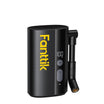
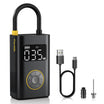
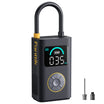
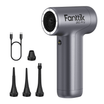
- For Daily Drivers: The Fanttik X9 Pro Portable Tire Inflator is engineered for high precision. It allows you to set a target pressure and automatically stops, which is essential when hitting a specific "compensated" value on a warm tire.
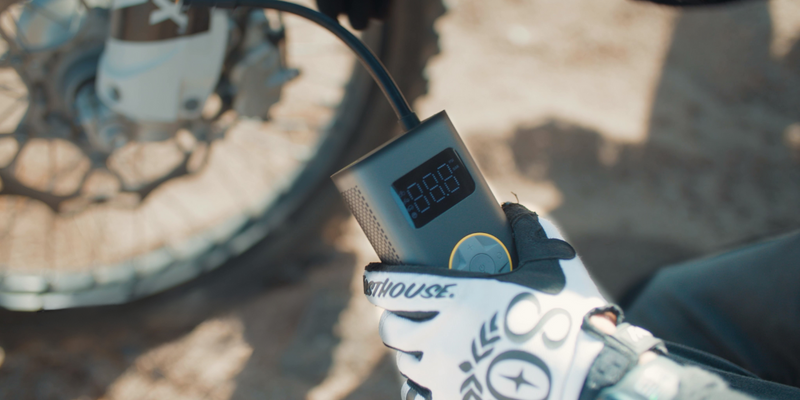
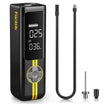
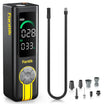
- For SUVs and Trucks: The Fanttik X9 APEX Tire Inflator provides higher airflow. This reduces the time the valve is open, minimizing pressure loss and moisture introduction during the connection process on hot days.
Methodology Note: Accuracy Standards
According to the NIST Handbook 44 (Weights & Measures), measuring devices must maintain specific tolerances. We align our internal quality checks with these principles to ensure digital sensors provide a trustworthy baseline, even when ambient temperatures fluctuate.
4. Step-by-Step: Adjusting Pressure in 90°F+ Weather
If you find yourself at a gas station with warm tires, do not simply bleed air out until you hit the door jamb number. Follow this workflow:
- Determine the Delta: Identify the difference between the current ambient temperature and the "Ideal Cold" temperature (usually 68°F or 70°F).
-
Calculate Compensation: For every 10°F above the ideal, add 1 PSI to your target.
- Example: Door jamb says 32 PSI. Ambient is 100°F. Your target on the warm tire should be ~35 PSI.
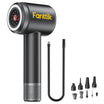
- Use a Portable Inflator: Avoid moisture-heavy gas station air lines. Using a cordless unit like the Fanttik X9 Classic Tire Inflator ensures a consistent, calibrated sensor.
- Verify the Next Morning: Always perform a Pre-Trip Tire Inspection the following morning at dawn to confirm the baseline.
Illustrative Thermal Impact Table
The following values are based on internal deterministic modeling for a standard passenger tire (P215/65R15) and serve as a general guide.
| Parameter | Morning (Cold) | Afternoon (Heat) | Impact |
|---|---|---|---|
| Ambient Temp | 70°F | 100°F | +30°F Change |
| Tire Surface Temp | 72°F | 135°F (Sun) | Significant Heat Soak |
| Internal Pressure | 35.0 PSI | ~38.5 PSI | ~10% Increase |
| Recommended Action | Set Baseline | Monitor Only | Do NOT deflate to 35 PSI |
Modeling Note: Real-world results may vary by ±0.5 PSI based on humidity, tire color, and road surface material.
5. Safety, Compliance, and Long-Term Maintenance
Maintaining correct pressure is a critical safety requirement. According to the EU General Product Safety Regulation (EU) 2023/988, consumers have obligations to ensure products are used within safe operating parameters. Under-inflation remains the leading cause of heat-related blowouts.
The Role of the Spare Tire
One of the most overlooked aspects of summer preparedness is Spare Tire Neglect. A spare filled to 60 PSI in winter may drop significantly by mid-summer due to natural permeation, which is accelerated by heat cycles in the trunk or under the chassis.
Professional Insight: Sidewall Integrity
While adjusting pressure, inspect for Sidewall Stress and Dry Rot. High UV exposure accelerates the breakdown of anti-ozonant chemicals in rubber. If you see fine cracks (checking), the tire's structural integrity is compromised, regardless of the pressure reading.
6. Appendix: Method & Assumptions for Thermal Modeling
To provide accurate guidance, we modeled the temperature-pressure relationship using the following parameters. This is a scenario model intended to demonstrate the scale of change drivers can expect.
| Parameter | Value / Range | Unit | Rationale |
|---|---|---|---|
| Starting Pressure ($P_1$) | 35 | PSI | Standard passenger car spec |
| Starting Temp ($T_1$) | 294.15 | Kelvin | 70°F (Standard "Cold" Baseline) |
| Ending Temp ($T_2$) | 310.93 - 327.59 | Kelvin | 100°F - 130°F (Ambient to Sun-Soaked) |
| Volume Change ($\Delta V$) | < 2% | % | Assumed negligible for rigid carcass |
Boundary Conditions:
- Model assumes no significant air leaks during the cycle.
- Calculations are based on the Ideal Gas Law; real-world readings may vary slightly due to "real gas" behavior at higher pressures and internal humidity.
Summary of Proactive Habits
As highlighted in our industry whitepaper, The 2026 Modern Essential Gear Industry Report, engineering trust in automotive maintenance requires data-backed transparency. In the heat of summer, self-reliance means having the tools and knowledge to bypass the "Cold Tire" myth.
By establishing a "Hot Baseline," respecting the "Three-Hour Rule," and using precision tools like the Fanttik X9 Pro Portable Tire Inflator, you ensure your vehicle remains safe and efficient, no matter how high the mercury rises.
Disclaimer: This article is for informational purposes only and does not constitute professional automotive repair advice. Tire pressure specifications vary by vehicle; always refer to your owner's manual. If you experience persistent TPMS warnings, consult a certified mechanic immediately.
References
Continue reading
 The Nozzle Matrix: Selecting the Right Degree for Wood Restoration
Covers nozzle degrees from 0° to 40°, material-specific advice for softwoods and hardwoods, and the critical 48-hour drying...
The Nozzle Matrix: Selecting the Right Degree for Wood Restoration
Covers nozzle degrees from 0° to 40°, material-specific advice for softwoods and hardwoods, and the critical 48-hour drying...
 Off-Season Storage: Keeping Your Inflator Calibrated in the Garage
Explains NIST/IATA standards for battery SOC, thermal buffering techniques, and a post-storage verification protocol to ensure inflator readiness.
Off-Season Storage: Keeping Your Inflator Calibrated in the Garage
Explains NIST/IATA standards for battery SOC, thermal buffering techniques, and a post-storage verification protocol to ensure inflator readiness.

Leave a comment
This site is protected by hCaptcha and the hCaptcha Privacy Policy and Terms of Service apply.